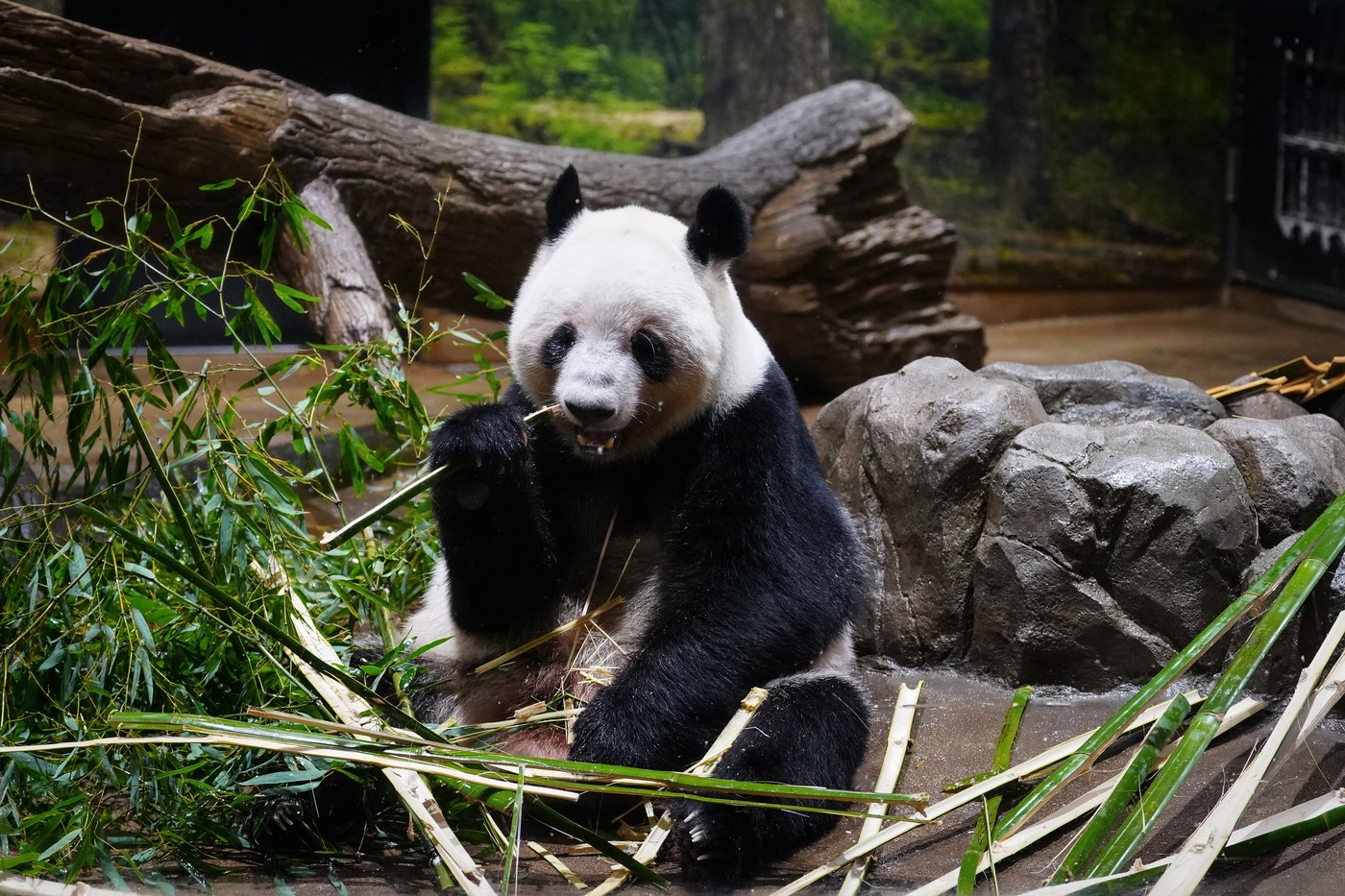
Fans of Japanese panda bears gathered for a final reunion at Tokyo's Ueno Zoo on Sunday before twins Xiao Xiao and Lei Lei return to China on Tuesday.
Their departure will leave Japan without a panda for the first time in half a century, and the chances of finding a replacement are slim, with Tokyo's relations with Beijing at their lowest level in years.
China first sent panda bears to Japan in 1972, a gift meant to mark the normalization of diplomatic ties between the two wary neighbors. The cute black and white bears immediately won the hearts of the Japanese, becoming national celebrities.

The newest panda twins drew huge crowds despite a zoo-imposed limit of one minute per visitor.
Many of those in attendance who didn't get tickets to see the pandas came to the zoo anyway to mark the last day.
Longtime panda fan Michiko Seki, wearing a black and white shirt with a panda pattern, said she was happy to photograph the panda twins. She was using the same camera she had bought when she started photographing their older sister, Xian Xian, who left Japan two years ago.
Seki says he doesn't want to see the pandas stuck in diplomatic disputes. “It's the animals that can provide tremendous comfort,” she said. “Japan needs pandas and (I) hope politicians will find a solution.”
Beijing lends panda bears to other countries, but retains ownership, including of the cubs they produce. Xiao Xiao and his sister Lei Lei were born at Ueno Zoo in 2021.
Chinese Foreign Ministry spokesman Guo Jiakun, when asked about China sending new pandas to Japan, said: “I know giant pandas are loved by many in Japan, and we invite Japanese friends to come and visit them in China.”
Japan faces growing political, trade and security tensions with China, which has been outraged by Prime Minister Sanae Takaichi's recent remarks that potential Chinese action against Taiwan could trigger Japanese intervention.
Relations between Japan and China have been strained since Japanese aggression in the 19th century. There are still territorial disputes in the East China Sea as China's rise is accompanied by security threats and growing economic influence in the region.
The Japanese government's chief spokesman, Minoru Kihara, acknowledged Thursday that the Japanese Consulate in Chongqing has been without a consul for a month because China has delayed approving a replacement.
Giant panda bears, native to southwest China, serve as the unofficial mascot. Beijing lends them to other countries as a goodwill gesture and as part of research and conservation programs.
The first pair of pandas, Kang Kang and Lan Lan, that China gave to Japan arrived in Ueno on October 28, 1972. One month after Japan's then-Prime Minister Kakuei Tanaka and China's Premier Zhou Enlai signed a joint communiqué to normalize relations between the countries. Japan noted that it “fully understands and respects” China's claim to Taiwan as an “inalienable part” of its territory.
China also gave the first giant pandas to other Western nations during that time, including the United States, France, Great Britain and Germany.
The absence of pandas from the zoo would cause an annual loss of about ¥20 billion ($128 million), according to Katsuhiro Miyamoto, an economics professor at Kansai University.
“If the situation continues for several years, the negative economic impact of the lack of pandas is expected to reach tens of billions of yen,” Miyamoto said in a statement. “For the panda-loving Japanese people, myself included, I hope they come back as soon as possible.”