When Donald Trump took office last year, he promised to end Russia's war of aggression against Ukraine within 24 hours. Twelve months later, the war continues and the Kremlin, emboldened by its successes, is stepping up its attacks rather than showing signs of slowing down. The political priority of the White House in the face of Russia's increasing aggression is to take action to take over Greenland from Denmark.
The White House may argue that Greenland and the Russia-Ukraine war are separate issues and that one policy initiative has no direct impact on the other, but such claims ignore the realities of both international negotiations and evidence from the Kremlin's actions and rhetoric. Whether the U.S. government intends to do so or not, its move to take over Greenland will impact the Kremlin's negotiating strategy and only complicate efforts to end the war with Ukraine.
In the middle of what the US government calls the final phase of the Russia-Ukraine war, the White House attempted to annex Greenland. With the US-Ukraine 20-point peace plan still not finalized, President Trump announced his intention to incorporate Greenland into the United States and sent his Secretary of State and Vice President to negotiate with the foreign ministers of Denmark and Greenland. Then, while Ukrainian negotiators Kyrylo Budanov, Rustem Umerov and David Arachamia were in the United States to meet again with Steve Witkoff and Jared Kushner, Trump announced that he would impose 10 percent tariffs on many European countries for showing solidarity with Denmark and Greenland, which would be increased to 25 percent if the U.S. takeover of Greenland was not finalized by June.
A Kremlin negotiator looking at the US government's coercion tactics towards Greenland will notice three things.
Lesson number one
The first is the White House's clear willingness to put pressure on allies on territorial issues. The Kremlin clearly understood that the White House was ready to use its leverage to force concessions from Ukraine when the (US) government halted intelligence sharing and halted deliveries of promised weapons systems for a short period last year.
But the Greenland case is more important: it is about coercion designed to extract territorial concessions regardless of the long-term costs to the U.S. government's European partnerships. This is a useful signal for the Kremlin, which continues to fight for additional territories in Ukraine.
Lesson number two
The second issue is the discrepancy in the approach of the United States towards its allies and Russia. There is a clear difference between harsh rhetoric and hasty decisions on punitive measures against European partners and moderate comments and slow decisions on sanctions against Russia.
The United States' reticence to put additional pressure on the Kremlin while increasing costs for allies sends a clear signal to Russia that Moscow's current strategies for war and negotiations with the United States are working better than could have been predicted.
Lesson number three
Third, the U.S. government's actions regarding Greenland signal that the longer Russia drags out the war, the more transatlantic relations may deteriorate. This has real implications for Ukraine in terms of post-war security guarantees, because under current proposals, the effectiveness of a European coalition of the willing depends on the presence, action, and cooperation of the United States. The greater the lack of unanimity caused by the White House's desire to annex Greenland, the more the basis for Ukraine's post-war security guarantees weakens.
Strengthening the Kremlin's long-term negotiation strategy
The Kremlin has already indicated that it is aware of these issues. Russian Foreign Minister Sergei Lavrov continues to speak openly about solving the issue of the fate of the inhabitants of the so-called Novorossiya – a territory defined by the Kremlin that includes the Odessa, Mykolaiv, Dnipropetrovsk and Kharkiv oblasts – in the same sentence in which it mentions Crimea and Donbas as a condition for ending hostilities. Meanwhile, Kirill Dmitriev, the Kremlin's envoy for peace talks, publishes numerous posts on social media in which he announces that “transatlantic unity is over” and criticizes European countries for failing “courage exercises” in the Greenland case.
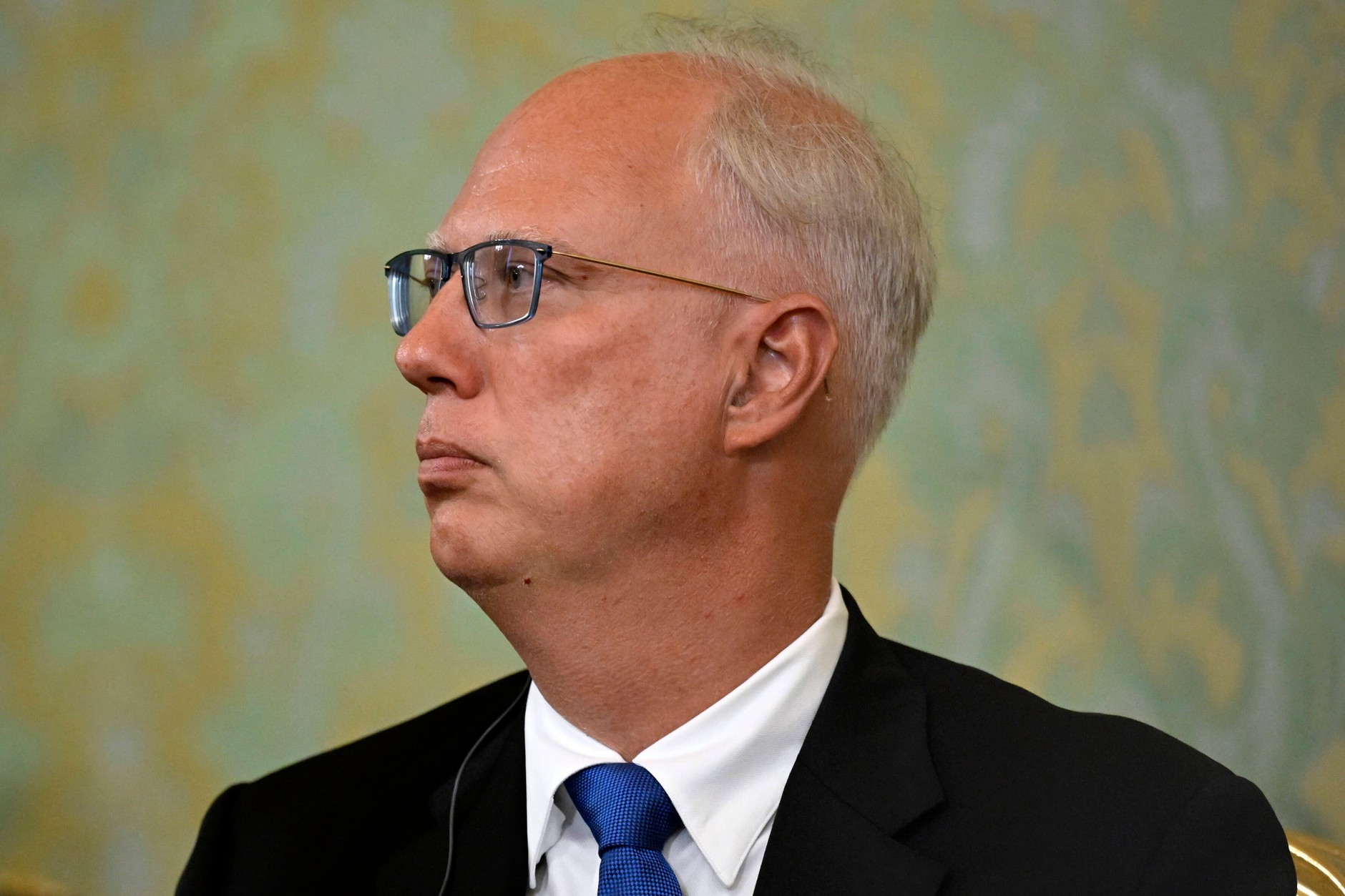
Russia's chief economic negotiator and head of the Russian Direct Investment Fund Kirill Dmitriev at the Kremlin in Moscow, Russia, August 7, 2025.ALEXANDER NEMENOV / POOL / PAP
In the face of the power play in Greenland, Russia is also showing increasing impunity in attacking Ukraine's energy infrastructure. In the middle of winter, the Kremlin deliberately plunges entire cities into darkness and without heating. This has one key goal: to weaken the resolve of Ukrainians in order to force them to accept additional concessions. These attacks were met with no response from the White House.
This entire situation strengthens the Kremlin's long-term negotiation strategy.
Since the start of the 2025 peace talks, Russia's approach has been simple: stick to maximalist demands and wait until Ukraine's partners lose interest, withdraw support and/or pressure Kyiv to make further concessions.
The United States' pursuit of Greenland not only allows Russia to continue making the same demands, but also to test how far it can go on the battlefield and at the negotiating table. Meanwhile, this situation distracts European partners from further support for Ukraine and undermines the basis for long-term security guarantees and financial support.
This week there will be another opportunity to check the extent to which the situation with Greenland affects the negotiation process on the Ukrainian side. Negotiators from the United States and Ukraine will meet again on the occasion of the World Economic Forum in Davos. The two sides still have not reached an agreement on the appropriate approach to engaging Russia and establishing multilateral security guarantees with European partners. It will be important to watch how the Greenland issue impacts negotiations between the United States and Ukraine and between Ukraine and Europe.
Meanwhile, observers should expect that the Russian side will introduce changes that go beyond the rhetoric that already appears in the information space. For the Kremlin, Greenland is not a secondary issue, but a signal that US attention, alliance cohesion and negotiating discipline are increasingly divided. As long as this signal persists, Moscow has every reason to toughen its demands, increase pressure on Ukraine, and wait for further disintegration of transatlantic unity rather than seeking a lasting and meaningful end to the war.
I’m Ashley Davis as an editor, I’m committed to upholding the highest standards of integrity and accuracy in every piece we publish. My work is driven by curiosity, a passion for truth, and a belief that journalism plays a crucial role in shaping public discourse. I strive to tell stories that not only inform but also inspire action and conversation.