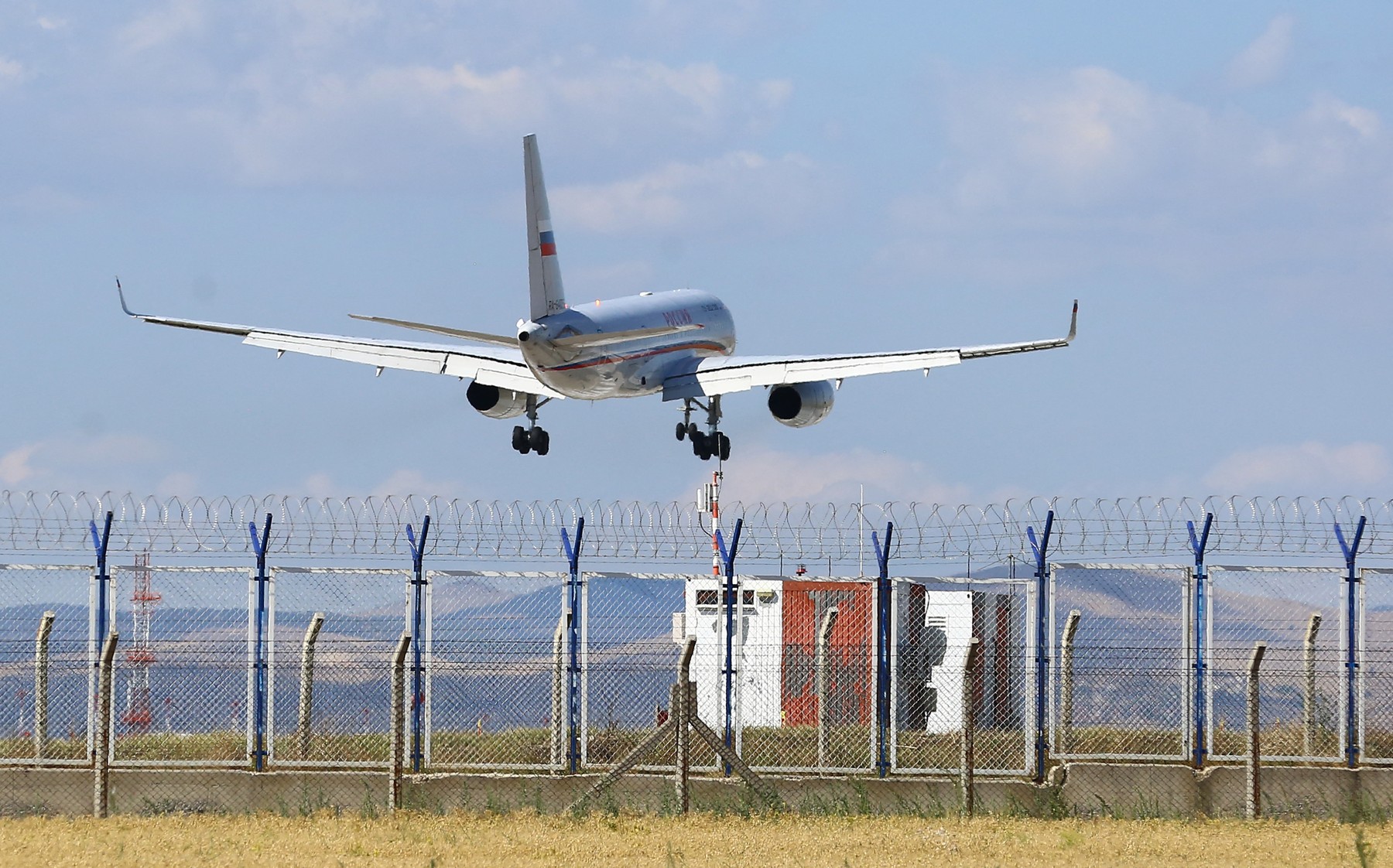
A Tupolev Tu-204-300 plane, photographed immediately after take-off (illustrative image), PHOTO: Caglar Oskay / AFP / Profimedia Images
Russian airlines are returning to service old aircraft, both domestic and foreign, that were taken out of service before the launch of the full-scale invasion against Ukraine, Izvestia reports, citing sources and representatives of the state corporation Rostec.
As Boeing and Airbus announced that they were suspending component deliveries to Russia immediately following the announcement of the first wave of Western sanctions after February 24, 2022, Russia began a restoration process for 12 domestically produced aircraft of various types, including nine aircraft of the Tupolev-204-214 family, one Antonov-148 and two Il-96s.
According to Izvestia, experts estimate that these aircraft are up to 30 years old. Ten of the 12 aircraft (passenger and cargo) have already been returned to service. The remaining two Tu-204 aircraft will also be delivered by 2027. Red Wings and other airlines are among the recipients of these aircraft, according to sources in Izvestia – Russia's oldest daily newspaper.
In addition, foreign Boeing 747 aircraft will be returned to service in 2026-2027. For example, Rossiya Airlines owns two such aircraft, which it acquired after Transaero Airlines went bankrupt in 2015-2016. They operated domestic and international routes but were put into storage during the COVID-19 pandemic.
One of Izvestia's sources says, however, that purchases of spare parts for the Boeing 747 have intensified in the past year, and an expert explains that the aircraft could be refurbished in “friendly” countries, such as Iran, which have the necessary technical resources.
Civil aviation in Russia is facing increasing problems
According to aviation experts, the return of older aircraft is intended to cover impending shortages. These are due to the natural withdrawal of aircraft, but the process is exacerbated by sanctions. Dmitri Yadrov, head of the Federal Air Transport Agency (Rosaviatsiya), said last October that by the end of this decade 230 Russian-made aircraft and 109 foreign aircraft could be withdrawn from the air fleets of domestic companies.
Experts note that the reduction in fleet size also explains the decrease in passenger traffic observed in 2025.
The European Union and the United States closed their airspace to Russian aircraft and banned the supply of spare parts for them days after Vladimir Putin launched the February 2022 invasion.
The EU also banned assistance and insurance for Russian carriers' aircraft and ordered leasing companies to ensure the return of aircraft leased to Russian airlines. Amid the sanctions, some Russian airlines have begun dismantling aircraft for spare parts to service other companies. Meanwhile, the delivery schedule for new domestic aircraft has been pushed back from 2024 to at least 2025-2026.
Dramatic increase in incidents involving planes of Russian airlines
In 2025, the number of incidents involving Russian airlines, due to sanctions and the lack of domestic production of spare parts, increased about four times compared to the previous year, according to calculations by the Novaia Gazeta Europa newspaper headed by Dmitri Muratov, one of the two laureates of the 2021 Nobel Peace Prize.
From January to the end of November, there were more than 800 malfunctions leading to the cancellation or emergency termination of flights, while in the same period in 2024 there were just over 200 such incidents.
In 2025, Russian commercial aviation has already suffered two accidents and two air crashes, resulting in a total of 53 deaths. The most serious of these was the crash of an Angara Airlines An-24 near Tinda in late July, in which 48 people died.