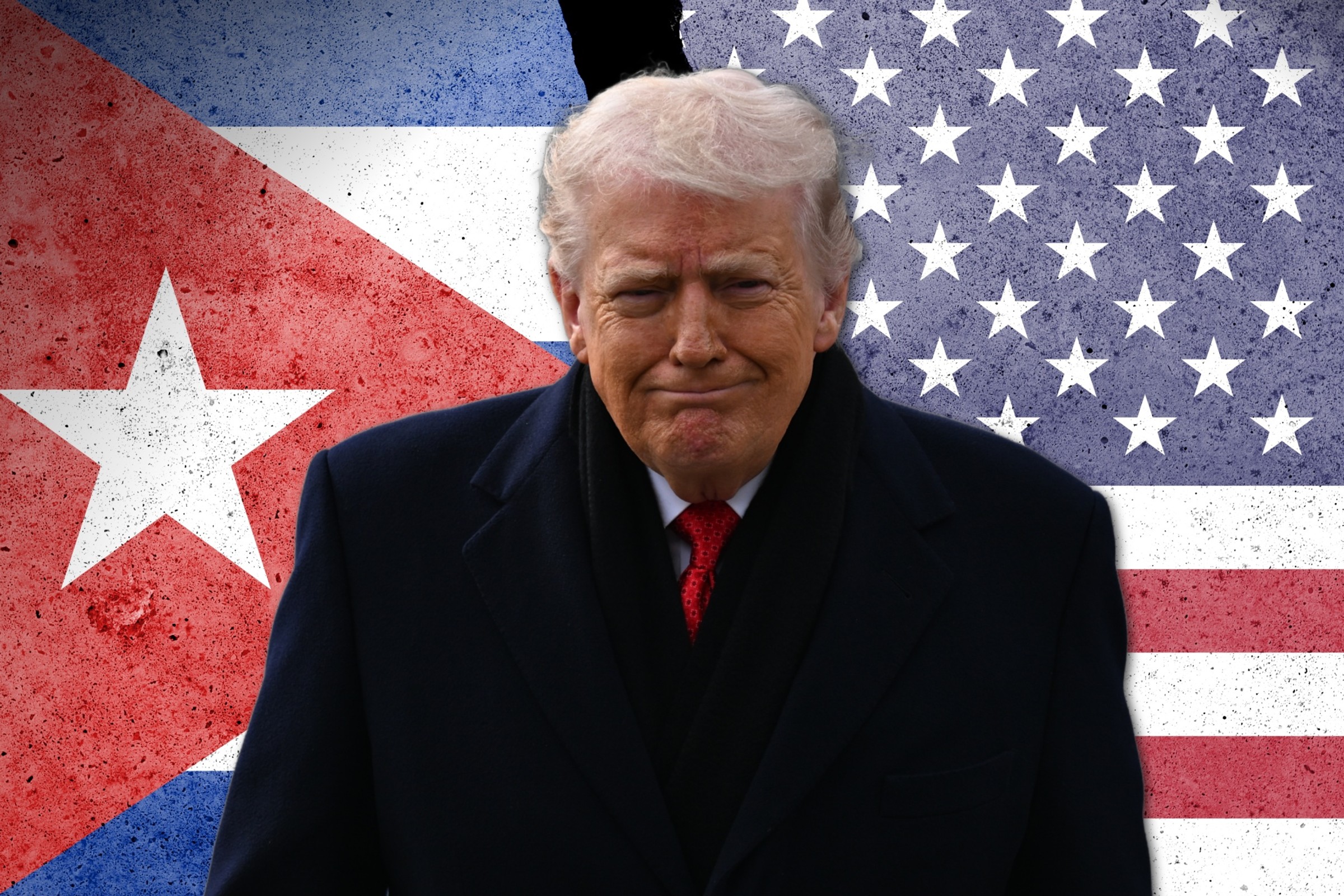
Many people thought that after the United States' military intervention in Venezuela, Donald Trump would be satisfied, at least for a moment – many officials in Washington considered it a success. However, it turns out that the American president has not had enough. Shortly after the attack on Caracas and the detention of Venezuelan President Nicolas Maduro, he began to threaten other countries.
At a time when conflict with Iran is in the air and tensions over Greenland are becoming more and more intense, Another country appears on Trump's horizon – Cuba. Initially, the US president suggested that although she was an “interesting case”, he did not intend to take full control over her. However, the situation changed very quickly.
– I think that eventually we will have to talk about Cuba, because it is a country that does not function properly – he told reporters. As usual, he emphasized that he wanted to help not only the inhabitants of Cuba, but also the large Cuban community in exile – and therefore his loyal voters.
A few days later, Trump escalated his rhetoric even further and issued a direct warning to the Cuban government. “I strongly advise them to reach an agreement before it is too late,” he said.
However, it is difficult to reach any agreement if there is no dialogue between the countries, at least that is what Cuba's president Miguel Diaz-Canel says. “We are not in any talks with the US government beyond technical contacts,” he explained.
The tension between Washington and Havana is shifting — at least for now — to the digital space and out to sea. On January 8, former White House speechwriter Marc Thiessen posted a provocative question on X. “The Cuban regime has outlasted every president since Eisenhower. Wouldn't it be unusual if this series ended with Donald Trump?”
The US president immediately shared the post on his Truth Social platform. But it didn't end there – he also published an artificial intelligence-generated graphic on this website showing him smoking a Cuban cigar. When asked by one user whether Marco Rubio, the current Secretary of State with Cuban roots, could become the future president of Cuba, he replied briefly: “sounds good to me!”
Although the president often talks about actions that could destabilize the Cuban government, he has not yet presented a specific invasion plan similar to the one that led to the fall of Nicolas Maduro. After the attack on Venezuela, which resulted in the death of 30 Cuban soldiers, the US regrouped its forces. The ships USS Iwo Jima and USS San Antonio were moved to the Atlantic, directly off the northern coast of Cuba, a few days ago.
Domino effect
However, the White House hopes that military intervention will not be necessary. “Cuba looks like it's going to fall,” Trump said in a conversation with reporters. According to him, the island currently has no income. The reason for this is the loss of Venezuelan oil – after the US attacked Venezuela and took control of the oil industry, Cuba lost about 30,000. barrels per day. For a government facing the biggest crisis since the revolution, these numbers are deadly.
Although acting Venezuelan President Delcy Rodriguez reaffirmed Venezuela's “historic stance” toward Cuba, Trump says the flow of immigrants from the country has dried up. — Cuba is literally on the verge of collapse. And there are a lot of great Cuban-Americans who will be very happy about it, he said.
The article continues below the video
The country's economic situation proves that Trump may be right. The oil problem is just another in a series of major crises. Cuba's social system is currently weakened, and suspending oil supplies will certainly not improve the situation. Havana is also struggling with a huge outflow of skilled workers. A combination of internal crisis and loss of allies may have disastrous consequences for Cuba.
Unpleasant deja vu
As Donald Trump escalates his rhetoric against Havana, his most loyal voter base – Cuban-Americans in Florida – is experiencing painful awakening. The community, which overwhelmingly supported the Republican candidate in the November elections (he gained 68 percent of the votes), sees a painful analogy – the reality in the country ruled by Trump reminds many of them of the regime from which they fled.
Many Cubans are beginning to see disturbing parallels between Trump and Fidel Castro. Attacks on the opposition, attempts to control the media and demonization of minorities cause unpleasant deja vu for those who remember the revolution. As Carlos Icaza, a 63-year-old Cuban-American hairdresser, said in an interview for “El Pais”: “Cubans have never known what democracy is. They need [silnego] a man who will tell them what to do.” He says he knows a dictator when he sees one. He finds it incomprehensible that a significant portion of his compatriots in the United States still defend Republicans.
Daimarys Hernandez agrees, finding it unbelievable that her people “don't understand how a dictator behaves.” “The same Cubans who have been living here for years don't realize that Trump behaves just like Fidel – says the manicurist in an interview with “El Pais”. Last year, her husband faced deportation.
The end of privileges
Cubans have a turbulent relationship with Donald Trump, but also with the conservative government itself. The Republican's campaign was largely based on promises of economic growth, but the reality is different. Rent and food prices (not only) in Florida are not falling. Jessica Ruiz said in an interview with “El Pais” that instead of progress, he sees only a weak economy and divisions in the administration.
The situation is even worse when it comes to immigration policy. Cubans, once a protected group of migrants in the US, have lost their privileges. Trump became not only the president who has deported the most Cubans to date, but also the one who threatened the immigration status of a community that had long enjoyed protection in the United States.
The situation is also critical for dissidents. People who escaped from prison after the July 2021 protests are often not admitted to the U.S., and judges will not grant them asylum following recent rule changes. After the brutal treatment of asylum seekers, many of them have lost their illusions and are no longer applying for American citizenship.
There is also growing concern about the future of the Cuban Adjustment Act [Cuban Adjustment Act — CAA z 1966 r., która gwarantowała Kubańczykom stały pobyt w USA]. Although it is still in force, for the first time in a long time Cubans are facing the same sense of insecurity, deportations and family separations as immigrants from other countries.
I’m Ashley Davis as an editor, I’m committed to upholding the highest standards of integrity and accuracy in every piece we publish. My work is driven by curiosity, a passion for truth, and a belief that journalism plays a crucial role in shaping public discourse. I strive to tell stories that not only inform but also inspire action and conversation.