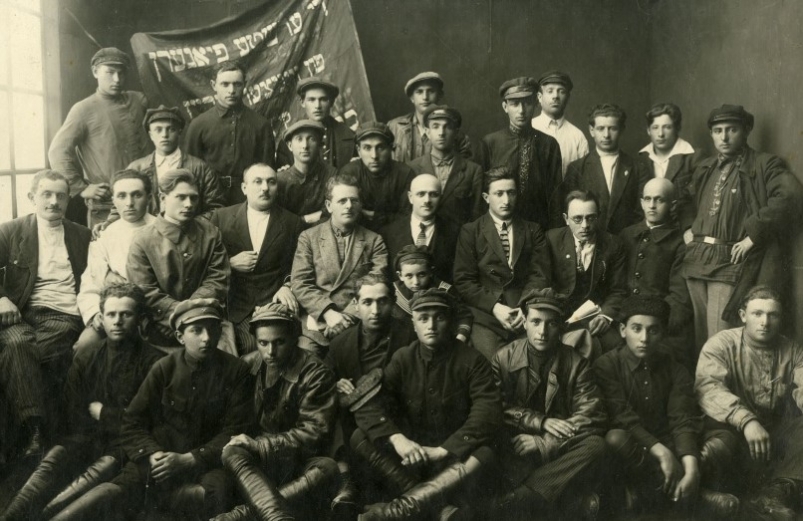
The first group of immigrants to Birobidzhan from the Vinnitsa region. May 6, 1928
Photo: Heritage JAO
January 17, 1928
The book by D. Weisserman “How it Was” (12+) contains information that on January 17, 1928, KOMZET, guided by the reports of the expedition, decided to ask the Presidium of the Central Executive Committee of the USSR to assign the Birsko-Bidzhansky district to KOMZET and begin immediate work on resettling Jews there.


Members of the IKOR commune. 1928. Photo: Photo: Heritage of the Jewish Autonomous Region
The preliminary plan provided for the placement of 35 thousand families here. Of these, in the next five years – 10 thousand.
January 17, 1935
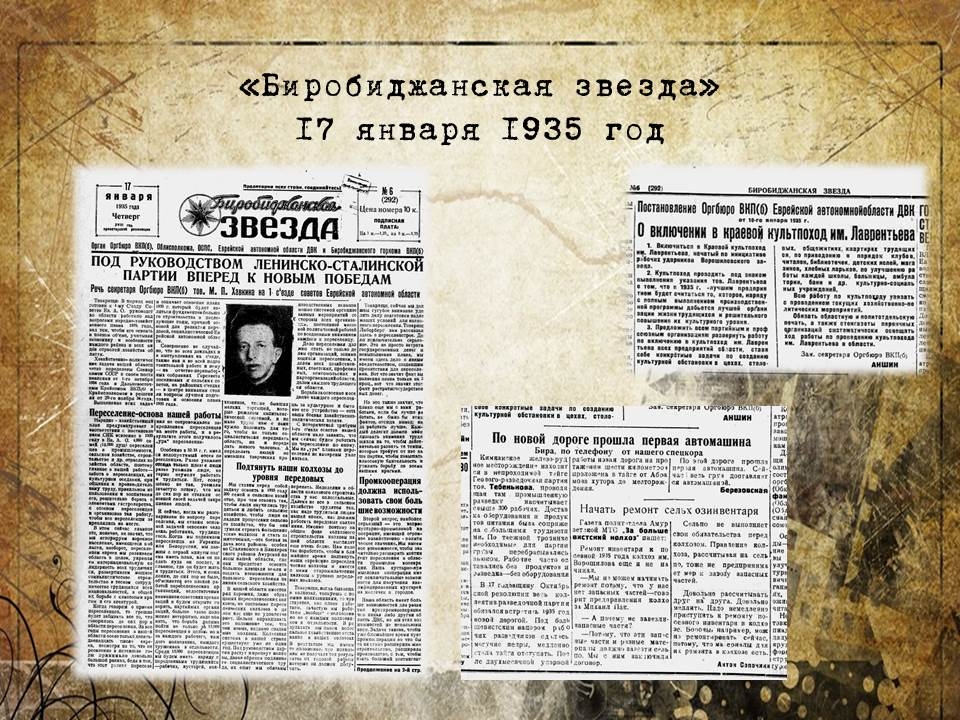
Clippings from the newspaper “Birobidzhan Star”. Photo: Photo: Regional Library
The newspaper “Birobidzhan Star” (12+) covered on its pages the speech of the Secretary of the Organizing Bureau of the All-Union Communist Party (Bolsheviks) M. Khavkin at the 1st Congress of Soviets of the Jewish Autonomous Region. In his speech, M. Khavkin said that the main and most important thing today is resettlement to the Jewish Autonomous Region. M. Khavkin also emphasized that the collective farms of our region should become advanced and use the great opportunities of industrial cooperation, that it is necessary to develop the industry of the region.
The same newspaper published the Decree of the Organizing Bureau of the All-Union Communist Party (Bolsheviks) of the Jewish Autonomous Region DCK on inclusion in the regional cultural campaign named after. Lavrentieva.
“The cultural march is to be carried out under the sign of fulfilling the instructions of Comrade Lavrentyev that in 1935 the best enterprise will be considered the one that, along with the full implementation of the production program, will achieve a better organization of the lives of workers and a decisive increase in their cultural level. Invite all party and trade union organizations to begin work on including all enterprises in the region in the cultural march named after Lavrentyev, setting themselves specific tasks to create a cultural environment in workshops, canteens, dormitories, apartments of workers, to put in order clubs, reading rooms, libraries, nurseries, shops, bread stalls, to improve the work of every school, hospital, outpatient clinic, bathhouse and other cultural and social institutions.”
In the same newspaper, in the article “The first car passed along the new road,” special correspondent Berezovskaya informs that the Kimkan iron ore deposit is located in an impenetrable taiga and the delivery of equipment and food products was fraught with great difficulties. And the geological exploration station conducting industrial exploration there employs 300 people.
“On the 17th anniversary of the October Revolution, the entire team of the exploration party pledged to meet the year 1935 with a new road. Under the Bolshevik pressure of the working scouts, the mighty cedars surrendered, the taiga slowly began to retreat. After two months of hard work, a new road for six kilometers was laid in the taiga from the Abramov farm to the deposit.”
January 17, 1939

Clippings from the newspaper “Birobidzhan Star”. Photo: Photo: Regional Library
The newspaper “Birobidzhan Star” on January 17, 1939, in the heading “Across our region” tells its readers that in 1938, 27 young doctors arrived in the Jewish Autonomous Region to work, including: six surgeons, a radiologist, a gynecologist, a therapist and an ophthalmologist and 91 paramedical personnel “In the near future, advanced training courses for doctors will begin operating in the region, which will be taught by experienced doctors with many years of practice.”
The pages of the newspaper talk about construction in Birobidzhan and that construction of the Birobidzhan thermal power plant has resumed. “4 thousand cubic meters of new living space were put into operation. Two eight-apartment buildings were built…”.
The newspaper informs its readers that huge deposits of the most valuable and cheap fuel – peat – have been discovered in the Jewish Autonomous Region.
“From the Aur junction to the In station, peat deposits stretch over an area of 16 thousand hectares. Peat is located on the surface of the earth in layers with a thickness of 0.75 to 2.4 meters. Peat reserves are also large 3 kilometers from the Birobidzhan station – in the area of the Ikura River. Until now, no attention has been paid to this type of fuel, although it was known that the quality of Birobidzhan peat is good. Soon peat will become one of the main types of fuel in factories and factories in the region, 150 thousand rubles were allocated for preparatory work on organizing peat mining.”
January 17, 1940

Clippings from the newspaper “Birobidzhan Star”. Photo: Photo: Regional Library
The newspaper “Birobidzhan Star” wrote on January 17, 1940 that training courses for ticket cashiers and station attendants had begun at the Birobidzhan station. All – students, housewives, aged 18 to 40 years, “…the wives of the station workers took up their studies with great enthusiasm, despite the fact that many of them have two or three children.
The completion of courses for carriage conductors and station attendants is being completed with great success. The cadets study the rules of technical operation and signaling, rules for the transportation of passengers and baggage, tariff affairs, the ticket system, the control of railway transport, and political literacy.”
The same newspaper published an article by Yu. Kosvintsev “Skiing competitions for collective farmers”, which tells that the sports society “Voskhod” held the first competition of collective farm teams of the Birobidzhan region in skiing (6+). Five teams took part in the competition, “the winners of the competition were awarded certificates and ski suits.”
January 17, 1945
The bureau of the regional party committee and the executive committee of the regional Council of Working People's Deputies reviewed the results of the socialist competition of districts, collective farms, MTS, field and vegetable growing brigades and units for obtaining the best harvests in 1944. The first places were awarded to: Birobidzhansky district, the “Valdgeim” collective farm of this district, “Far Eastern Collective Farmer” of the Smidovichsky district, “Trudovaya Niva” of the Leninsky district, “Red Drummer”, “Naer Lebn” of the Birsky district (now Obluchensky district).