A possible retaliation by Iran against the United States could be more dangerous than its previous reactions to strikes ordered by President Donald Trump on Iranian nuclear targets, regional analysts warn. The current context is different, experts say, as the regime in Tehran faces one of its worst internal threats in recent years, writes Newsweek.
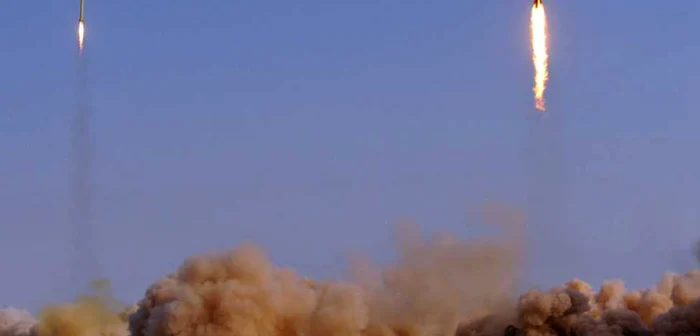
Iranian missiles/PHOTO:X
Donald Trump is considering options for intervention in Iran, amid protests and instability that are putting pressure on the country's religious leadership. Iranian officials have warned that any US military strike could endanger US military assets throughout the Middle East.
In June 2025, Iran struck Al Udeid Air Base in Qatar – the largest US base in the region – in retaliation for US attacks on three Iranian nuclear sites. On Wednesday, personnel at the same base were advised to leave the area after new threats from Tehran. This time, however, the situation is much more tense.
“It's a completely different dynamic. The stake is whether the regime will continue to exist in its current form,” explains Rosemary Kelanic, director of the Middle East program at the Defense Priorities think tank.
According to her, Iran has shown restraint in the past, but an American intervention that would explicitly aim for regime change could trigger a much harsher response. “The perceived threat level is completely different,” Kelanic says.
American troops in the region, vulnerable
The US military presence in the Middle East includes permanent bases, outposts, and shared facilities with host states. Jon Hoffman, a researcher at the Cato Institute, says Tehran would like to send a clear message that US or Israeli attacks on Iranian soil cannot become routine.
“There is a high probability that the regime will perceive the combination of military strikes and internal uprising as an existential threat, which could lead to a larger retaliation than in the past,” says Hoffman.
This could endanger the lives of the approximately 40,000 US troops stationed in the region in more than 60 bases and facilities, some of which are poorly protected, he warns. Al Udeid, located about 50 kilometers from Doha, is also home to a coordination center for the US Central Command (CENTCOM), which oversees US operations in the Middle East and Egypt.
US forces are also stationed in Iraq at the Al Asad and Erbil bases, in Bahrain – home to the US 5th Fleet – as well as in the United Arab Emirates, Saudi Arabia, Turkey and Jordan.
Indirect and “plausibly deniable” answer
Although Iran is clearly inferior militarily to the United States, it could still inflict significant losses and costs by using allied militias in the region, part of the so-called “axis of resistance.”
“Iran could attack US bases in Iraq and Syria through these local actors in a way that would provide some degree of deniability”explains Rosemary Kelanic.
Missiles, the Strait of Hormuz and cyber attacks
According to the international intelligence consultancy S-RM, Iran could resort to short- and medium-range ballistic missiles, as it has done in previous retaliations, including after the assassination of General Qasem Soleimani in 2020.
Another major tool of pressure would be the disruption of traffic through the Strait of Hormuz, through which about 20% of global oil and gas trade transits. However, experts consider this scenario an extreme one, as it would also affect Iran's exports.
S-RM points out that any direct US military action would almost certainly trigger an Iranian response. “The lack of a response would fuel the perception of the regime's weakness at a critical moment,” the analysis says.
The threshold for retaliation could also be lower because of a recent doctrinal change. In early January, Iran's Supreme Defense Council announced that it reserves the right to act preemptively based on “objective threat signals,” hinting at a possible move away from reactive defensive doctrine.
Controlled escalation or unpredictable reaction?
Ameneh Mehvar, senior Middle East analyst at ACLED, says Iran's reaction would depend on the extent of US intervention. A limited strike would not necessarily trigger a major response, but the risk of escalation remains high.
“The impact of US intervention is extremely difficult to predict – from cyber attacks and economic pressures to limited military strikes or targeted operations against leaders”she explains.
If the US objective were regime change, recent experiences suggest that airstrikes or token shows of force would not quickly produce that result.
Iranian officials have already warned that an attack would trigger retaliation against Israel. A regime under extreme pressure could react unpredictably, including by attacking Gulf energy infrastructure or ballistic strikes.
Iran could also diversify its response through asymmetric or clandestine actions against US and Israeli interests outside the region, including diplomatic targets, Mehvar warns.
“To show that he is not helpless”
According to an Israeli assessment cited by Reuters, Donald Trump may have decided to intervene, although the extent and timing remain unclear. Yossi Kuperwasser, a former Israeli general and head of the Institute for Strategy and Security in Jerusalem, says Iran will try to demonstrate that it is not without options.
“As in the past, he could choose a calculated response, just enough to save his prestige without sliding into all-out war,” he states.
In this context, the central question remains not whether Iran will react, but how far it will be willing to go to defend its political survival.