2026-01-14 22:20
publication
2026-01-14 22:20
Wednesday brought a predominance of declines on the New York stock exchanges. Technology companies were particularly hit. A day earlier, the S&P500 index and the Dow Jones industrial average set new historic highs.

On Wednesday, the Dow returned just 0.09% and ended the day at 49,149.63 points. The S&P500 fell by 0.53% and finished with a score of 6,926.63 points. On Tuesday, both indexes reached new records, and the S&P500 approached the 7,000-point mark.
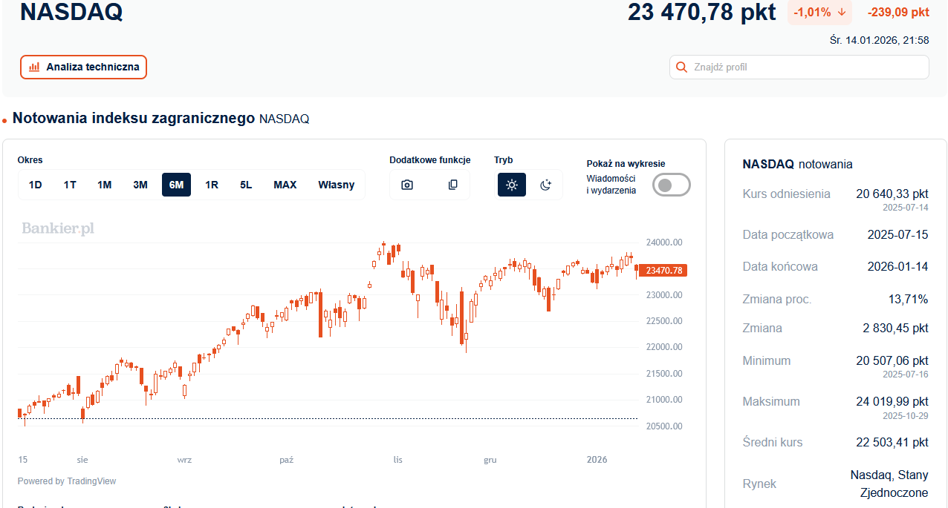
This time, the sell-off focused on shares of trendy companies related to the boom in generative artificial intelligence. Shares of Broadcom and Oracle fell by more than 4% each, and Amazon's shares fell by 2.4%. As a result, the Nasdaq Composite index dropped by 1% and closed for the second session in a row.
– In the technology sector, investors are starting to shift away from expensive technology giants towards value stocks and more defensive stocks, said Michael O'Rourke, head of market strategies at JonesTrading, speaking to Reuters.
Shares of banks, which are harmed by the idea of legally limiting credit card interest rates, also fell significantly. Bank of America lost 3.8%, Wells Fargo 4.6% and Citigroup 3.4%. However, only Wells Fargo disappointed with its fourth quarter results, while Citigroup and BofA beat the market consensus in terms of earnings per share.
Investors also received a portion of overdue, but already significantly outdated, macroeconomic data. We learned from them that November's retail sales were unexpectedly good, growing by 0.6% month-on-year against expectations of 0.4%. The positive message of this information was slightly clouded by the revision of the already weak data for October. Still, at the end of 2025, the American consumer (or at least its highest-earning fraction) was eagerly spending money.
The policy of producers continued to be pro-inflationary and they raised the prices of their products at a rapid pace in October and November. In October, producer prices (the so-called PPI inflation) were 2.8% higher than a year ago, and in November they increased by 3.0% y/y – which is clearly stronger than the market consensus of 2.7%.
K.K