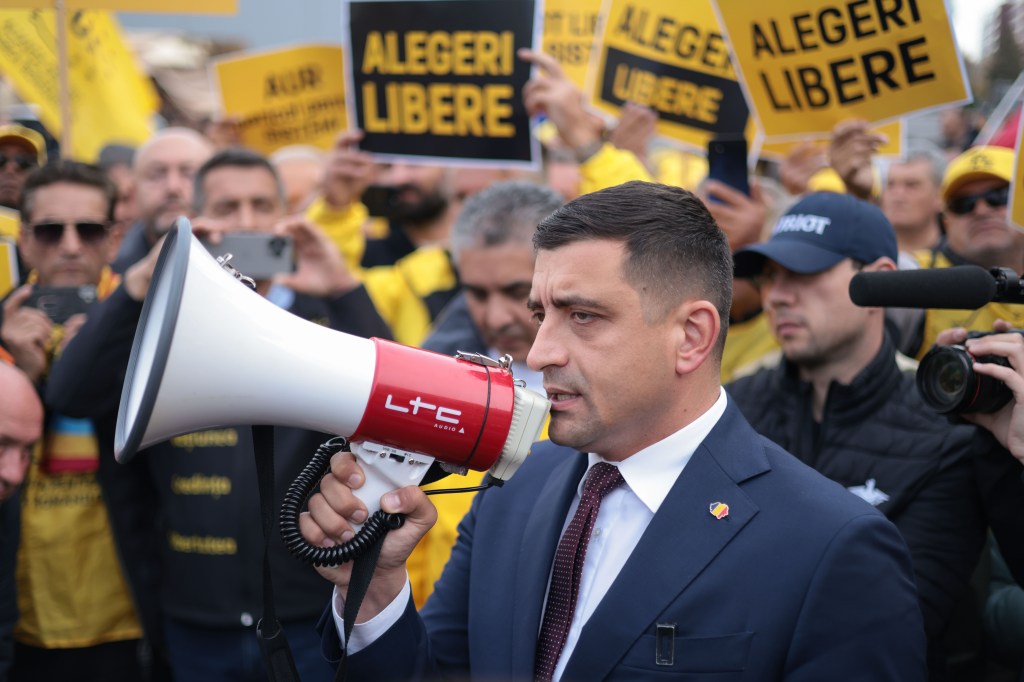
Protest today in Bucharest “against the Vexler Law”, organized by Claudiu Târziu and supported by AUR, his former party / The parallel between Radu Gyr and Ana Blandiana


“Radu Gyr was sentenced to death for a poem, not because he was a legionnaire,” says the main organizer of Thursday's Bucharest protest, Claudiu Târziu, leader of the Conservative Action party. The protest will start at 18:00 at the University, and then the participants will march. The party led by George Simion, of which Târziu was a member until last year, announced that it supports the protest and that AUR members will participate.
Around 10,000 people are expected to take part in the demonstration, says the main organizer, Claudiu Târziu, who said, in a dialogue with HotNews, that the only subject against which today's action is directed is the Vexler Law on combating extremism.
“The Vexler law, in our opinion, is a priority now from the point of view of the public reaction we must have. Of course, the other problems related to the way the PSD-PNL-USR-UDMR coalition governs are to be fought, but we preferred to hold other events dedicated to those economic and social problems generated by the Bolojan government, not to mix our messages, because then no one understands anything,” explained Claudiu Târziu.
 A new scandal in Parliament upon the adoption of the law on combating extremism / The law had been challenged by President Nicușor Dan and the opposition
“Other protests are coming, but dedicated to other themes,” he assured.
“There were creators who were sentenced to prison for a poem or an article”
In a post on Facebook, Claudiu Târziu wrote that “there were times when poets were sentenced to hard prison or even death for a poem. They seem to be returning”. Asked what he specifically refers to, he replied:
“We know that, for example, Ioan Slavici was imprisoned in the Austro-Hungarian Empire for his Romanian attitudes in the press. We also know that during communism there were poets, Christians, without any political involvement, such as Traian Dorz, who were put in prison.”
He then spoke about the conviction of Rady Gyr
“I saw that this association was also made. Yes, Radu Gyr was sentenced to death for a poem, not because he was a legionnaire. Attention, because he was a legionnaire he had already been sentenced, he had served. But in 1959, he wrote a poem: “Rise up, Gheorghe, Rise up, Ioane” (…) and he was accused of inciting the legionary rebellion. I heard this phrase before in 1990, from Ion Iliescu, in the University Square – and on this basis they sentenced him to death”, declared Claudiu Târziu.
The parallel he makes between Radu Gyr and Ana Blandiana
“Sure, after that they commuted the sentence to 25 years in hard prison (n. ed.: for Radu Gyr). But for a poem, yes? Which was not a legionary manifesto. It was not “Holy Legionary Youth”, which was a song of the legionaries. It was a poem. It's as if Ana Blandiana was convicted for the “Adventures of Motan Arpagic”, which, mind you, drew the wrath of the Security and the party, and they put her on the index in the 1980s,” said the leader of the Action Conservative party.
He claims that through the Vexler law there is a risk “that the literary work or a creator will be censored on ideological grounds”. “It's a totalitarian reflex,” he added.
The idea expressed by Claudiu Târziu, according to which certain authors would be banned following the Vexler Law, is not clearly provided for in the law adopted in December by the Parliament.
At the same time, last year, President Nicușor Dan attacked the law at the CCR and later sent it back to the Parliament for re-examination, stating that “such a law must be very clear, so as not to leave room for interpretations and possibly abuses”.
The protest route
The Bucharest Police announced that the declared purpose of today's protest is “defense and promotion of Romanian cultural values and identity”. The program of the protest will be as follows:
- between 17.30-18.30, gathering of participants in the University Square – statue esplanade;
- between 18.30-18.45, short speeches in the University Square – statue esplanade;
- between 18.45 and 19.30, the movement of the participants will be carried out on the first traffic lane, on the following route: University Square (statue esplanade) – cross in front of the Bucharest City Museum – Nicolae Bălcescu Blvd – Magheru Blvd – left on George Enescu Street – left on Nicolae Golescu Street – Episcopiei Street – the sidewalk in front of the Romanian Athenaeum Park;
- between 19.30-19.40, short speeches and laying of wreaths on the sidewalk in front of the park of the Romanian Athenaeum;
- between 19.40-20.30, the total flow of participants along the following route: Benjamin Franklin Street – left Bd. Magheru – Piața Romană – Bd. Lascăr Catargiu – end point the sidewalk adjacent to the intersection of Bd. Lascăr Catargiu with Bd. Iancu de Hunedoara.
“The Road Brigade will order measures to streamline traffic and prevent traffic accidents and requests motorists to drive with caution, to keep a sufficient distance to be able to brake safely, not to stop or park except in specially arranged places and to respect the signals and indications of the traffic police”, according to the Capital Police.
 George Simion announces that AUR is participating in the first opposition protest this year / Message on Facebook to his followers: “If you don't like Simion, if you don't like AUR, make a protest yourself”
What the Vexler Act provides
In the law adopted by the Parliament for the second time in December of last year, it is specified that “distributing or making available to the public, in any way, fascist, legionary, racist and xenophobic materials constitutes a crime and is punishable by imprisonment from one to 5 years and the prohibition of certain rights”, and if the act is committed through a computer system, “the punishment limit is increased by half”.
In the previous form, the words “fascists and legionnaires” were also missing.
The law also introduces a penalty of 3 months to 3 years for people who publicly promote the cult of people “who were part of the leadership of fascist organizations”.
 VIDEO Like any other form of racial contempt, anti-Semitism does not end with threats. We know how it ends
“The act of the person promoting, in public, the cult of persons guilty of genocide, against humanity and war crimes of persons who were part of the leadership of fascist, legionary, racist or xenophobic organizations, as well as the act of promoting, in public, fascist, legionary, racist or xenophobic ideas, concepts or doctrines is punishable by imprisonment from 3 months to 3 years or a fine and the prohibition of certain rights”, according to the law adopted.
Previously, the law also sanctioned “the fact of the person promoting, in public, the cult of persons guilty of crimes of genocide against humanity and war crimes, as well as the fact of promoting, in public, fascist, legionary, racist or xenophobic ideas, conceptions or doctrines, within the meaning of art. 2 letter a), is punishable by imprisonment from 3 months to 3 years and the prohibition of certain rights”.
Another change is that for “denying, contesting, approving, justifying or minimizing obviously, by any means, in public, the holocaust on the territory of Romania or its effects is punishable by imprisonment from 6 to 3 years and the prohibition of certain rights”. Before, the law also provided for the possibility of a fine, instead of a prison sentence.