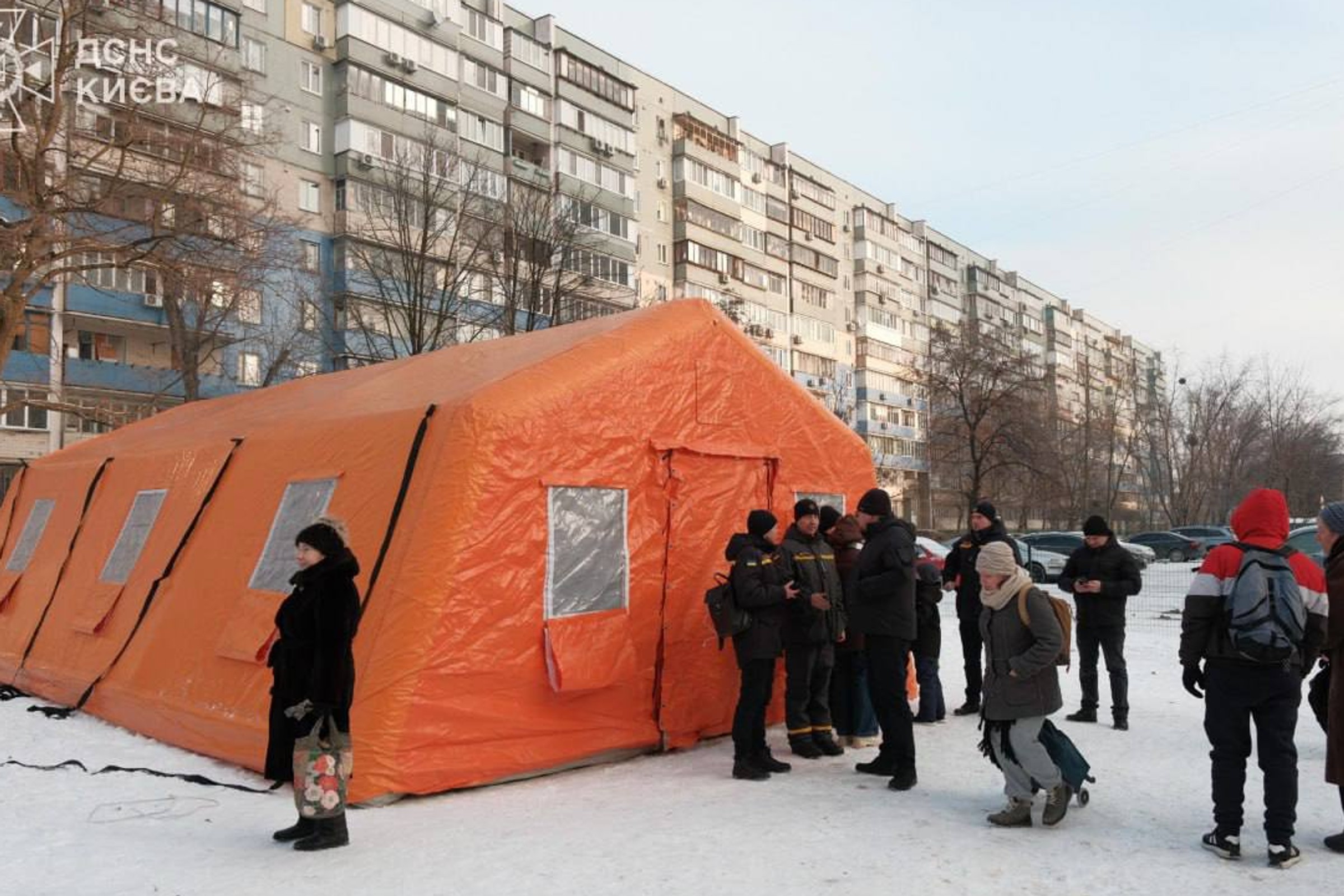
The situation in the capital of Ukraine remains very difficult. Kyiv lives and functions in the conditions of an energy and heat crisis. After the last mass attack, people still live without light, and many of them also without heating. Meanwhile, the temperature on the street remains 15 degrees Celsius below zero. Many apartments in the capital have no heating at all or only minimal heating. There are aid stations throughout the city where people can warm up and recharge their batteries. Residents of the capital actively procure food and water. Hot meals will soon be provided for the elderly and disabled.
In an interview for Onet, MP and former Minister of Housing and Municipal Affairs Oleksiy Kuchenko talked about how critical the situation is and what can be expected in the future.
Oleksiy Kuchenko: Of course, there are also other regions where the situation is difficult. However, the worst situation is currently in Kiev. Both technically and physically. There is simply no electricity in Kiev. 24 hours a day without electricity is a catastrophic situation. And it's really hard to control.
Today, the Prime Minister said quite cautiously that, in principle, there may be some improvement tomorrow. But what does “some improvement” mean? This is conditionally 3-4 hours a day when there is light.
But what is critical is not so much the lack of light as the lack of heat in winter.
Yes, the problem is not only with light, but also with heat. Currently, about 400 multi-family buildings in Kiev are completely without heating. That's a lot. Out of approximately 12 thousand 400 buildings in the city have no heating at all. People sit without heating for 5-6 days in the coldest weather. On the street it is -18 degrees Celsius at night, -12 degrees during the day.
War in Ukraine. “The government has finally declared a state of emergency in the energy sector”
400 buildings – these are official figures. But honestly, I feel like this number is significantly underestimated. Because literally all my acquaintances, friends and relatives are freezing. It can't be that they all ended up in these 400 buildings…
Yes, we can rely on the statements of the Kiev authorities, as there are no exact statistics. I can say as I see it: 400 houses – completely without heating, but thousands of other houses have heating, but very weak. The temperature in these apartments is 14-16 degrees. The radiators are barely warm, they do not provide full heating. People sleep under several blankets, in jackets, in hats. We are talking about thousands of houses throughout the city. My relatives and close friends tell me every day what is happening to them, and I understand that it concerns the whole of Kiev.
So during the last massive attack, the enemy managed to cause damage that was not there before?
The attack took place on the night from Thursday to Friday last week. It's basically been a week. The damage is very serious. It is no coincidence that the government finally declared a state of emergency in the energy sector. This gives the government strict mechanisms of discipline – technological, financial, resource. It provides a management vertical. In such conditions, I would subordinate all energy and heating enterprises to one vertical structure, so that there would be one statistics, one understanding of the division of resources, spare parts and materials.
The mayor of Kiev keeps talking about evacuation.
Yes, the topic of the evacuation of Kiev often comes up.
But how realistic is this?
What does the evacuation of a city of four million people look like? I think the mayor himself doesn't fully understand it. How to evacuate four million people? I can't imagine it. Therefore, the situation is extremely tense. And this is not just a crisis anymore. This is an extraordinary energy situation at extremely low temperatures.
Is it possible to repair the damage?
They could be repaired and rebuilt, but the heating had to be started literally from scratch. Thermal power plants that generate heat for two-thirds of the city have lost the ability to supply heat carriers. There was a real risk of cooling of heat carriers in the main networks. Currently, all this is being gradually restored. Every day it gets a little better. However, electricity generation in Kiev will not be restored quickly — at least until the end of spring. Kyiv is completely dependent on external sources: nuclear energy and imports. The city itself does not produce electricity. That's why we wait with horror to see what might happen next. We pray to our air defense system to protect the capital from a possible but probable new attack.
“Kiev Blackout”. Ukraine is fighting the cold and enemy missiles
Is it possible after a new strike Kiev blackout?
Depends on what you mean by blackout.
Total blackout – in all neighborhoods, in all homes – for a day, two or three?
There will most likely be some light. But the situation depends very much on the condition of key substations that are supposed to ensure the transmission of electricity from nuclear power plants. The enemy has placed Kyiv under an energy blockade. At the same time, it hit key Ukrenergo transformer substations that ensure the transmission of electricity from nuclear power plants. Kiev cannot produce electricity on its own and its transmission is impossible – substations are damaged. They are located around the city and this is where most of the rockets fell. It was virtually impossible to completely protect them from missiles.
What can we expect in the future and what are the key factors for the city's survival this winter?
The key factor is air defense. If it prevents new impacts, we will move towards improvement. What scares me more with new strokes is not turning off the lights, but turning off the heat. The forecast for the coming weeks is bad, frosts will continue. You can survive without electricity thanks to flashlights and heating points. But without heating in this cold, this is a key danger. Power engineers work heroically, but there are damages that cannot be repaired or are very difficult to repair. The reserve of strength of any engineering system is not infinite – each new impact reduces it.
In a scenario where the enemy is unable to further damage energy infrastructure – how quickly will we be able to rebuild and achieve a more or less stable energy supply?
If there are no new strikes, according to the interim energy minister, who said that without strikes by the end of spring, the energy system can be more or less restored – either with no or minimal schedules. There are damages that can be repaired within a week, a month or two, and there are those that require half a year or a year. This is the reality.