Large-scale protests in Iran have entered their third week, and their outcome remains unpredictable. It is unclear whether the authorities will be able to quell the movement through violent repression or whether tensions will escalate into a deeper crisis.
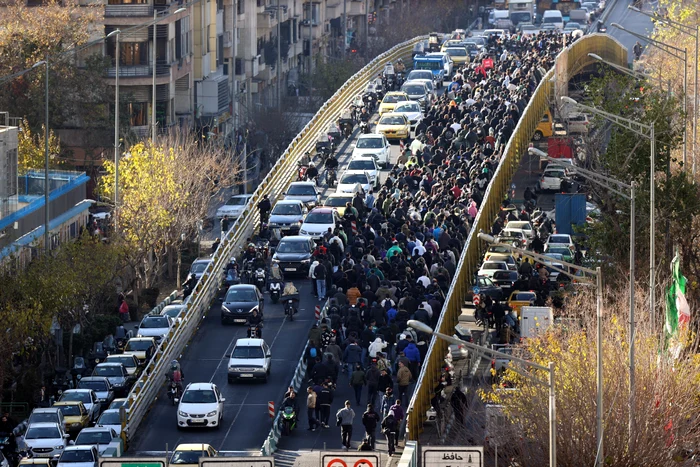
Protests in Iran/PHOTO: EPA/EFE
Information inside the country is fragmentary. Last Thursday, the authorities cut off mobile communications and internet access nationwide. By the end of the week, there were indications that Iran had succeeded in jamming the Starlink network signal as well, possibly with the help of Russian electronic warfare technology and some Chinese systems. If this information is confirmed, it could have serious global implications, including for states that rely on satellite communications in conflict situations, such as Ukraine or Taiwan.
Meanwhile, clashes between protesters and security forces are turning increasingly violent in dozens of cities. Images circulating online show not just isolated shots, but bursts of automatic weapons. The army was also involved in operations to restore order.
Victims and repression
Estimates of the number of victims differ significantly. The Human Rights Activists News Agency (HRANA) reports more than 500 deaths and more than 10,000 arrests by Sunday. These figures are considered minimum, as each case is checked individually, and the actual balance could be much higher.
It is notable that among the victims are also members of the security forces. The Tasnim agency, close to the Revolutionary Guard, published a list of more than 100 policemen and members of the paramilitary forces killed. Although this information has an obvious propagandistic function – the regime denies the peaceful nature of the protests – they may reflect, at least partially, the reality on the ground.
There is also video evidence showing protesters attacking law enforcement officers with their bare hands or improvised objects. Other images show individuals in civilian clothes, speaking Arabic, involved in clashes, believed to be from groups loyal to Iran in Iraq or Lebanon. Even isolated cases of the involvement of foreign fighters have a major symbolic impact, fueling the perception that the regime no longer enjoys sufficient domestic support, writes Zerkalo Nedeli.
The lack of leaders and the emergence of a symbolic figure
Despite the scale of the protests, the movement suffers from a lack of clear leadership. There are no functioning opposition parties and coordination is difficult, especially with communications cut off. Only in certain regions populated by ethnic or religious minorities are there informal structures capable of organizing resistance.
In this leadership vacuum, an unexpected figure has gained visibility: Reza Pahlavi, the son of Iran's last shah. His calls have coincided with massive mobilizations, with some protesters displaying symbols of pre-revolutionary Iran. However, the support he enjoys seems to be the result of the absence of other known leaders rather than a revival of monarchist sentiments.
Four possible scenarios
1. The first scenario, considered the most bleak, involves the violent repression of protests. The regime seems to rely on terror, including public executions of demonstrators convicted in speedy trials. Recent history shows that Iranian authorities have previously succeeded in quelling uprisings through extreme force, even as structural problems remained unresolved.
2. The second scenario involves the country sliding into civil war. This outcome would become possible only if the protesters get significant external support or if army units come over to their side. Such a conflict could be long and devastating, with no guarantee of a democratic transition.
3. The third scenario takes into account an external intervention. Recent statements by US President Donald Trump have fueled speculation, but experience shows that such operations require lengthy preparations. Moreover, a military intervention could reinforce the regime's narrative that the protests are being orchestrated from the outside, diminishing popular support for the movement.
4. The fourth scenario, considered the most favorable, would involve the fracturing of the elites and the passage of a part of them to the side of the protesters. The Iranian leadership is not monolithic, but so far no figure has emerged willing to openly challenge the supreme leader's authority.