The shocking hypotheses regarding the bizarre skulls at the end of the world. An expert believes it is a different species


In the area of the Paracas peninsula, in the South American state of Peru, the most bizarre and fascinating human remains have been discovered. These are unusually long skulls, with a capacity much greater than that of other people. It even talks about a different human species.
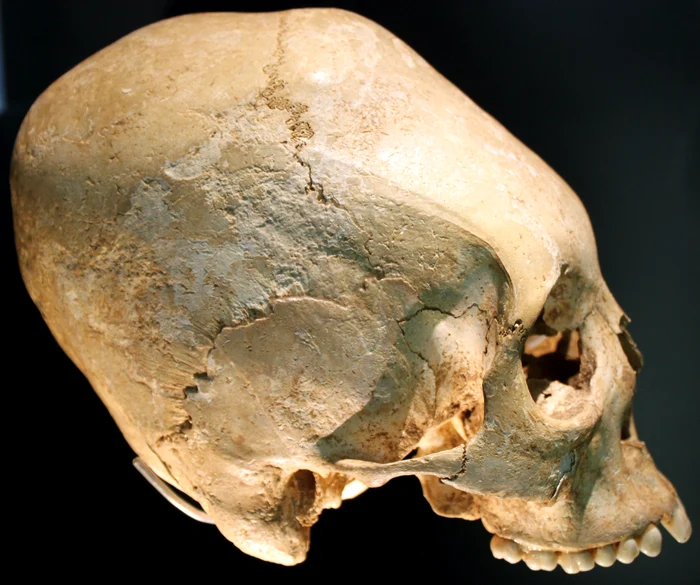
Artificially elongated skull belonging to the tribes of the Germans PHOTO wikipedia
Throughout history there have been many bizarre rituals of beautification or marking of social and political status among human communities. One of these customs, visually and aesthetically impressive, is that of ritually changing the shape of the skull. Basically, a child's skull was bound with textile bands, in a certain way, until the age of three. This results in a skull that is usually elongated, depending on the religious beliefs and customs of the respective community. Neuronal function and cranial capacity were not affected, only the shape was different. This custom was practiced by many populations around the globe until the middle of the 20th century. The most bizarre modified skulls and the most controversial in the world are those of Paracas, a peninsula in the southern part of the state of Peru. On the one hand, there is an official version that indicates that these heavily modified, huge skulls were made by methods known to other civilizations. On the other hand, some specialists say that they are a fruit of genetics and belong to a species that would not have been related to the genetic line of modern man.
Elongated skulls, a fashion of hundreds of thousands of years
The practice of skull elongation is older than modern man. It would have been first practiced by the Neanderthal Man, as evidenced by a series of remains of this hominid discovered at the Shanidar cave in Iraq. The fashion was later taken over by the Central Asian populations and was borrowed, with the westward migration of the steppe tribes, also by some Germanic peoples of Late Antiquity. The main vector of the transmission of this custom in the European area was the Hun population, who practiced the ritual lengthening of the skull on a large scale, being rather a symbol of status. The Gepids, Alamanni and several other Germanic tribes that were subjugated and included in the Hunnic federation in the European area borrowed the custom. In parallel, skull deformation was also practiced in Oceania, Africa and South America.
In Oceania, known for cranial deformation were those from Vanuatu and in South America, the pre-Columbian populations and the Olmecs of Mexico. The deformation was performed in many ways, but the most common was the elongated shape of the skull. How was it obtained? Quite simple in technique, but it required constancy and a lot of patience. A very young baby's skull is flexible at birth and remains so for months. Therefore, with the help of textile bands, the head was tied in the part that was wanted to be deformed. Behind and in front of the skull (in the area of the forehead and the back of the head) were placed two thin pieces of board, which pushed the skull into the desired shape. Modeling was done between the ages of six months and three years. After the age of three, the bones fuse together and the skull deformity remains forever. Neurological function and cranial capacity were not affected. Deformation can change the shape but not the volume of the bone material. Cranial pilosity was not influenced by this procedure either.
A fascinating and mysterious civilization on the coast of South America
Among those who practiced this bizarre ritual of skull deformation were the populations of the Paracas culture in South America, who lived 2800 years ago in the area of the same name. It is a desert peninsula located in the province of Pisco, the Inca region, on the southern coast of Peru. The fascinating remains of this civilization were discovered in 1928 by Peruvian archaeologist Julio Tello. More precisely, in the Paracas area, he found a massive and elaborate cemetery full of graves from the period 800-100 BC. The graves contained the naturally mummified osteological remains due to the dry climate of individuals well wrapped in textiles, a kind of colorful blankets, with very interesting decorations.
The graves contained quite a rich inventory, with vessels, jewelry and other objects of domestic or military use. Many were robbed of the most valuable pieces. Excavation of the site revealed an incredible settlement, spread over a linear area of 2 kilometers, just above the shore. Most of the houses were underground or organized on levels. Specialist research has revealed that these peoples of the Paracas culture were highly developed for that time, having vast knowledge of irrigation and water management in the settlement, through distribution to homes and storage for periods of drought. In addition, they had extraordinary knowledge of textile art. Archaeological discoveries have also revealed the fact that the people of the Paracas civilization made petroglyphs, that is, large symbolic drawings on rocks or rocks in the natural environment, preceding the Nazca drawings. In fact, it is assumed that the mysterious Nazca culture derived from the Paracas civilization, Chiat if it did not have a unitary leadership and administration. Rather, it consisted of independent city-states or villages that had their own chieftains but were united by a common culture and religious system. Relations between these chieftains were not always peaceful, as evidenced by violent battle wounds, heads taken as trophies, and obsidian knives found at Paracas civilization sites. The location found by Julio Tello in the Paracas Peninsula was probably a large economic as well as religious center, with a huge necropolis, where the dead were probably brought from several regions.
Bizarre skulls that look like no human
The Paracas civilization amazed with its material culture and the extent of this settlement, but nothing could match the stupor created by the skulls discovered in the tombs, especially those discovered in the tombs of Cerro Colorado, near the settlement. In total, Tello found more than 300 people with elongated skulls, dating back about 2,800 years. The fact that they were ritually deformed was not an archaeological novelty, but their incredible size. It is assumed that no such skulls have been discovered anywhere in the world. Specialist and author Brien Foerster, passionate about the ancient civilizations of the Andean area, developed a series of theories and observations.
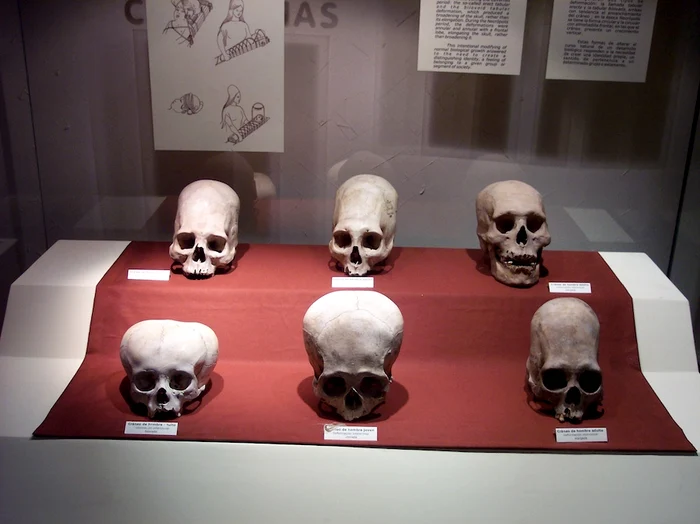
Paracas skulls PHOTO wikipedia
First, Foerster noticed that, unlike the rest of the deformed skulls throughout history, those from Paracas have not only changed their shape, but are also heavier and have a larger cranial capacity. “What you can do with this technique is change the shape of the skull, but not the actual volume. You can change the shape, but not the size. However, Tello found several skulls, at least 300 at a site called Cerro Colorado, adjacent to the main cemetery in Paracas, that had a larger cranial volume, and in some cases 25% more than a conventional modern human skull. How is this possible? As I said, deformation can change the shape but not the volume of the bone material. It is therefore obvious that we are dealing with two different phenomena: elongation by binding and elongation by genetics.(..) What is also intriguing is that these Paracas skulls, on average, weigh 60% more than contemporary human skulls from the same area”states Brien Foerster in the material “Elongated Human Skulls from Peru: Possible Evidence of a Lost Human Species?”, for Ancient Origins. The first DNA tests on the skulls and the hairs attached to them from the Paracas sites were carried out by a German team in 2010. Other genetic tests, says Brien Foerster, point to an even more shocking reality.
“Mutations not known in any human”
It was assumed that these skulls are different, up to 25% larger than a normal human and 60% heavier. In addition, the individuals, based on recent reconstructions, had Andean features, with long dark red hair. The mystery of the elongation of these huge skulls has not been solved, but Brien Foerster claims that initial genetic tests indicate that these individuals may represent a different human species. The evidence would be that these skulls would contain a single parietal plate, instead of two, and would be genetically unrelated to the other populations in the Peruvian area.
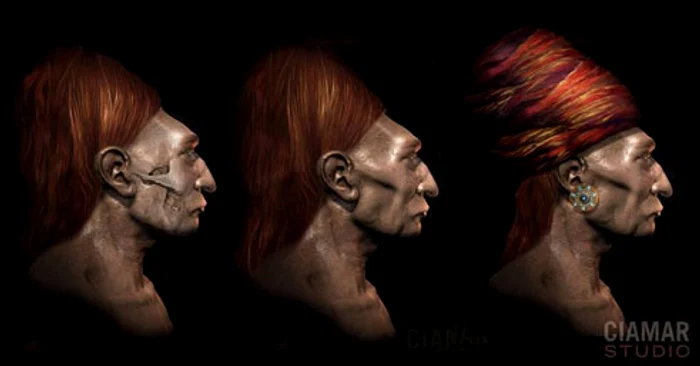
Reconstruction of an individual of the Paracas civilization PHOTO Marcia Moore/Ciamar Studio
“It had mtDNA (mitochondrial DNA) with mutations not known in any human, primate or animal known to date. Only a few fragments that I have been able to sequence from this sample indicate that, if these mutations hold, we are dealing with a new human-like creature, very distant from Homo sapiens, Neanderthals and Denisovans. The implications are, of course, huge”Foerster stated for the mentioned publication. Obviously, genetic research is at the beginning following other comparative analyzes and from other skulls from the Paracas area. At the moment, these considerations are only guesswork. Officially, what is currently known about the Paracas culture is that it was very advanced compared to the times, had incredible art and remained known for these bizarre skulls.