Inflation ends 2025 above BNR estimates. The food basket remains a social barometer, and the increase in the price of coffee by 24% is a tax on the daily ritual


Romania ended the year 2025 with an annual inflation of 9.7% – a level above the estimates of the Board of Directors of the National Bank, after more than two years of a global slowdown in inflation. “The fiscal consolidation process will exert disinflationary pressures by reducing aggregate demand, which will cause a gradual decrease in CPI dynamics, reflecting including the adjustment of inflation expectations. Under these conditions, the annual inflation rate is forecast at 9.6% at the end of the current year and at 3.7% at the end of next year”, says the BNR in the Inflation Report.
The figures, published by the National Institute of Statistics in early January, show a stark contrast between goods categories: services led the rise, fueled by rising operational costs and less elastic demand.
In December 2025, prices of services increased by 11% compared to the same month in 2024, followed by non-food goods (+10.5%) and food products (+7.8%). Beyond statistical averages, the composition of inflation reveals an economy where energy shocks persist, logistics chains still reverberate, and consumers face an “invisible” phenomenon: the silent erosion of budgets, with real effects on living standards.
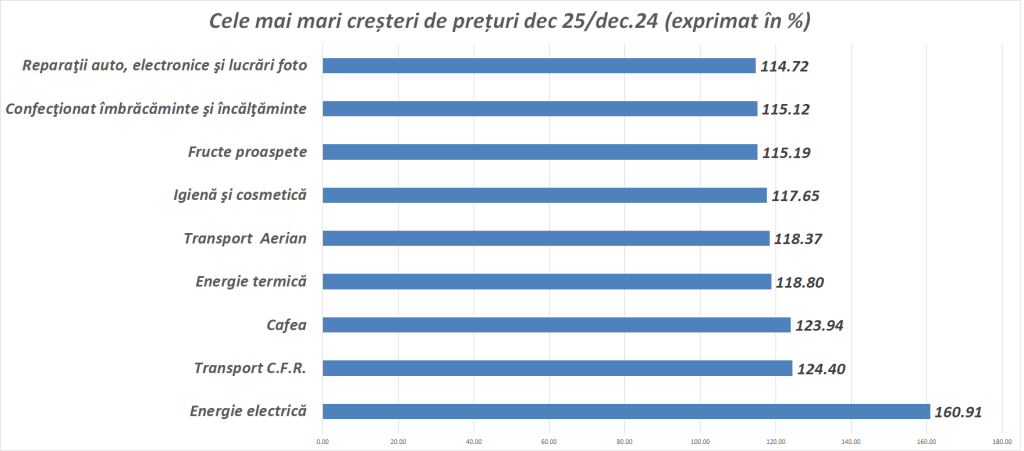
The food basket remains a social barometer. The 24% increase in the price of coffee in a single year – almost a tax on the daily ritual – captures this reality. Fresh fruit (+15%), sugar (+14%), beef (+12%), milk (+11%) and bread (+10%) reinforce the picture of organic inflation, fueled by production costs and, in some cases, global trade realignments.
Even eggs, a product often taken as a benchmark of stability, rose in price by more than 10%.
There are, however, some benchmarks in the opposite direction: potatoes (-11%), canned vegetables (-1.4%) and pulses (-4.1%) all fell in price, along with a slight adjustment to sugar (-0.35%). There are exceptions that do not change the general direction, but avoid exaggerating the inflationary narrative.
But services are the central story of 2025. Rail transport rose by 24%, air flights by 18%, and apparently mundane services – hygiene, cosmetics, repairs – rose between 14% and 18%, signaling wage pressures and a lack of alternatives. Rents, a relevant indicator for urban mobility, rose by almost 9%, while healthcare became 13.6% more expensive – a detail that does not go unnoticed in a rapidly aging society.
The real shock of the year, however, came from the energy sector.
The removal of the electricity price cap scheme triggered a more than 60% jump in electricity tariffs, dragging down much of the rest of the consumer basket. Thermal energy rose by 19%, publications by 10%, detergents by 9%, and tobacco by almost 7%. Medicines (+5.5%) and fuels (+3.9%) rounded out the picture, in a year where basic needs rarely offered refuge.
In contrast to previous months, the end of 2025 did not bring price drops in either services or non-food goods – a rigidity that suggests that inflation in Romania is no longer just an energy story, but a structural one: sticky prices, high operational costs and an economy where indexation is becoming the norm.
With an average annual inflation of 7.3% in 2025, compared to 5.6% in the previous year, Romania enters 2026 in a moment of macroeconomic ambiguity.
The NBR has maintained its cautious stance, companies are adjusting prices slowly, and households continue to learn an old lesson: inflation does not need spectacular crises to erode welfare – it can do so silently, months at a time.