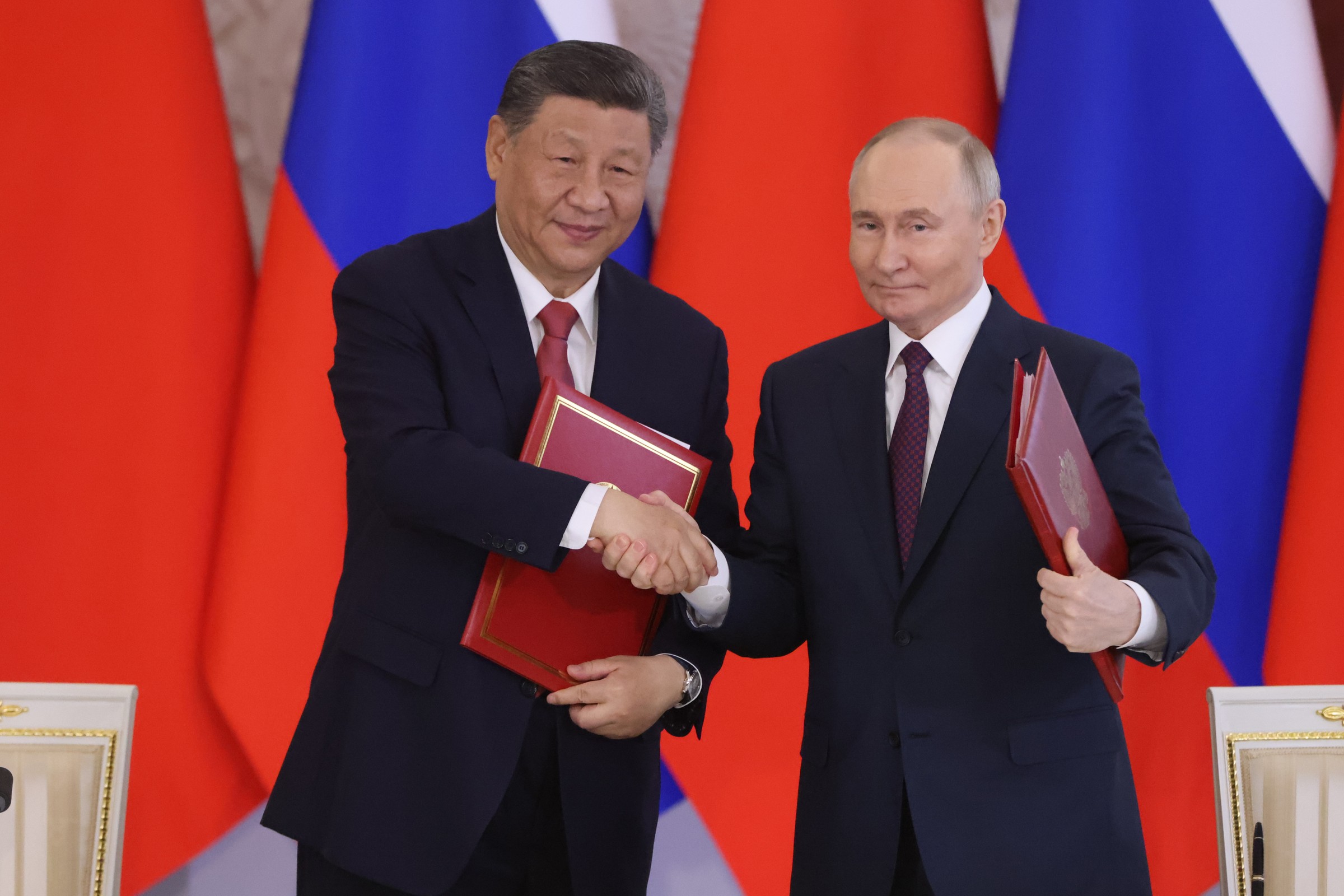
French President Emmanuel Macron said a thought-provoking sentence last week. “We live in a world of great powers that are willing to divide the world among themselves,” he emphasized. Indeed, everything indicates that Trump, Putin and Xi want to divide the cake into three parts. The troubling question remains: who gets what piece? And what will happen to Europe?
After World War II, the world order prevailed for several decades, although it was disrupted by regional wars, but overall it had its justification. It was West against East, and then there was the rest of the world.
When the Iron Curtain fell in 1989, the world became more colorful. Klemens H. Fischer, professor of international relations and geopolitics at the University of Cologne, tells Blick that “now this phase has finally come to an end“. – We are entering a new era, the era of the renaissance of empires – he adds.
Three great powers – the United States, Russia and China – are seeking to consolidate their dominance. They are interested not only in places of strategic importance, but above all in raw materials such as rare earth metals, crude oil and natural gas.
The article continues below the video
It is on these lines that the real limits of the expansion of the three great powers begin. If they want to go further, they will have to take military action against each other
– notes Fischer.
The return of global imperialism is not a surprise, says Fischer. He is a consequence exhaustion of the spheres of influence of the great powers and starting a fight for areas that have not yet been clearly divided.
USA – Western domination
The United States wants to expand its influence over the entire American continent and exert clear dominance throughout the Western world. Greenland is also in Donald Trump's plans. He wants the island, which is a dependent territory of Denmark, “at all costs”.
Russia – return to the tsarist empire
Moscow revealed its imperial goals by attacking Ukraine. The focus is on the restoration of the former Tsarist Empire and the former Soviet Union. The actions are brutal.
China – Global Shopping
Beijing has been stoking tensions over Taiwan for decades. For strategic reasons China wants to expand its influence over the entire East and Southeast Asian region. Xi Jinping is doing it quietly. The army has so far been used only as a means of intimidation.
“Beijing went on a global shopping expedition and, thanks to the Belt and Road Initiative, developed a near-perfect strategy,” says Fischer. This initiative, also called the New Silk Road, involves building trade routes and infrastructure networks in over a hundred countries.
India – no expansion ambitions
India currently has more inhabitants than China. They are becoming an increasingly powerful power, but they have no major expansion plans.
Africa – a tragic continent
Africa, rich in raw materials but economically poor, has become a hidden theater of war for the great powers. The United States, Russia, China, and India are trying to gain a foothold on this continent by all means except military intervention..
They do this partly through direct investment, partly through more or less generous lending, and partly through cooperation in education and technology. “Africa plays perhaps the most tragic role in this era of neo-imperialism,” argues Fischer.
Europe – the ball in the hands of the great powers
Europe plays the role of an extra in the struggle of empires. “The EU simply lacks the military capacity to have a say,” says Fischer.
Europe is under attack from all sides: Russia is threatening militarily, the United States wants to win Russia over to its side by supporting right-wing parties, and China is exerting economic pressure through its low-price policy.
— Europe's independence will largely depend on whether it manages to consolidate economically again, the expert notes in an interview with Blick.
Europe must find a place in neo-imperialism that will provide it with the greatest possible autonomy, but also, if necessary, a safe haven. — And despite the current administration in Washington, it will still be the United States, Fischer believes.
I’m Ashley Davis as an editor, I’m committed to upholding the highest standards of integrity and accuracy in every piece we publish. My work is driven by curiosity, a passion for truth, and a belief that journalism plays a crucial role in shaping public discourse. I strive to tell stories that not only inform but also inspire action and conversation.