Hungary aims to extract more gas, through hydraulic fracturing, close to the border with Romania


The exploitation of hydrocarbons from the Sarkad I mining perimeter, part of the Corvinus project, located in eastern Hungary, near the border with Romania, could reach an extraction volume of over 500 tons of crude oil per day.
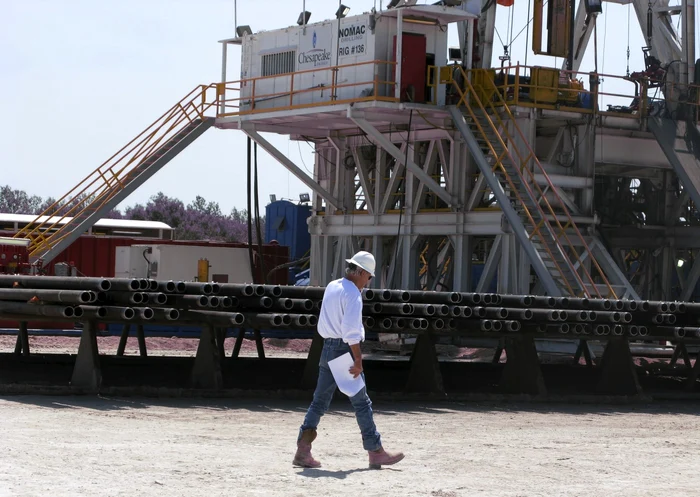
Hungary wants to extract gas through hydraulic fracturing PHOTO: Archive
The Ministry of the Environment from Bucharest has published on its website a notification received from the Ministry of Energy – Department for Environmental Protection in Hungary, for the expansion of investments in the project “Corvinus Nyékpuszta”, a controversial investment in Békés County.
Corvinus was conceived as a reaction to the energy crisis triggered by the war between Russia and Ukraine, intended to increase Hungary's domestic gas production through hydraulic fracturing, a controversial procedure because it is harmful to the environment.
The project was criticized by environmental organizations and because it bypassed public debates in Hungary, being declared by the Government in Budapest as one of national importance, which allowed citizens' consultation to be circumvented.
“In In Hungary, the Hungarian Association for the Protection of Nature has sued the authority overseeing the drilling, demanding details of the controversial project. The first wells were drilled in 2023, and now the company HHE Sarkad Kft (which is the beneficiary of the investment, taking it over from Magyar Horizont Energia Kft., the initiator of the Corvinus project) wants to expand the exploitation, which is why it also sent the notification published by the Ministry from Bucharest”. writes Bihoreanul.
Existing probes
Currently, in the Sarkad I perimeter, located near the Ciumeghiu-Salonta area of Bihor, there are six active production wells, and the drilling of the Nyékpuszta-24 well has been completed, and will go into production. Seven wells have been drilled so far, and the operator estimates that, depending on the exploration results, another 2-3 new wells will be drilled per year.
The Nyékpuszta Gas Plant was built within the mining perimeter, where the extracted gas is treated to adjust the dew point of hydrocarbons and water, after which it is delivered to the FGSZ Méhkerék receiving station through a 12-kilometer long pipeline.
The installed technological capacity of the station allows the treatment of 480,000 cubic meters of natural gas per day.
Hydraulic fracturing, by 2028
According to the documentation, fracking is carried out at depths of approximately 4,000 meters, and the micro-fractures created “do not affect the hydrodynamic status quo”.
“Authorities claim that there is a safety distance of 2-3 kilometers from used or potentially usable water bodies. The total water requirement for drilling a well, including up to three fracturing operations, is estimated at about 3,800 cubic meters. To date, a total of about 22,800 cubic meters of water has been used for the six wells made. The very high consumption of water is the main reason why hydraulic fracturing is contested by environmentalists.” claims the Bihorean,
For the drilling of 2-3 more wells annually, the requirement would be approximately 11,400 cubic meters of water per year, the Hungarian authorities stating that this amount is “less than the requirement of agricultural irrigation facilities” and equivalent to industrial consumption for 1–2 days.
Water will be provided from a specially drilled well, K-141, for which an annual volume of 13,000 cubic meters is authorized.
Hungarian company: There is no impact on Romania
The measurements so far “do not indicate the occurrence of earthquakes”. Activities are monitored before, during and after operations, including seismic, water and soil quality, noise, vibration and waste management.
The Hungarian authorities explicitly claim that the activities in the Sarkad I perimeter do not generate cross-border impacts, showing that the distance from the Romanian-Hungarian border is sufficient for the impact areas to remain within the mining perimeter.
“The activities carried out in the Sarkad I mining perimeter do not generate cross-border impacts. Considering the distance between the mining perimeter and the state border, the impact zone of the extraction carried out within the perimeter does not reach the Hungarian-Romanian border and therefore cannot generate cross-border effects“, it is stated in the environmental study on the investment.