“The mullahs must go.” Protests in Iran have spread and security forces are stepping up repression. Violent clashes in several cities and dozens of deaths


At least 34 protesters and four members of the security forces have been killed during the unrest and more than 2,000 protesters have been arrested, human rights activists quoted by the BBC and the New York Times say.
Violent clashes broke out between anti-government protesters and security forces in several cities across Iran, as a wave of unrest sparked by the country's economic crisis continued for an 11th straight day.
The protests have so far spread to 111 cities and towns in all 31 provinces, according to the US-based Human Rights Activists News Agency (HRANA).
It reported that at least 34 protesters and four members of the security forces were killed during the unrest and that 2,200 protesters were arrested.
BBC Persian confirmed the deaths and identities of 21 people, while Iranian authorities reported the deaths of five members of the security forces.
A protest by traders which immediately grew
The protests began on December 28, when traders of the Grand Bazaar took to the streets in the capital Tehran to express their displeasure at another sharp drop in the value of Iran's currency, the rial, against the US dollar on the open market.
The rial has hit an all-time low over the past year and inflation has soared to 40 percent amid sanctions on Iran's nuclear program that are affecting an economy already weakened by government mismanagement and corruption.
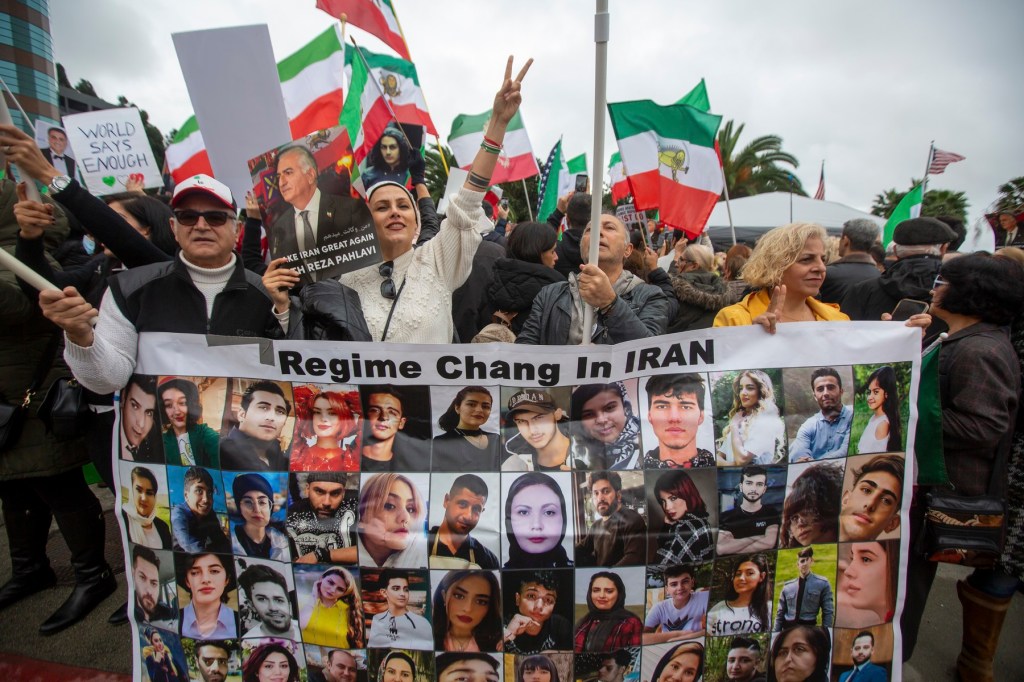 Under the pressure of street protests and Trump's threats, the Islamic regime in Iran is at its most vulnerable moment in decades / What's next
Students quickly joined the protests, which began to spread to other cities, with crowds frequently chanting slogans against the country's supreme leader, Ayatollah Ali Khamenei, and sometimes in support of Reza Pahlavi, the exiled son of Iran's former shah.
Footage filmed on Wednesday showed crowds protesting in Qazvin, northwest of Tehran, chanting slogans such as “Death to the dictator” – a reference to Khamenei – and “Long live the Shah”.
“The mullahs must go”
Footage from the Persian Gulf port of Bandar Abbas showed images of police forces dispersing protesters.
In the Shiite holy city of Mashhad in the northwest of the country, protesters were seen clashing with security forces and forcing them to retreat. Another clip showed people chanting in support of the Pahlavi dynasty, which was toppled by the 1979 Islamic revolution.
Late on Wednesday afternoon, a demonstration also took place in the southwestern city of Abadan, near the border with Iraq, according to footage verified by BBC Persian, with protesters chanting “Cannons, tanks, firecrackers! The mullahs must go,” a reference to Iran's clerical leadership.
Other footage shot from a balcony in the city appeared to show security forces opening fire as they fled the advancing protesters, throwing stones and other objects.
At nightfall, security forces were filmed firing tear gas to disperse a demonstration in Aligudarz, another western city, after a crowd had gathered in a square chanting “People's Revolt, Viva!”.
In Lordegan, the official Fars news agency reported that two policemen were killed during a demonstration on Wednesday.
The agency added that the police were fatally shot by “gunmen” who were in a group it called “revolutionaries”.
Money and arrests
Following a cabinet meeting on Wednesday, Vice President for Executive Affairs Mohammad Jafar Qaempanah said President Masoud Pezeshkian had ordered that “no security measures of any kind” be taken against the peaceful protesters.
State media also reported that the government has started paying a new monthly allowance equivalent to $7 to ease the effects of the high cost of living.
Meanwhile, the head of the judiciary, Gholamhossein Mohseni Ejei, told police commanders that “participants in the riots” would be prosecuted and punished “swiftly” to serve as a deterrent.
Khamenei – who, as supreme leader, holds ultimate power in Iran – said on Saturday that authorities should “talk to the protesters” but that “revolutionaries should be put in their place”.
His comments came after President Donald Trump threatened that the US would intervene if Iranian security forces killed peaceful protesters, saying: “We are prepared and ready to act.”
Caution, after Trump's warnings
Dr Sanam Vakil, director of the Middle East program at London-based think tank Chatham House, told the BBC that the protests had quickly become political and were fueled by deep anger among the population.
“People are fed up. They have no future prospects. Daily life is becoming more and more difficult,” she said.
“If the movement intensifies and if more people take to the streets, (the protests) will become more serious and of course the government's response will become more violent.”
Sadegh Zibakalam, a professor of political science at Tehran University, said Iranian authorities could resist a tougher crackdown because of Trump's threats.
“Some Iranian leaders – the commanders of the Revolutionary Guards and the security forces – are perhaps a little more cautious and are not rushing to crack down on the crowd this time, for fear that this could provoke an American intervention,” he told the BBC.
The current protests are the largest since the 2022 uprising, sparked by the death in custody of Mahsa Amini, a young Kurdish woman who was detained by morality police for not wearing the hijab properly.
According to human rights organizations, more than 550 people have been killed and 20,000 detained following the violent crackdown on protests by security forces.