Polish banks have been occupying an important place on the map of global innovations in the financial sector for years. They are distinguished primarily by the pace of digitization of services, the quality of mobile banking and the ability to implement technology on a mass scale.
Experience, built on successes in the individual customer segment, is increasingly moving to strategic areas in 2026: cybersecurity, artificial intelligence, cloud architecture and digital service for companies. From the perspective of the global market, the directions are similar, but Poland has its unique advantages: a quick pace of adaptation, a pragmatic approach to technology and the courage to implement new customer service models. Here are the four most important technological trends in finance and banking:
1. Cybersecurity: the king of all trends
Banks are facing an increasing number of attacks, the techniques of which are becoming more and more sophisticated. In Poland, this is particularly visible due to the geopolitical situation and the war in Ukraine. According to the “Check Point Security Report 2025”, as many as 1,850 attacks per week are directed exclusively at financial institutions in our country. This means there is a need for a radical change in the approach to cybersecurity. In 2026, it will not be just one of the priorities, but will become the absolute foundation on the basis of which banks will implement financial services.
Before our eyes, security is becoming the “king” of technological trends, including both customer protection (phishing, spoofing, transaction fraud) and operational resilience of the entire infrastructure.
An additional challenge is the growing use of generative AI – banks must secure models, data, integrations with external tools and monitor potential errors and abuses. This enforces a “security by design” approach and consistent risk management across the entire service ecosystem, which is reinforced by DORA and NIS2 regulations. In practice, this means more resilience tests, greater emphasis on 24/7 monitoring and advanced anomaly detection and incident response mechanisms. XDR (Extended Detection and Response) tools will gain in importance, as they aggregate threat data from multiple sources (end devices, network, cloud services) and allow for better correlation of events in order to detect an attack.
2. AI and agents: from pilots to scale
Polish banks (like global banks) have undergone a phase of intensive testing and experimentation with generative AI. Today they focus on implementations that bring real value. In 2026, solutions based on AI agents will gain particular importance. This is not only about “simple” answers to customer questions, but above all about the implementation of multi-stage activities, process automation, risk analysis support and improved onboarding.
Proper implementation of AI agents will allow you to more effectively perform tasks that previously required individual employee decisions or the creation of a complicated process that was often expensive and ineffective. Global financial institutions declare the implementation of AI agents in customer service, fraud detection and credit processes. Poland is following the same path, building competences and a supervisory framework. At the same time, banks strive to act in the spirit of “regulation by design”, ensuring transparency of algorithms, auditability and control over the operation of AI models, which is no longer an addition but becomes an element of the architecture.
3. Edge will complement multi-cloud: an architecture that gives you an advantage
Cloud computing in Poland has come a long way from cautious implementations to the “cloud-first” strategy. According to the Standard PolishCloud 3.0 recommendation developed by the Polish Bank Association, the vast majority of Polish banks have already adopted cloud computing technology.
Nowadays, it has become standard to use multiple clouds for various tasks. Market leaders treat a multi-cloud strategy as a way to achieve flexibility, resilience and avoid dependence on a single supplier, as well as a platform for complex analytical systems and AI models. At the same time, edge computing appears (or rather returns) on the horizon, complementing the cloud model where quick response and business continuity are important. Data processing at the edge of the network means that calculations can be performed locally and decisions are made faster. In the Polish banking sector, processing on end devices is not yet carried out on a mass scale, but the trend is clear.
The “cloud + edge” architecture allows you to meet the requirement to provide services 24/7. The exponential pace of genAI development will soon give us the opportunity to use artificial intelligence models even on the customer's device, e.g. in a banking mobile application. Thanks to this, in addition to increasing efficiency, the level of AI security in banking will also increase, as data will not be sent to a central model but will remain within a given device.
4. Digital corporate banking is catching up with retail
In 2026, digital customer service for corporate and SME customers will accelerate. According to the report “Tech-Driven, Client-Centric: New Priorities in SME & Corporate Banking Transformation”, 57% of banks have developed a strategy for implementing omnichannel customer service or are in the process of developing it. Banks are developing modern portals and applications, automating onboarding and KYC (Know Your Customer) processes, and consistently eliminating the circulation of paper documents by introducing their digital versions with electronic signatures.
The service philosophy is also changing, companies expect similar simplicity as individual customers, but with much greater complexity of functions, such as: multi-person authorization, integration with the ERP system or international operations. The Asseco expert argues that digital corporate banking in Poland will, over time, begin to catch up with retail banking, and customer experience (CX) will be one of the key fields of competition. This, in turn, determines the direction of banks' development. According to a report by the SME Banking Club think tank, for 86% of them, investments in process automation in the area of SME services are a priority for the coming years.
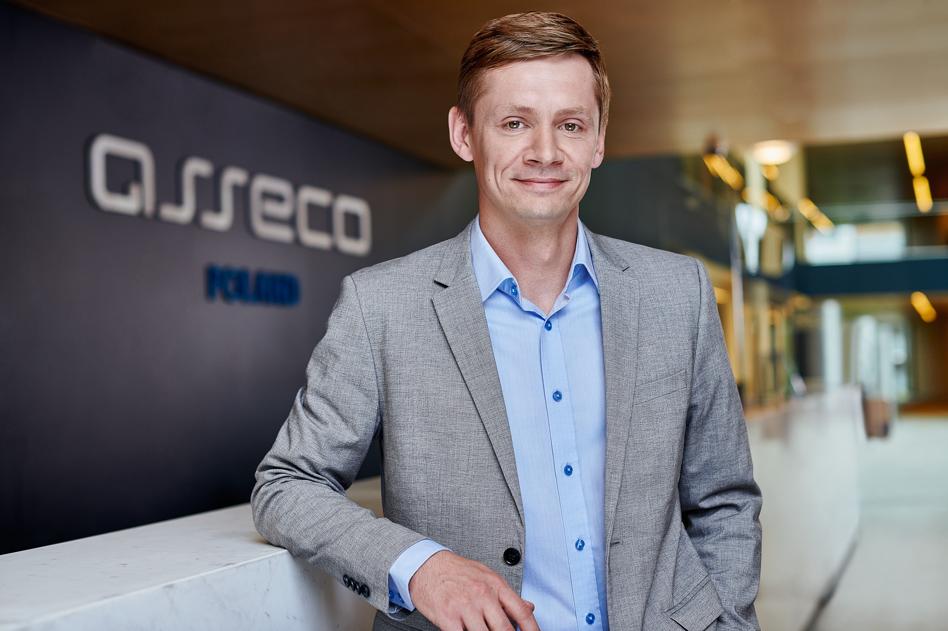
Wojciech Nowak, director in the Commercial Banks Division, Asseco Poland