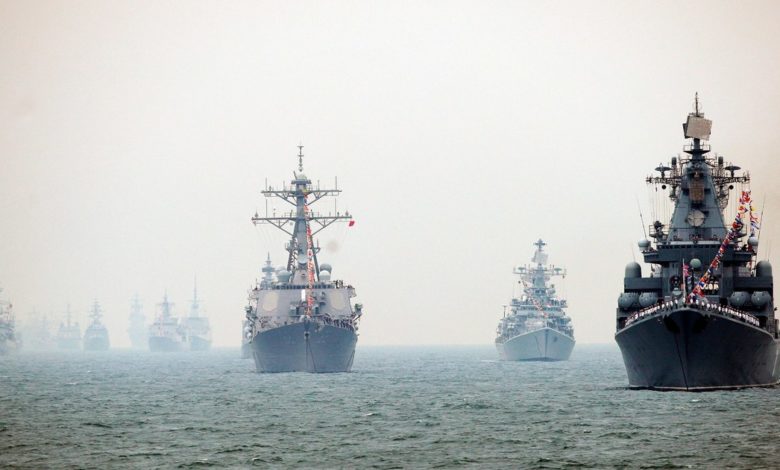
A possible invasion would most likely start on the so-called “red beaches” – considered today among the most dangerous places on the globe, writes The Telegraph.
On a gloomy day in northern Taiwan, a few fishermen are chatting on Linkou Beach, discussing the day's catch. The area is about a 30-minute drive from Taipei, and on warmer days the beach is frequented by families looking for a break from the hustle and bustle of the city.
At first glance, Linkou does not seem different from other stretches of coast. In reality, it is considered one of Taiwan's most vulnerable areas in the event of a military conflict with China.
The “Red Beaches” of Taiwan
Linkou is one of about 20 “red beaches” – stretches of coast identified by military experts as possible landing points for Chinese troops in an invasion scenario.
The beach is part of New Taipei City, the municipality surrounding the capital, and is considered the most strategic of all. It is near Taiwan's largest airport, next to Taipei Harbor – a deep sea hub – and at the mouth of the Tamsui River, which runs through the capital before emptying into the Taiwan Strait.
Dr. Su Tzu-yun, director of research at Taiwan's National Defense and Security Institute, says occupying this area would have a major impact.
“Capturing this point would cut off Taipei's main external links, isolate the capital, disrupt food supplies, and undermine morale. It would basically be a blitzkrieg campaign.” he says.
Beijing's shows of force
The risks are not just theoretical. China recently launched its largest-ever military drills around Taiwan, simulating the blockade of its main ports and launching missiles near the island. Beijing described the actions as a “stern warning” to Taiwanese separatist forces and “external interference”.
Experts estimate that in the event of a successful landing at Linkou – a scenario considered extremely difficult – Chinese forces could reach Taiwan's command centers in less than an hour.
An invasion of unprecedented proportions
Such an attack would require hundreds of thousands of well-trained soldiers and a huge fleet, made up of both modern warships and civilian vessels adapted for military use. Preparing such an operation would take months or even years, but Beijing appears to be already building this capability.
China has one of the largest shipbuilding industries in the world. Although its military budget is much smaller than that of the United States, its shipbuilding capacity is estimated to be at least 200 times greater.
China's navy currently has about 405 warships, compared to the US's 295, and the number is growing. A recent report by the Stockholm International Peace Research Institute shows that while many Chinese defense companies have lost revenue, the shipbuilding sector continues to expand.
From land army to sea power
China's military modernization has long been focused on land forces. In recent decades, however, the focus has shifted decisively to the sea amid disputes in the South China Sea and ambitions over Taiwan.
President Xi Jinping has made the “reunification” of Taiwan a central goal of his tenure. The subject is constantly brought up in official speeches from Beijing and has gained increased visibility following recent statements by Japan and US arms shipments to Taipei.
A civilian fleet with a military role
Even so, existing warships would not be sufficient for an invasion, experts say. China thus turned to the use of civilian dual-purpose ships adapted for military transport.
Since 2015, civilian shipbuilders are required to design vessels that can be quickly converted for military use. These include container ships, freighters and roll-on/roll-off ferries capable of carrying heavy vehicles and military equipment.
Production of these ships has increased significantly, and some are already being tested in exercises that appear to simulate an operation in Taiwan.
Other pressure scenarios
However, a direct invasion would not necessarily be the first step. Alexander Huang, a Taiwanese expert in strategic simulations, says Beijing could initially opt for cyber attacks and sabotage of critical infrastructure or a “maritime quarantine”.
Such a strategy would aim to block energy and food imports, on which Taiwan is almost entirely dependent. Experts estimate that the island's current reserves could sustain the economy for only a few weeks.
China has already tested such tactics with massive deployments of ships and aircraft around Taiwan, in a strategy known as the “gray zone,” designed to exert pressure without igniting open war.
The challenges of a landing
The Taiwan Strait is difficult to cross due to weather conditions, strong currents and typhoon season. In addition, most large ships cannot reach the shore directly.
To overcome these obstacles, China built special barges, capable of creating temporary ports offshore, from where troops and equipment could be transferred to the coast.
Even so, some experts remain skeptical of the feasibility of a large-scale landing, citing geographic changes to Taiwan's coastlines and the island's military's defensive preparations.
A fleet of historic size
In parallel, China continues to expand its fleet of advanced warships. Recently, it launched the Fujian aircraft carrier, equipped with an electromagnetic aircraft launch system, comparable to that of the most modern American aircraft carriers.
A fourth aircraft carrier, possibly nuclear-powered, is already under construction, which would allow China to keep the ships at sea for long periods.
In an eventual conflict, these warships would join the adapted merchant fleet, creating an unprecedented concentration of forces.
“Many underestimate the scale of such an operation”warns Tom Shugart, analyst at the Center for a New American Security. “It would not be dozens of ships in the strait, but thousands.”