Onet's election forecast. Tusk's bitter victory and Grzegorz Braun's record


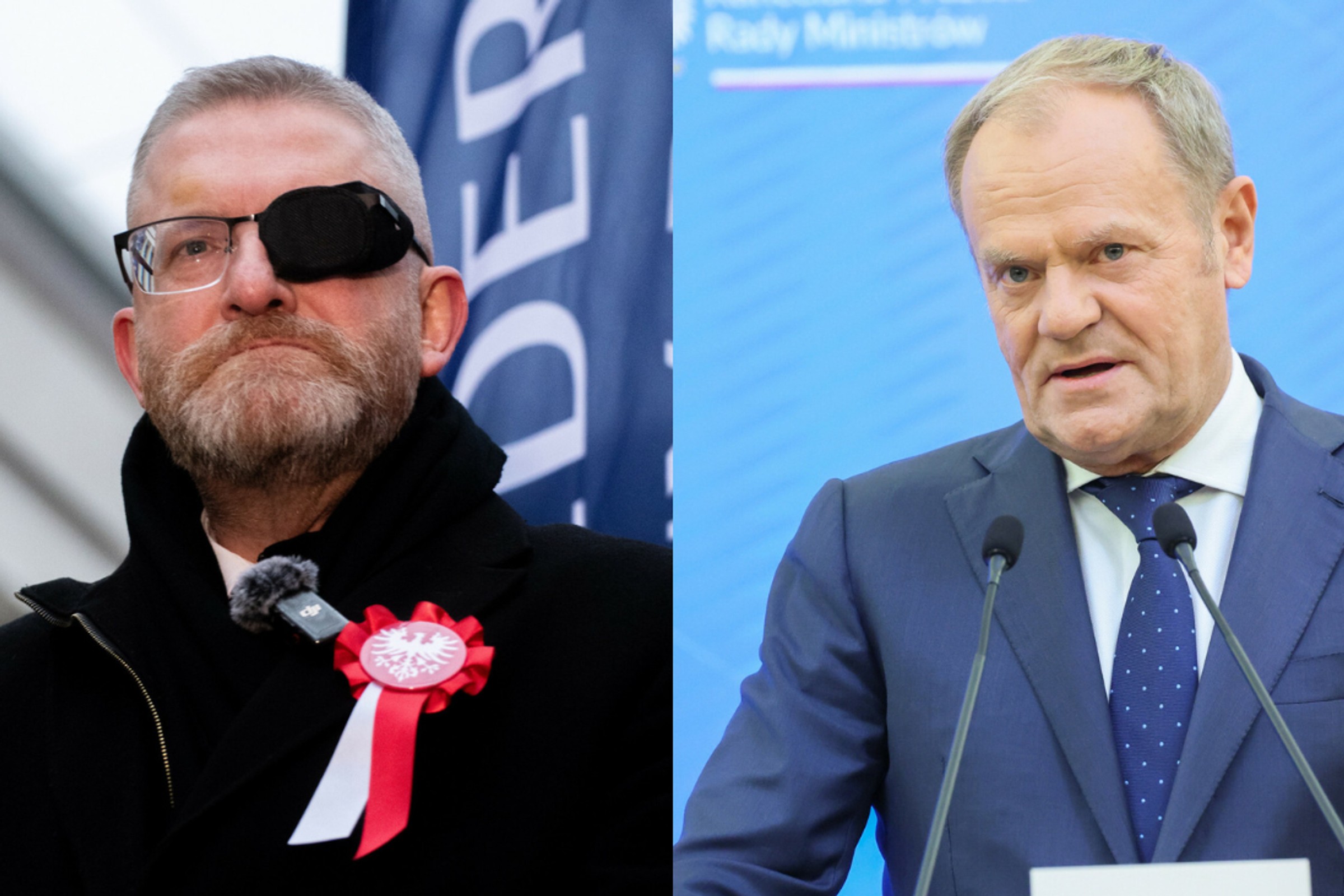
Below we present both our latest forecast of current support for the parties, as well as a calculation of the division of seats. We also check what the competition looks like on the electoral map and what chances the ruling coalition has to maintain a majority in the Sejm.
Tusk's bitter victory
According to Onet's latest parliamentary forecast, the Civic Coalition would win the Sejm elections today with support 34.5 percent voters. This formation would increase its support by 3.8 percentage points. compared to the previous elections. However, this is where the good news for Donald Tusk ends. The next three positions would be taken by right-wing opposition parties, which would effectively block the chances of extending the rule of the “October 15 Coalition” for another four years.
Law and Justice would be in second place with the result 28.3 percent This would be a clear drop in support for Jarosław Kaczyński's formation, which received as much as 7.1 percentage points in the 2023 elections. more. The move to the opposition did not bring any solution to stopping or even reversing the downward trend that the party has been facing continuously for five years. PiS, naively believing that there was no competition on the right, gave it room to grow.
Thus, the Confederation closes the podium today. The formation of Sławomir Mentzen and Krzysztof Bosak can count on support 13.3 percent voters, which is an increase of 6.1 percentage points compared to 2023. As we recently calculated, this increase is responsible not only for former PiS voters, but also for some of those who previously voted for the Third Way..
However, the pool of potential voters is quickly depleting and, along with the growing competition on the right, means that today's model result is lower than the one obtained by Mentzen in the first round of the presidential elections. So far, the 14.8 percent obtained then. has become a ceiling that is difficult to overcome.
The article continues below the video
Fighting in the peloton
In fourth place would be the far-right Confederation of the Crown of Poland, which might have seemed shocking at the beginning of the year. Grzegorz Braun's formation would get the result 8.2 percent In the previous elections, this party ran together with Konfederacja and they obtained 7.16 percent. Today, the combined support for both of these formations would be as much as 21.5 percent. — three times more than two years ago.
The last party that would pass the electoral test is the Left. The formation of the newly elected Speaker of the Sejm, Włodzimierz Czarzasty, would obtain 6.1 percent This support has been stagnant for months, teetering above the electoral threshold and putting the party in a dangerous situation at the threshold of the next campaign.
The worst data for the ruling coalition is below 5%. the threshold of where she could be today Razem Party (3.9%), PSL (2.5%) and Polska 2050 (2.3%). It is worth paying attention to the significant decline in support for the formations that previously formed the Third Way. Just two years ago, their coalition won 14.4 percent. votes, and today they would not exceed the electoral threshold, even if they ran together from the list of one party, to avoid the eight percent threshold for traditional coalitions.
Difficult parliamentary arithmetic
How would these results translate into seats in parliament? KO would introduce 191 deputies to the Sejm, PiS 160, Konfederacja 63, KKP 33, and the Left only 13 deputies.
Such a division of seats would make creating a new parliamentary majority a very difficult task. Even if it could be agreed, it would be very unstable. The current government coalition could count on only 204 seats, which means it would be 27 MPs short of a majority.. A potential coalition of PiS and Confederation would also not have a majority a third partner would be necessary – the Confederation of the Polish Crown. It remains an open question whether PiS is ready for such cooperation. Not to mention how much political fuel it would give the other side.
Another theoretically possible, although exotic, coalition would be the alliance of KO and Confederation. However, voters of both parties have great dislike for each other, and such a scenario can only be considered at the level of political fantasy.
The continuing high risk of wasting some of the votes of the ruling coalition's voters will certainly raise the concept of a joint list in the future. If we were to sum up today's support for the party in competition with the unchanged opposition, it would give approx. 239 seats. However, the very likely bonus for the Razem party in such a scenario could quickly ruin its chances for a majority.
The coalition's chances are slim
All this means that if parliamentary elections were held today, the coalition's chances of maintaining the majority on October 15 would be only 15%. This means an increase of only 2 percentage points. compared to our previous forecast in October. Even though the total support for the center-left camp and the Razem Party does not differ significantly from the total support for right-wing parties, on the other side a lot of votes are wasted below the electoral threshold.
Reshuffles on the electoral map
The current situation of Donald Tusk's party is almost a mirror reflection of the situation of PiS in 2023, also on the map. The Civic Coalition would win the vote today in 11 out of 16 voivodeships. Law and Justice would only win in five eastern bastions.
The five voivodeships that KO would win from PiS are the Kujawsko-Pomorskie, Warmian-Masurian, Silesian, Masovian and Łódź voivodeships. Of course, this only has a purely symbolic meaning, because the first place at the finish line does not guarantee anything. In the previous elections, PiS won the vote in 10 voivodeships, but was still unable to retain power.
When we go down to the level of constituencies, we will also see significant changes compared to the previous elections. KO would win the vote in 26 districts and PiS in 15 districts. Two years ago, PiS won in 22, i.e. most of the districts, and KO triumphed in the remaining 19.
The illusion of stability
The key perspective in a polarized political environment remains the combined support for both camps. In this way, we can see how the ruling coalition found itself in such a difficult position. After the triumph of the right in the presidential elections and the victory of Karol Nawrocki, the biggest crisis of support so far occurred, lasting until November. Then, for the first time in years, the total support for right-wing parties exceeded the total survey support for center and left-wing parties.
Today we managed to make up for part of the earlier loss and in mid-December we were able to take the lead again in this competition. Our year-end model shows that both camps are now virtually neck and neck. However, this is only an illusion of stabilization, because taking into account the above forecasts of the distribution of seats, there is still a long way to achieve real political balance.