Romania ends 2025 with mixed signals. The direction of 2026 depends on the answer to five essential questions. The economy entered the new year in a state of fragile equilibrium. There are no signs of an imminent crisis, but neither are the premises for a solid recovery. Rather, this year is shaping up to be a test: of fiscal maturity, of the state's ability to make real reforms and of the patience of the private sector.
This text is an excerpt from the “EconoMix” newsletter, which journalist Dan Popa sends every Thursday morning. You can subscribe here:
The common message from banks, analysts and business is clear: the adjustment could not be delayed any longer. The question is not whether it will be painful (because it will be), but who will bear the main cost.
2025: A rapid but unbalanced correction
The year 2025 brought a fiscal correction achieved, for the most part, through the easiest solutions to implement politically: tax increases, rule changes on the fly, and additional pressure on the private sector. The reform of public spending was again postponed.
The budget deficit remained extremely high – over 9% of GDP in 2024 and with a target of around 8.4% in 2025. The adjustment was made mainly through VAT increases, excise duties and revenue freezes in the public sector, not through restructuring the state apparatus.
The result: the state gained time, but transferred a large part of the cost of adjustment to firms and the population.
2026: Modest growth, economy “with the brakes on”
The predictions for 2026 converge towards the same scenario:
- economic growth between 1% and 1.5%, according to the European Commission, IMF and ING;
- budget deficit around 6–6.5% of GDP, still far above European thresholds;
- the engine of growth: investments, especially those financed from European funds;
- weak private consumption in the first part of the year, with a slow recovery towards the end
Romania avoids recession, but remains far from its real growth potential, estimated at around 3%.
Interest rates: lower, but not lower
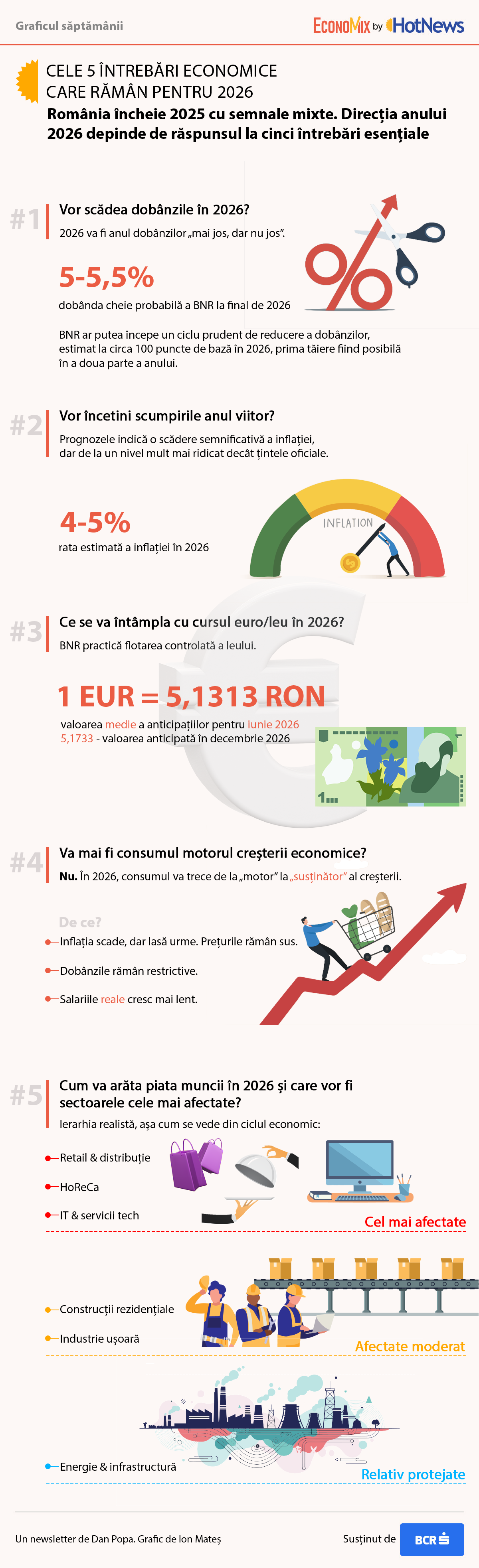
In 2026, the NBR could begin a cautious cycle of interest rate cuts, estimated at around 100 basis points, with the first possible cut in the second part of the year. Relaxation will be slow and the central bank will go more slowly than the ECB
IRCC will decreasebut belatedly, and rates will gradually relax, not crash. 2026 will most likely be the year of “lower than 2025” interest rates, but far from the comfort of previous years.
Inflation: Declining but still persistent
Forecasts indicate a tempering inflation in 2026, towards 4–5%, but from a still high level. The CFA Romania survey is more pessimistic, with an anticipated rate of over 6% at the end of the year
Even in the optimistic scenario, inflation remains above the NBR target and above the EU average, which means that the pressure on household budgets does not disappear.
Exchange rate: controlled stability, slight depreciation
The NBR will continue the policy of controlled floating. CFA Romania economists anticipate a slow depreciation of the leu, with an estimated average exchange rate of approximately 5.13 lei/euro in mid-2026 and 5.17 lei/euro at the end of the year
No sudden moves are expected, but the trend remains one of gradual adjustment.
Consumption: from engine to simple supporter
In 2026, consumption loses its central role. Inflation has left its mark, interest rates remain tight and real wage growth is slowing. Without optimism and without cheap credit, consumption stabilizes, not accelerates.
The economy will rely more on investment and less on debt spending.
The labor market: pressure and selection, not collapse
The most affected sectors will be those directly dependent on consumption and with small margins:
- Retail and distribution – pressure on margins, automation, fewer employees;
- hospitality – vulnerable to the decrease in discretionary income;
- IT and tech services – the end of the “golden age”, with tougher selection and slower salary increases
- Residential construction and light industry will be moderately affected, while energy and infrastructure remain relatively protected, supported by large projects and European funds.
Conclusion
2026 will not be a spectacular year, but not a crisis year either. It will, however, be a year of real adjustments, in which Romania's economy will operate with the brakes on. After years of consumer-fueled growth, the focus is shifting to discipline, investment and resilience.