In late August, a group of Indonesian sailors hurriedly crossed the Singapore Strait to board an LNG ship that had been anchored offshore for months. Some of them had been unemployed for over a year. No one told them that they would be participating in an operation to bypass sanctions.
The ship is called CCH Gas and is not on any blacklist. But according to Bloomberg, it is a key part of a transportation network designed specifically to transport sanctioned Russian gas without attracting the attention of Western authorities.
Following the 2022 invasion of Ukraine, Kyiv's allies imposed sanctions on several Russian LNG export facilities and related vessels. Moscow began to look for alternative solutions, and Beijing turned out to be a partner willing to help.
The model is not new. Russia has already used it in the case of oil exports. Now he also uses it for gas. According to the investigation, the ships are old, purchased at prices slightly above scrap value, change ownership frequently and are registered to companies with unclear postal addresses. Some of them modify their location systems to be able to spoof their position at sea.
In the case of the CCH Gas vessel, several sources cited by Bloomberg claim that the AIS tracking system was changed in mid-September. The new equipment made it possible to spoof coordinates. At least one crew member asked to leave the ship, fearing it would be used in the shadow fleet.
Illegal gas transfer off the coast of Malaysia
Satellite images and social media posts show CCH Gas seizing gas from the Perle, a sanctioned tanker loaded with LNG from the Portovaya facility in the Baltic region of Russia, also subject to US sanctions.
The transfer took place off the coast of Malaysia, in an area that Windward analyst Michelle Wiese Bockmann describes as “the epicenter of illicit maritime activity.” After the operation, CCH Gas began to appear on radar near Malaysia, while satellite imagery showed it was actually near Hong Kong.
Beihai: the entry gate of Russian gas to China
The cargo was destined for the Beihai terminal in southern China, according to Bloomberg analytics. Authorities in Beijing apparently decided that Beihai would be the only entry point for sanctioned Russian LNG precisely to protect other Chinese importers from possible secondary sanctions.
From August to the end of the year, Beihai received over 20 shipments of sanctioned LNG, the value of which was estimated by traders at at least USD 500 million. [1 mld 797 mln zł].
The terminal operator, state-owned PipeChina, removed the project from its website and suspended tenders for import slots. The company did not respond to Bloomberg's questions.
A small but effective fleet
Bloomberg has identified 15 LNG ships that are part of this Russian-Chinese shadow fleet. The number is small compared to the fleet of more than 1,000 ships used by Russia to transport oil, but enough to ease financial pressure on the Kremlin.
“It's already quite a large fleet. If they continue, we expect many ships to be taken out of normal use,” Oystein Kalleklev, a former Flex LNG executive, told Bloomberg.
Arctic LNG 2: high stakes for the Kremlin
For Russia, these transports are of key importance. They allow Arctic LNG 2, the largest liquefied gas project in the country and one of Vladimir Putin's favorite projects, to be kept in operation.
The installation was sanctioned by the United States in 2023 and had to curtail production for many months due to lack of storage space. Arctic LNG 2 is expected to produce approximately 20 million tons per year. Russia's plan to reach 100 million tons per year by the end of the decade has already been postponed.
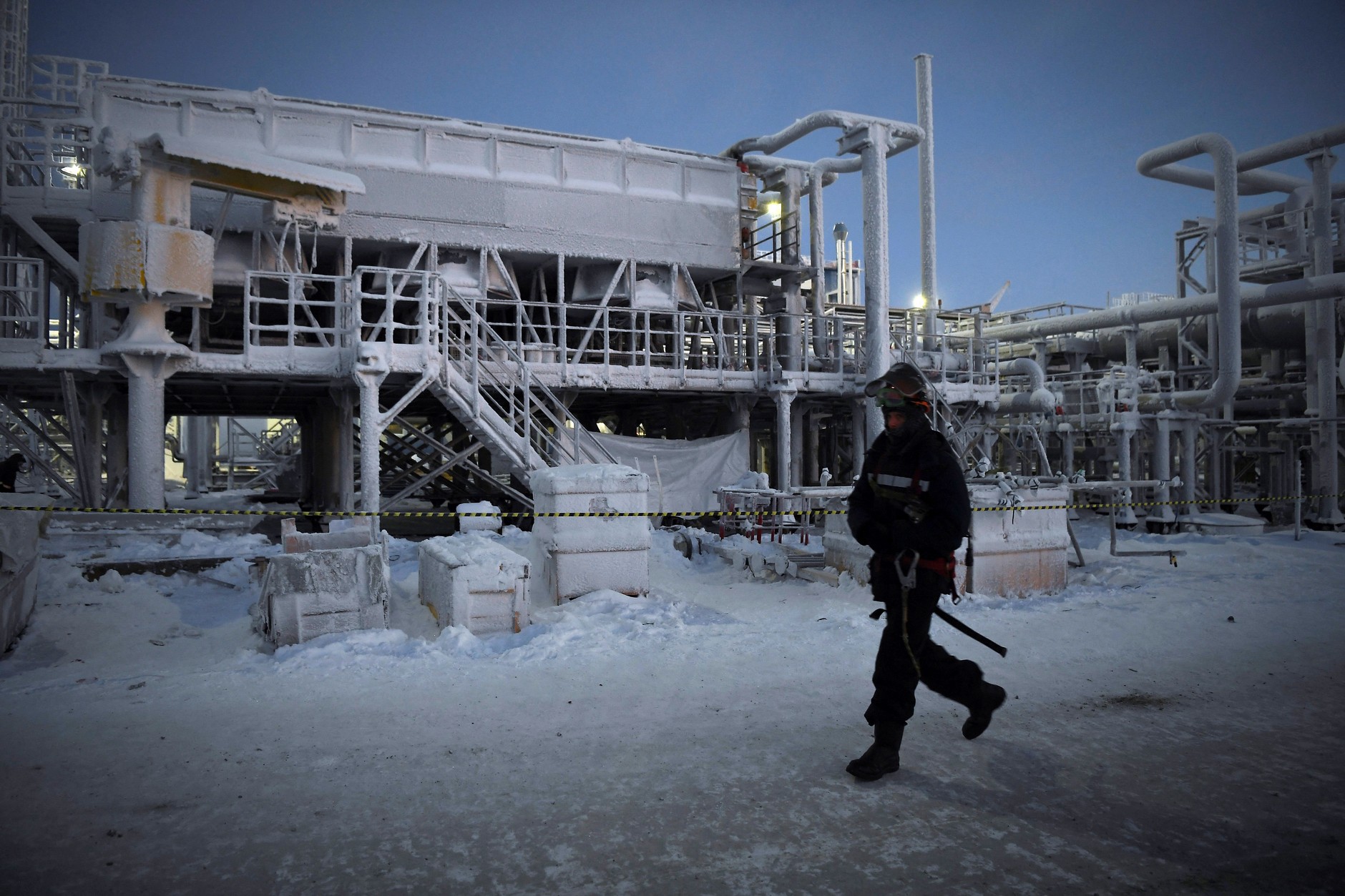
The Utrennee Field, a resource source for Novatek's Arctic LNG 2 project, located on the Kara Sea above the Arctic Circle, about 2,500 km from Moscow, November 30, 2021.NATALIA KOLESNIKOVA / AFP / AFP
Inexperienced crews and serious risks
The existence of such a shadow fleet also carries risks. LNG ships are extremely technically advanced, and some information on social media indicates that not all crew members have the necessary qualifications to operate them.
In addition, if a ship is removed from the flag register, the crew remains practically without legal protection. “The Shadow Fleet is a safety, environmental and crew well-being risk,” warns Michelle Wiese Bockmann.
The U.S. Department of State said the sanctions remain in force: “Entities doing business with sanctioned entities, such as Arctic LNG 2, face significant risk of sanctions,” it said.
For now, however, Russian gas still goes to China, and the shadow fleet remains one of the Kremlin's most effective economic weapons.