Should Romania follow Bulgaria's example of joining the Euro? Tax consultant: Loans would be cheaper


While Bulgaria is preparing to officially abandon the Leva in favor of the Euro in a few days, Romania is still far from this goal, which the political class seems to have postponed indefinitely. And, the experts point out that the postponement of the transition to the single European currency deeply affects the national economy, but also the common people who are obliged to pay the most expensive credits in the European Union.
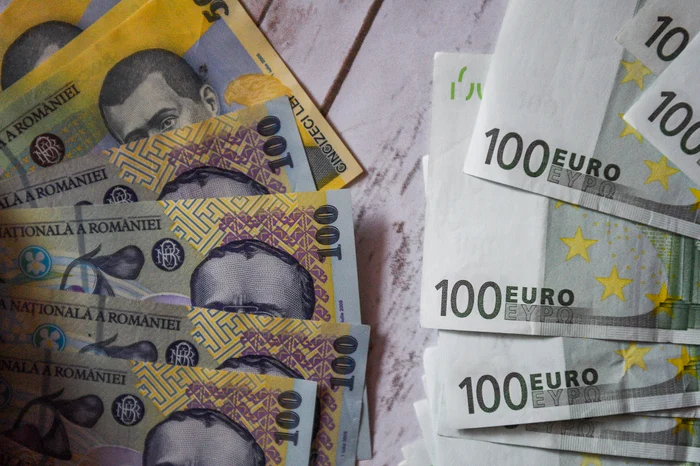
Lei and Euro, January 28, 2018. PHOTO: Inquam Photos / Alberto Groşescu
Romania is formally obliged by the Treaty of Accession to the European Union to adopt the euro currency, but it currently does not have an assumed and credible calendar for entering the euro zone. Although the authorities have advanced several targets over time (2019, 2024 or 2029), none of them have been supported by the fulfillment of the necessary conditions.
At the moment, our country is not a member of the ERM II mechanism, the mandatory stage preceding the adoption of the euro, which requires maintaining the exchange rate in a stable range for at least 2 years. Entry into ERM II cannot take place without meeting the Maastricht convergence criteria, especially those related to price stability, budgetary discipline and the level of public debt.
Gabriel Biriș: “We killed our competitiveness”
Fiscal consultant Gabriel Biriș is of the opinion that the only ones who lose by switching to the Euro are the politicians, who would no longer be able to mask the holes in the budget through monetary juggling. For the rest of the economy, the benefits would be immediate, especially since the leu has appreciated “artificially” in recent years, destroying the ability of companies to export.
“Honestly, I don't really see any disadvantages. The disadvantages are for politicians, that they can no longer play with this exchange rate difference. With monetary policies, they can no longer compensate for the inefficiency of budget policies. For the economy, I think it would be a very good thing, because, at the moment, Romania is rapidly losing competitiveness due to the appreciation of the leu”Biriș explains for “Adevărul”.
The mechanism is subtle, but devastating: in a country where everything, from apartments to telecom bills, is related to the Euro, maintaining the exchange rate combined with 10% inflation means a massive increase in the price of Romanian products compared to foreign ones.
“Practically, only in 2022 and 2023 the leu appreciated by 8% against the euro. This means a loss of competitiveness. We make domestic production more expensive and imports cheaper. I think that if we do the calculation for the last five years, we pass a 25% loss of competitiveness. This is the reason why consumer goods are brought from Poland and Hungary. I think they need our straitjacket, right?”concludes the tax expert.
Adrian Negrescu: “Joining the euro zone means cheaper loans”
If for companies the Euro means survival, for the population it means, first of all, more money in the pocket through lower interest rates. Economic analyst Adrian Negrescu points out that Romanians are paying a huge “distrust tax” today.
“For the majority of the population, joining the euro zone means cheaper credits, loans at interest rates at least half of those practiced at the moment in the market. Companies in Romania borrow at the highest interest rates in the European Union. The chances to develop, to create manufacturing lines, are much lower than those of the competition”says Negrescu.
Beyond bank rates, the switch to the Euro would bring a discipline that the political class in Bucharest has not been able to impose on itself.
“It is almost impossible to generate inflation by classical methods, as currently practiced by the NBR, by issuing currency, things that will no longer be able to happen from one day to the next, but according to a calendar established by the European Central Bank. It means financial stability and more confidence for foreign investors”adds the analyst.
The big problem of Romania remains the lack of horizon. An investor who wants to open a factory needs to know how much labor will cost in 5 years. Currently, this calculation is impossible.
“Serious long-term investors want stability. It doesn't suit them either to have a factory in a country where wages rise in lei and prices remain stable in euros, that they compete in foreign markets with manufacturers who are in markets that have euros. Stability and predictability is the 'name of the game'.”, says Gabriel Biriș.