The delicious holiday recipes of ancient Rome. They have been preserved for thousands of years and inherited in the Romanian tradition

The oldest holiday recipes have been known for over two millennia and have inspired traditional Romanian cuisine. In Antiquity, these dishes also had a ritual role, being offered to the gods as offerings before being consumed at festive meals.
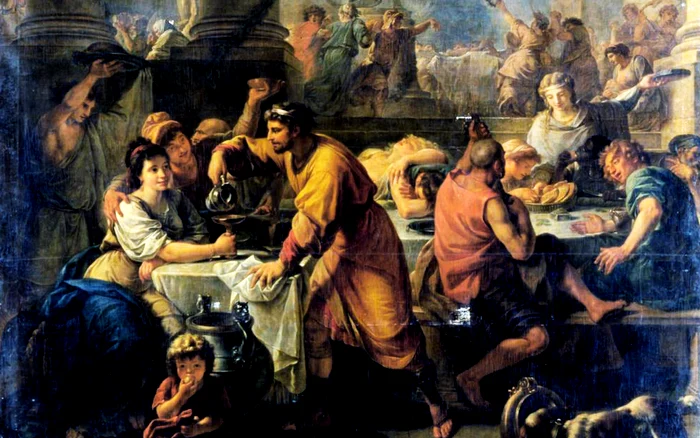
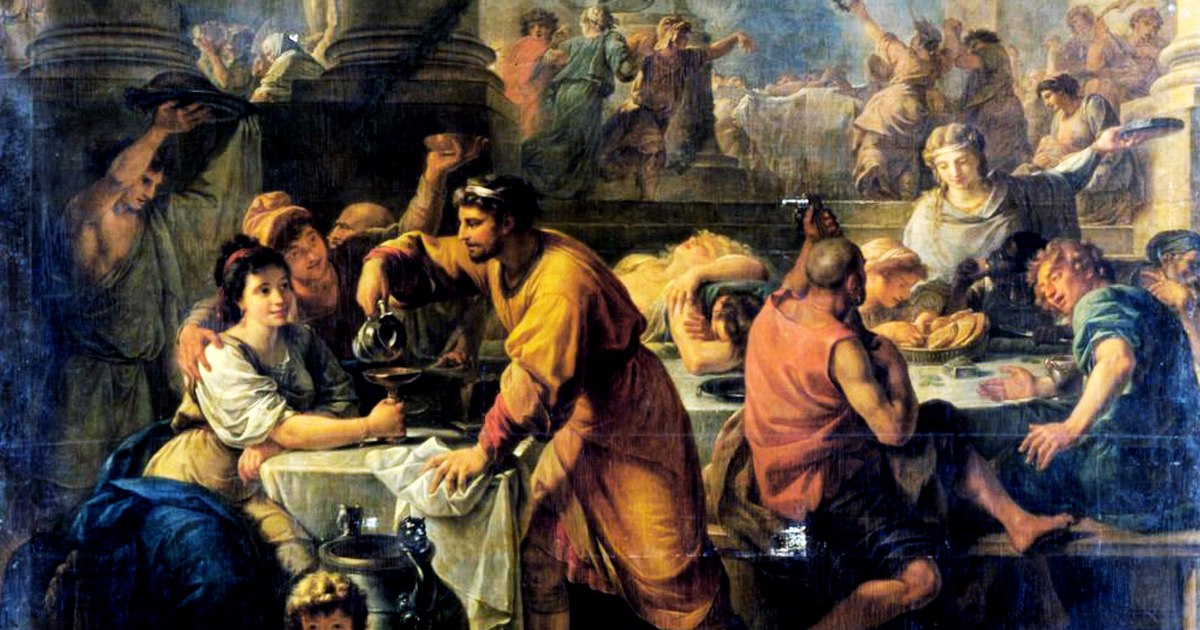
Saturnalia. Painting from 1783, by Antoine François Callet. Source: Wikipedia
Sweets are almost indispensable on holiday tables, and Christmas brings abundance and diversity in the preparation of these dishes. Traditional recipes for scones, cakes and pies have their origins in Antiquity and have been adapted over time to new eras and holidays.
Saturnalia inspired modern celebrations
In the Roman world, which took deep roots on the current territory of Romania, long before the celebration of the Nativity, the most important festive days of December were dedicated to the god Saturn, the protector of agriculture and time. The cult of Saturn developed in the 2nd–3rd centuries and in Roman Dacia, as shown by numerous archaeological evidences discovered in the old urban settlements on the territory of Romania.
Celebrated in mid-December, the Saturnalia spanned several days (December 17–23) around the winter solstice, and included many of the elements now associated with Christmas: an atmosphere of celebration and collective joy, lavish meals, and a symbolic break from ordinary labor and commercial activities. The final days of the Saturnalia were known as Sigillaria, after people's custom of offering gifts such as candles, fruit wax models, and wax statuettes, made by sigillarii (craftsmen in wax processing).
In addition to gifts, feasts and leisure, cakes were essential during this period because, in addition to their role as festive food, they also had a ritual function. Sweets were offered as offerings to the gods on the occasion of the Saturnalia, and were then consumed.
Many of the traditional cakes retain elements of the oldest recipes of the Roman world, even if their ancient meaning is less known and has been lost over time.
Libum, the offering cake
In the Roman world, the most famous ancient cakes, used as offerings and festive foods at the feast that influenced Christmas and New Year, were the libum (a dense cake, close to today's gingerbread) and the placenta, considered the ancestor of modern pies.
Details about their preparation were provided by Cato the Elder (Marcus Porcius Cato), one of the most important Romans of the 2nd century BC. Cato the Elder described these recipes in his work De Agri Cultura (“On Agriculture”), written around 160 BC.
According to the Roman scholar, libum (from libare – “to offer to the gods”) was a ritual cake made of flour, cheese and eggs, sometimes sweetened with honey.
“The recipe for the libum: grind well two pounds of cheese (about 650 g) in a mortar (no stone or wooden vessel), using the pestle (no cylindrical instrument); when it is well pulverized, add one pound of wheat flour, or, if you want the cake to be finer, half a pound of white flour, and mix it well with the cheese. Add an egg and knead the whole well composition. Shape a cake, place it on the leaves and bake it slowly on a warm hearth, under a clay bell.” noted Cato the Elder.
The oldest pie recipe
Placenta would have Greek origins, from plakous, and meant a layered cake. The placenta recipe described by Cato used two pounds of wheat flour (650 g) for the base crust and a separate sheet dough (tracta) made from four pounds of flour (1.3 kg) and two pounds of fine groats (650 g), that is, crushed cereal grains.
The preparation was described as follows:
“Soak the groats in water, and when they are well soaked, pour them into a clean vessel, drain them well, and knead them with your hand; after they are well kneaded, gradually add the four pounds of flour. From this dough make tracta (thin sheets) and spread them in a basket, where they can dry; after they are dry, arrange them evenly.
Each tractum is prepared as follows: after kneading, smear it with a cloth soaked in oil, wipe it well and cover it with oil. When the carts are ready, thoroughly heat the hearth on which you will bake the clay bell.
Moisten the two pounds of flour, knead it and make a thin crust for the base. Soak fourteen pounds of sweet and very fresh sheep's cheese in water, changing the water three times. Remove a little at a time, squeeze the water well with your hands and put the well-dried cheese in a bowl. After all the cheese has been thoroughly dried, knead it by hand in a clean bowl until it is as smooth as possible, then pass it through a clean flour sieve. Add four and a half pounds of fine honey and mix well with the cheese.
Spread the crust on a clean board, a foot wide, over oiled bay leaves, and make the placenta as follows: place a first layer of separate tracts over the entire surface of the crust, cover it with the mixture in the dish, then add the tracts one by one, layer upon layer, until the cheese and honey are used up. On top, place the simple tract, then fold the edges of the crust and prepare the hearth; place the placenta, cover it with a hot bell, and put embers on top and around it. Make sure it cooks well and slowly, uncovering it two or three times to check. When it's done, take it out and brush it with honey. This recipe yields a cake of half a modius (approx. 4–5 kilograms),” informed Cato the Elder.
The Recipes of Cato the Elder
Along with the ritual cakes, the author presented other recipes of preparations known to the Romans, sweetened with honey.
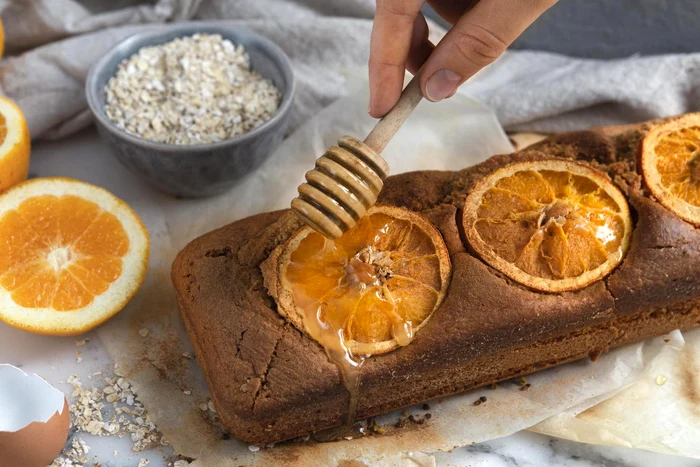
Honey was an important food in Roman cuisine. Source: Freepik.com
Recipe for the spiral:
“For the quantity desired, do everything in proportion, exactly as with the placenta, except for the shape. Cover the tract on the crust liberally with honey, then stretch them like a rope and place them thus on the crust, filling tightly with the plain tract. Otherwise, proceed as with the placenta and bake in the same way,” noted Cato the Elder.
Recipe for scriblita:
Follow the same instructions for crust, tract and cheese as for the placenta, but without the honey, the ancient author added.
Recipe for globes:
“Mix the cheese and ale in the same way, in sufficient quantity for the desired number. Pour the lard into a hot copper dish, and fry one or two at a time, turning them often with two sticks. When done, take them out, brush them with honey, sprinkle with poppy seeds, and serve.” it looked like this.
Encytum recipe:
“It is prepared in the same way as a globus, except that a dish with a hole in the bottom is used; the dough is pressed through this hole into boiling lard and shaped into a spiral, twisting it and securing it with two sticks. Brush with honey and glaze while still warm. Serve with honey or mulsum (honey-sweetened wine).” note the author.
Recipe for erneum:
It is made in the same way as placenta and has the same ingredients. Mix it in a ladle, pour it into a clay pot, dip it into a copper cauldron filled with hot water, and boil it over a fire. When it is ready, the dish is broken and the dish is served.
Spaerita recipe:
It is prepared in the same way as the spira, with the following difference in shape: shape fist-sized balls from the tract, cheese and honey; these sit on the crust, as tightly as the spiral, and bake in the same way.