
No Fluff Jobs research shows that as many as 92.9 percent Poles consider showing the range as an important or very important element of job advertisements. According to Grant Thornton data, only 21 percent published job offers contain information about remuneration.
Companies do not disclose salaries because they are afraid of employees' reactions and queues for raises. – If we don't have it pay scales in the company, and the market forces the employment of more and more expensive specialists, revealing the range in the advertisement could result in a queue of people coming for a raise – explained Karol Kapuściński, labor market expert and Chief Revenue Officer at No Fluff Jobs, in Business Insider Polska.
Will the amendment to the Labor Code, which comes into force on December 24 this year, be a breakthrough and change the approach of companies? Partially yes, but there is no point counting on the miracle of full disclosure. This is the result of regulations that currently partially implement the EU directive on the wage gap. The situation may change slightly in the second stage of the reform, which has just been submitted for consultation. We explain what the existing regulations mean for candidates and companies, and what the government's plans are.
See also: The government is relaxing the minimum wage bill. Postpones key deadlines
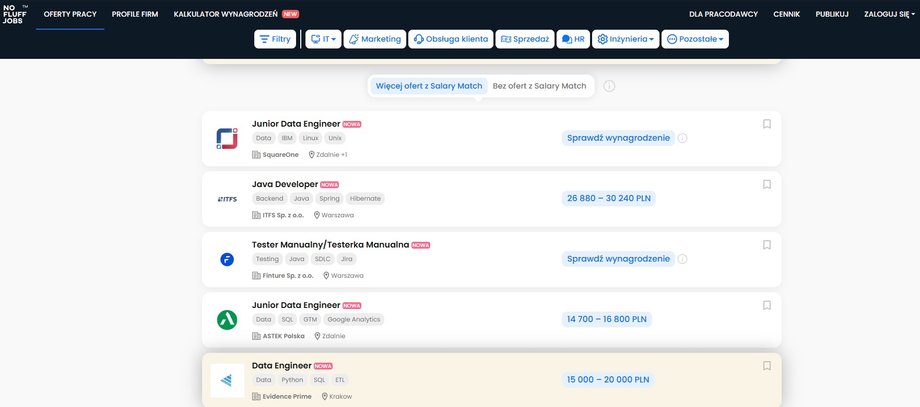
Advertisements without salary ranges will not disappear, but there will be fewer of them
|
nofluffjobs.com/pl
Informing about remuneration is already an obligation
So far, the salary ranges in the announcement have been “good practice”. From December 24 information about remuneration becomes a legal element of the recruitment processwhich is intended to provide the candidate with the opportunity to negotiate consciously.
This is the result of the Act of June 4, 2025 amending the Labor Code, published in the Journal of Laws. June 23, 2025, item 807. It implements certain provisions of the Directive on strengthening the application of the principle of equal pay for men and women for equal work or for work of equal value through pay transparency and enforcement mechanisms (Directive 2023/970).
— The directive aims to be transparent and non-discriminatory. An important element in eliminating pay discrimination is the transparency of remuneration before employment, explains Dr. Dominika Dörre-Kolasa, legal advisor, partner at the Raczkowski law firm.
In accordance with the newly added Art. 18 [3ca] to the Labor Code, a person applying for employment in a given position receives information about remuneration from the employer.
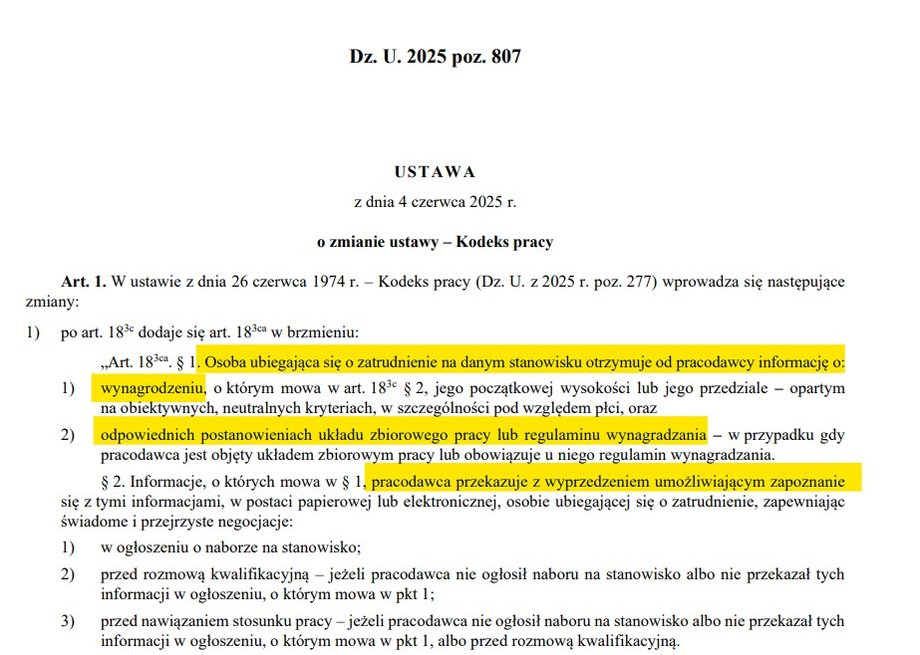
Amendment to the Labor Code on salary transparency
|
ISAP
What salary should a job candidate know about?
This means that after December 24, the employer is obliged to provide the candidate, both those applying from the market and employees participating in internal recruitment, with information about the starting salary or its range.
Dr. Dominika Dörre-Kolasa explains that remuneration should include not only monthly wages, but also supplementary or variable components. — Any benefits in addition to the normal basic or minimum hourly wage or monthly wage that an employee receives directly or indirectly, in cash or in kind, it adds.
In her opinion, information about remuneration should include those components that can be negotiated, i.e.:
- basic salary: fixed monthly or hourly rate;
- additional or variable ingredients: regulatory bonuses, discretionary bonuses (if paid systematically), cash prizes;
- extras: functional, internship;
- commissions and sales bonuses: if they are part of the position.
This means that the employer does not have to inform about:
- non-wage benefitsunless fully financed by the employer;
- benefits from the Social Fund: holidays under a pear tree, Christmas packages.
- work tools: laptop, telephone, company car (as long as it is used in accordance with the rules and does not constitute an unlimited bonus for private purposes).
- refunds: lump sums for remote work, allowances, reimbursements for fuel while on business trips.
Will there be spreads in every ad?
In accordance with the amendment the employer must disclose the salary (or its range) to the person applying for a job, i.e. at the recruitment stage. This means that information about remuneration or ranges will not be in every advertisement.
The regulations give companies some flexibility. Those who want to can publish information about the salary or range in advertisements. Others can only inform the candidate about the remuneration in advance in paper or electronic form. This can be done before the interview, but even in the letter of intent.
– So we have two options to choose from. Firstly, when we inform you, either in the advertisement or at a later stage of recruitment. And secondly, whether we provide information about the promoted salary or the salary range for a given position – explains Dr. Dominika Dörre-Kolasa.
May I ask: how much do you want to earn?
In practice, this means that a candidate can still go for a blind interview. This also means that candidates may still be asked how much you would like to earn.
– During the recruitment interview, the employer will be able to ask what salary expectations are – admits attorney Dörre-Kolasa.
However, a future potential employer cannot ask a job candidate about his or her previous earnings, and not in the current or previous jobs.
Recruitment without discrimination. This will be the biggest challenge
The amendment also explicitly obliges employers to make recruitment announcements and job titles neutral in terms of gender, but not only that. The act also states that the entire recruitment process must be conducted in a non-discriminatory manner. What does this mean in practice?
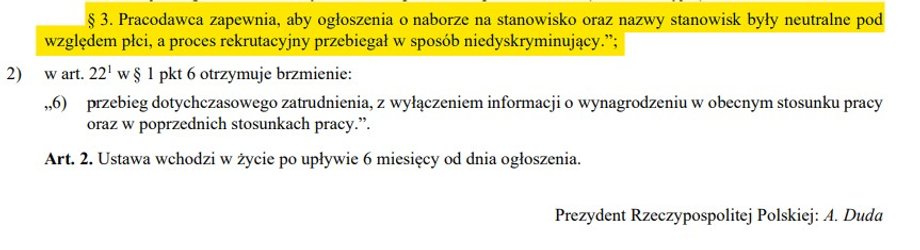
Neutrality of job advertisements
|
ISAP
– The idea is that the ad should not look male or female on a good morning – says Dr. Dominika Dörre-Kolasa from the Raczkowski law firm. And he gives a specific example.
If an employer is looking for a manager, but expects a strong person, and the advertisement shows a fragment of a hand in a suit with a watch, it is immediately obvious that it is an offer for a specific gender, which is prohibited by the new law. As a result, it is not enough to ensure only the right names of positions, but also the selection of words and illustrations.
Importantly, not only the advertisement must be neutral, but the entire recruitment process. Non-discriminatory recruitment means that at every stage there are objective criteria for selecting people for work.
— This will be a challenge for companies to apply the same criteria to all candidates, avoid personal criteria, and have everything properly documented. It's about the selection criteria at individual stages of recruitment, i.e. on what basis the first choice is made and why someone moves to the next stage – explains the expert.
Mec. Dörre-Kolasa points out that at every stage of recruitment, salary may still be an expected selection criterion.
– If someone wants to earn PLN 20,000 PLN, and the potential employer has a maximum budget of PLN 15,000 for this position. PLN, then clarifying this is in the interest of both parties. A situation in which a person applying for employment finds out that their expectations do not fall within the upper range will be unfavorable. Therefore, this information should be provided as early as possible to make the process transparent, adds Dörre-Kolasa.
Employers must prepare for full transparency of salaries
Importantly, both the obligation to inform about remuneration and the requirement for the neutrality of the recruitment process are the beginning of changes. Before Christmas, the Ministry of Family, Labor and Social Policy submitted the second stage of the reform for consultation. We were the first to report that the ministry was working on it at the beginning of the year.
This is a draft law on strengthening the application of the right to equal remuneration for men and women for equal work or for work of equal value.
He predicts that inAll employers, even those employing one employee, will have to evaluate job positions and define the criteria for determining remuneration, their levels and increases.
On the other hand the employee will have the right to request information about his or her individual remuneration level and average remuneration levels divided by gender in their category of employees.
If the answer obtained within 30 days is not satisfactory, the employee will be able to request additional explanations and more precise data.
Liwiusz Laska, general director of MRPiP, assures that the project does not go beyond the regulations resulting from the directive, which must be implemented by June 2026.