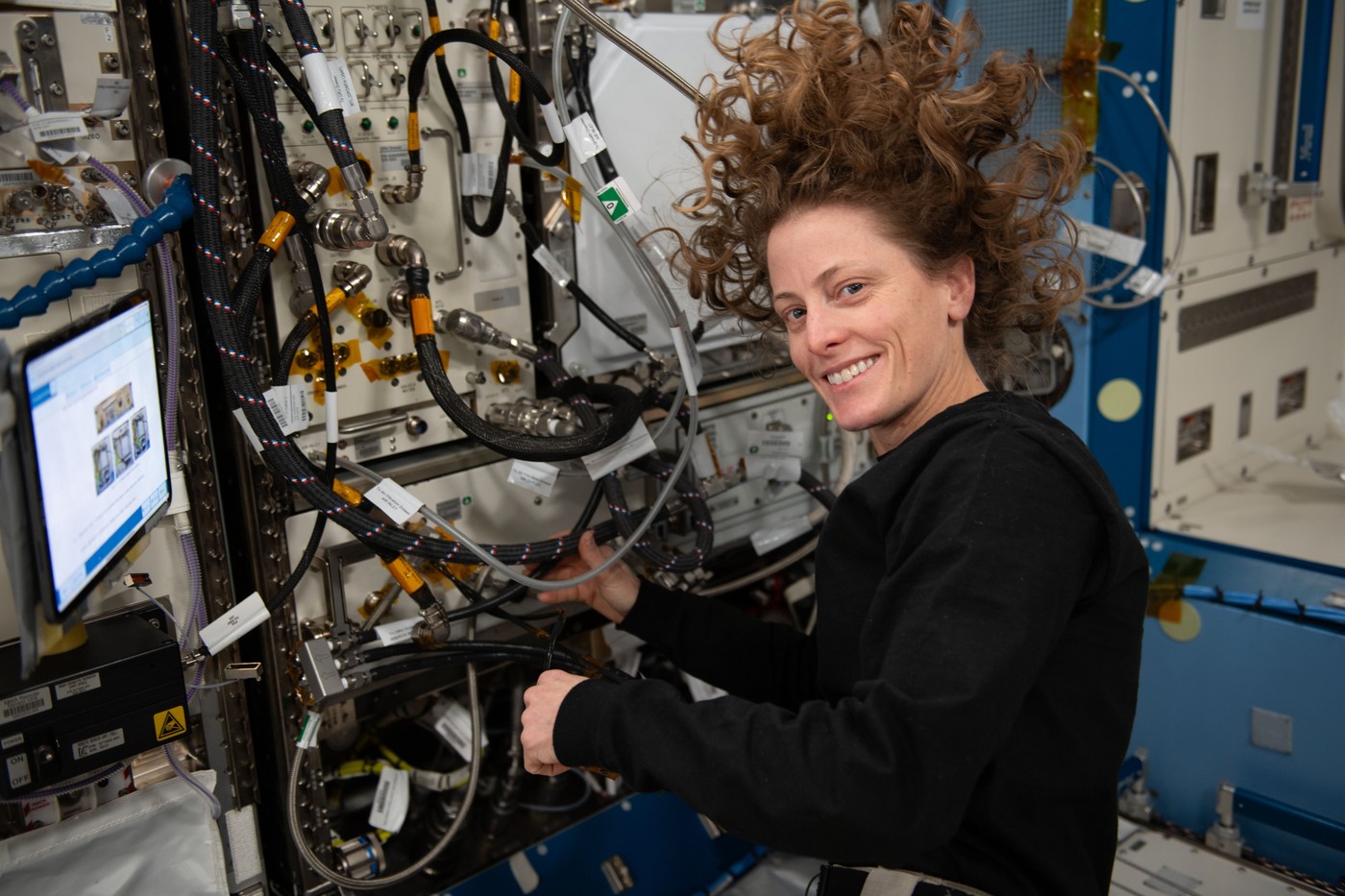
Astronaut on the International Space Station Photo: Iss Crew/Nasa / Zuma Press / Profimedia
The Russian rocket company Energia has obtained the patent for a new architecture for space vehicles capable of generating artificial gravity, a technology that has the ability to revolutionize long-duration space missions with human crew, reports Space.com on Wednesday, taken over by Agerpres.
A report by the Russian news agency TASS, which obtained the patent, shows that it is a rotating system that is designed to generate a gravitational force of 0.5 g, or 50% of Earth's gravity. The patent filing includes illustrations of a fictional space station structure with a central axial module, with both static and rotating components, with modules and habitats connected by flexible, hermetically sealed junctions.
The radially attached habitable modules will be rotated about an axis to simulate gravity for the crew, producing a centrifugal force that pushes outward. They would need to have about five revolutions per minute and a radius of 40 meters to produce 0.5 g. A space station of this size would require multiple launches with each module, which would then be assembled in orbit.
The documentation mentions the disadvantage of the need to rotate and coordinate the rotation of transport ships to dock at the station, which reduces the safety of using such a station.
Similar project at NASA
The generation of artificial gravity could have a profound beneficial impact on crews on long-duration space missions, whether in low Earth orbit or on interplanetary journeys. Prolonged exposure to microgravity has numerous negative effects on astronauts' health, including muscle atrophy and loss of bone density.
NASA has also produced similar concepts, such as the Nautilus-X wheeled space station, while more recently Vast has announced plans to build artificial gravity stations.
Russia has not indicated the deadlines for such a project, nor the resources to support its development. However, the patent attests to the interest in the concept of artificial gravity at a time when the end for the International Space Station (ISS) is approaching and new projects of space outposts are being advanced.
Currently, NASA and Roskosmos plan to deorbit the ISS in 2030, using a modified SpaceX Dragon capsule to push the station toward Earth, only to burn up completely due to friction with the atmosphere above the Pacific Ocean. Russia has committed to remain aboard the ISS until 2028.