By the time a family in Romania opens a gift box on Christmas Eve, unwraps a toy or hangs a globe on the tree, that object has already traveled further than most people in a lifetime.
This text is an excerpt from the “EconoMix” newsletter, which journalist Dan Popa sends every Thursday morning. You can subscribe here:
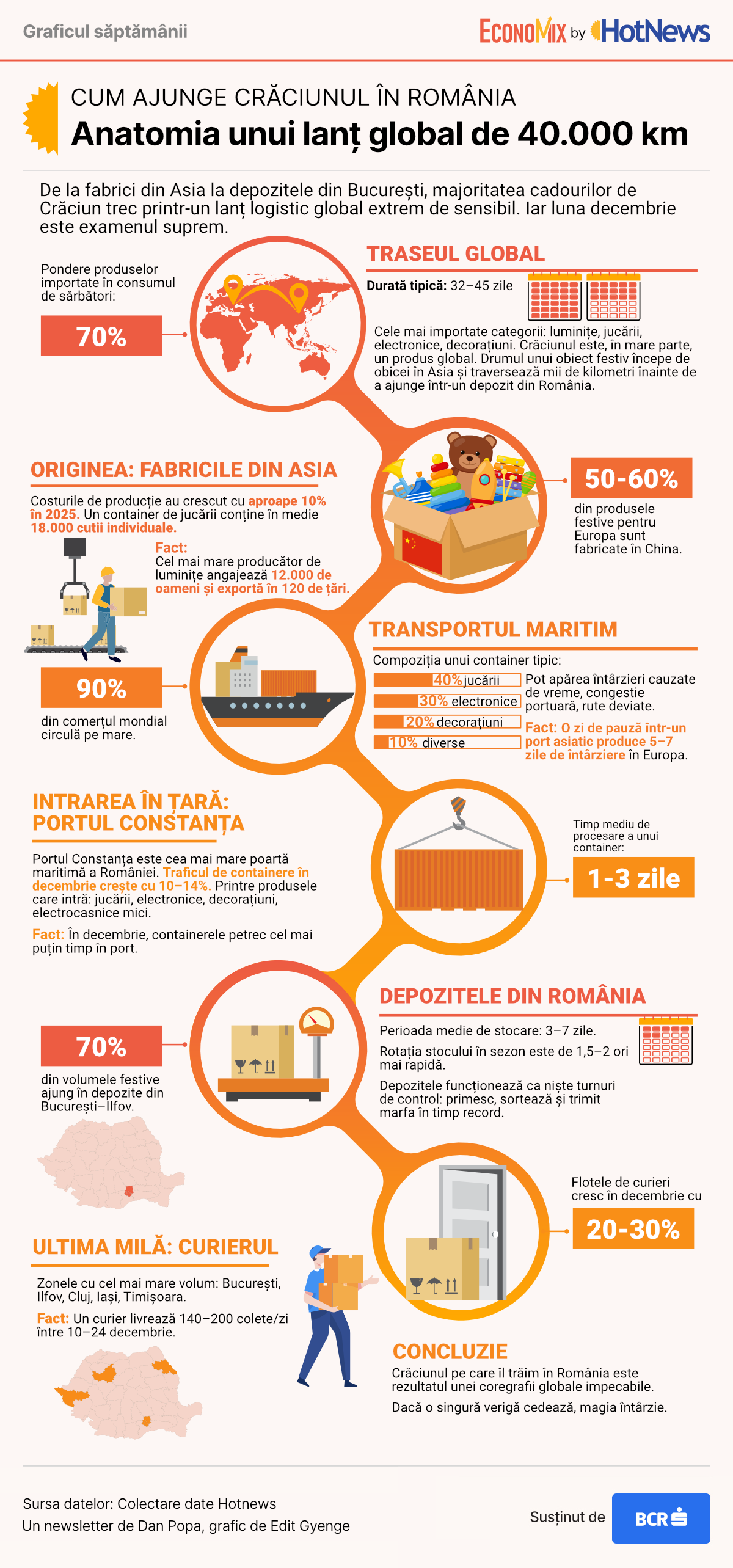
The gifts that arrive in your living room are assembled — discreetly, efficiently and almost invisibly — by a global supply chain that stretches some 40,000 kilometers, from Asian factories to European ports, warehouses, trucks and finally your living room.
This is the story of that road.
Step 1: Where Christmas is “born” (Asia, late winter–spring)
For most Christmas products sold in Romania — decorations, toys, light installations, artificial trees, gift accessories — the journey begins many months in advance, in southern China, Vietnam and other parts of Southeast Asia.
Production decisions are made early: designs are finalized in January–February, orders are placed in the spring, factories run at full capacity during the summer.
When Romanians start thinking about gifts, in December, the economic fate of Christmas is already decided.
Step 2: The long sea journey (20,000 km on water)
After packaging, the goods are loaded into 40-foot containers, each with tens of thousands of euros worth of seasonal produce.
The route is a classic one: South China Sea, Indian Ocean, Suez Canal, Mediterranean Sea.
Shipping only takes 30-45 days.
Any blockage here — rising fuel prices, pipeline incidents, geopolitical tensions — is seen months from now in the form of higher prices or emptier shelves, not breaking news.
Step 3: Eastern Gateway to Europe — Port Constanța
For Romania, Christmas often comes through Constanța, one of the most strategic ports of the European Union on the Black Sea.
Here, containers are unloaded, cleared, redistributed according to destination
At this point, Christmas products enter Romania's trade statistics — imports that discreetly widen the trade deficit every autumn.
A revealing detail: a container that enters full will often leave Romania empty on its return, a faithful image of an economy dominated by consumption.
Step 4: Warehouses, Algorithms and Trucks (Central and Eastern Europe)
From the port, goods move inland to regional logistics hubs, retailer warehouses, distribution centers around major cities.
This is where algorithms come into play: demand forecasts, price adjustments, inventory optimization
For the Romanian consumer, this translates into: “discounts” in November, sudden stock shortages in December, surprisingly similar prices between stores.
At this point, Christmas is no longer a product. It's a flow issue.
Step 5: The last 100 km — where the economy gets personal
The last part of the road is also the most expensive per kilometer: transport fuel, local labor, last mile delivery.
This is where the global economy hits the family budget directly:
higher logistics costs → higher shelf prices
exchange rate fluctuations → sudden price adjustments
cautious consumers → smaller baskets
When Christmas arrives in the living room, its price reflects not just materials and labor, but energy, interest rates, exchange rates and geopolitical risk.
What this chain tells us about Romania
Christmas is a perfect economic mirror. He shows:
how integrated Romania is in global trade
how dependent consumption is on imports
how external shocks discretely tax households
how little of the seasonal expenditure remains in the local production economy
In December, Romania consumes globally and produces only marginally locally.
The silent paradox of Christmas
The lights are warm, the music is familiar, the rituals are deeply local. But the economy behind them is anything but local.
Christmas in Romania is a global logistical achievement, an event that affects the trade balance and a stress test for family budgets — all wrapped up in tinsel.
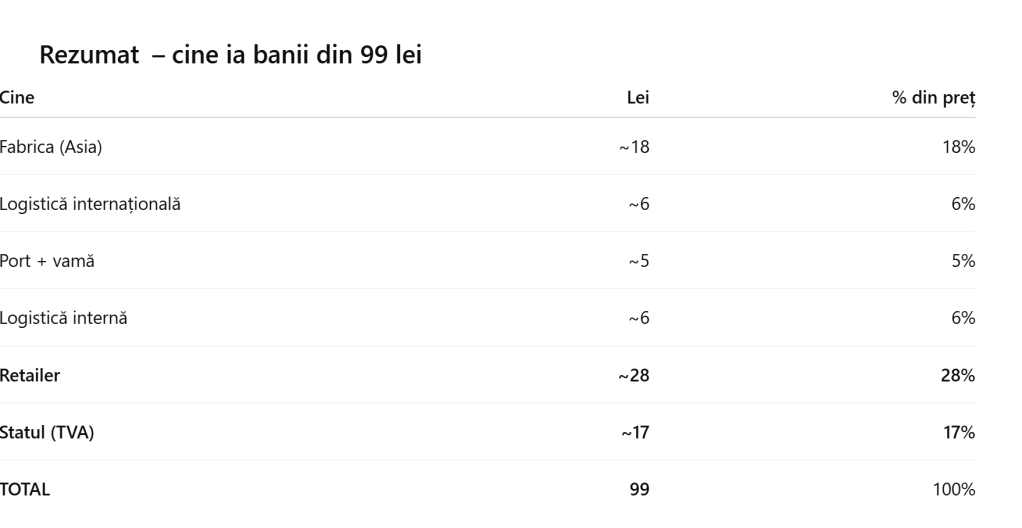
Let's take the case of a toy whose shelf price is 99 lei (VAT included). Where the money goes: