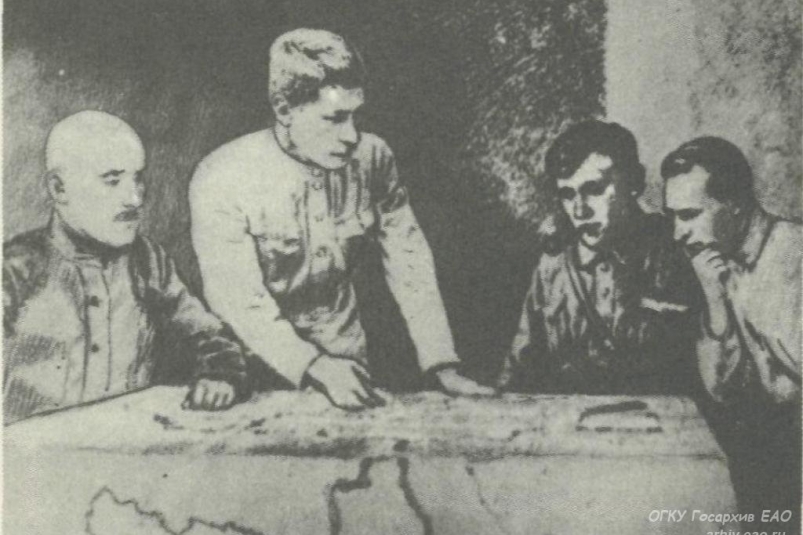
Commander-in-Chief of the People's Revolutionary Army Blucher, members of the Military Council, Postyshev, Melnikov, Seryshev are developing a plan for the assault on Volochaevka
Photo: State Archive of the Jewish Autonomous Region
December 24, 1921
As Alexey Zaitsev writes in his book “The Immortality of the Names of the Volochaev Land” (6+), The first Volochaevsky battle took place on December 24, 1921 during the retreat of units of the People's Revolutionary Army (NRA) from Khabarovsk. It was practically not covered in Soviet literature, because it was a rather tragic moment of the retreat of the “Reds”, who stopped only at the In station. After the battles near Vladimirovka and Pokrovka, the NRA lost guns, several trains of various cargo, according to various sources, from 40 to 300 people were captured, many were wounded and killed.

After Dezhnevka, an important station on the route was Volochaevka, where the Headquarters of the Amur Military District, headed by Stepan Seryshev, was located; trains accumulated that had to be sent to the In station in a timely manner.
The battle near Volochaevka was quite strong. The “Whites” occupied the village in a cheerful mood, despite the fact that they were opposed by an armored train. Here one Korean was captured, who was shot, and one soldier with documents confirming his dismissal from service. The Whites lost 10 people killed. The White rebels were opposed by both parts of the Amur troops and the partisans of I.P. Shevchuk’s detachment, who were taking carts with weapons to Arkhangelovka. Volochaevka was occupied by the fifth column of General N.P. Sakharov numbering 1300 bayonets, 33 sabers, three guns.
December 24, 1939
Elections to local Soviets of Workers' Deputies took place. Summing up the election results, the bureau of the regional committee of the All-Union Communist Party of Bolsheviks noted that they took place in an atmosphere of high labor and political activity. 99.8% of all voters in the region took part in the voting. 98.8% of the total number of voters who took part in the voting voted for the candidates of the bloc of communists and non-party members. 1,116 deputies were elected by the working people of the region in the regional, city, district, town and rural Councils of Working People's Deputies. Among the deputies of local Soviets there were 419 members and candidates for membership of the CPSU(b), 697 non-party members, 313 women.
December 24, 1940
The Bureau of the Regional Committee of the All-Union Communist Party of Bolsheviks considered the issue “On the state of telephone, telegraph and radio communications in the region.” The adopted resolution noted some improvement in communications in the region, indicated shortcomings and measures to eliminate them. Attention is drawn to the need to organize the training of workers, employees and managers of enterprises and communications departments, to widely introduce and in every possible way support new forms and methods of Stakhanovist labor, and to take decisive measures against violations of labor discipline.
December 24, 1963


The Bureau of the Regional Committee of the CPSU approved the initiative of the teams of the Dalselmash plant and the Birobidzhan knitting factory, who supported the initiative of the Makeevka miners and committed themselves to contribute 85 thousand rubles to the national fund of big chemistry. It is recommended to spread this initiative among the teams of industrial enterprises in the city and districts.
December 24, 1981
The Bureau of the Regional Committee of the CPSU considered the issue of the work of the party committee of the Smidovichi state farm to implement the Resolution of the CPSU Central Committee “On further improvement of control and verification of implementation in the light of the decisions of the XXVI Congress of the CPSU.”
It was noted that the party committee of the Smidovichi state farm began to pay more attention to organizing and improving control and verification of execution.
The Bureau obliged the party committee of the Smidovichi state farm to eliminate existing shortcomings in monitoring and verifying execution, and to ensure further improvement of the forms and methods of this work.
December 24, 1936
Viliy Izrailovich Arnapolin was born – Honorary Citizen of the Jewish Autonomous Region, Deputy of the City Council, City Duma. He is considered the first born in the city of Birobidzhan, his parents received birth certificate No. 1.

Viliy Izrailovich Arnapolin. Photo: Photo: Heritage EAO
Arnapolin V.I. studied at secondary school No. 1. Since 1952, he worked in the Metalist artel as a turner's apprentice, a turner, and continued his studies at the school for working youth. In June 1953 he entered the Khabarovsk Technological College, after which in 1957 he was drafted into the ranks of the Soviet Army. After serving in the army, he returned to Birobidzhan and worked at the Dalselkhozmash plant as a mechanic, technician, and senior foreman.
In 1979, he headed the Birobidzhan mobile mechanized column of the Dalsantekhmontazh trust, which took part in the construction of key industrial and cultural facilities in the region.
Awarded the medals “For Labor Valor”, “Veteran of Labor”, “For Valiant Labor. In commemoration of the 100th anniversary of the birth of Vladimir Ilyich Lenin”, Certificate of Honor of the Jewish Autonomous Region.
In 2001, the Legislative Assembly of the JAO awarded V. I. Arnapolin the title “Honorary Citizen of the Jewish Autonomous Region.”
In July 2021, a memorial plaque was installed on the wall of the house on the street. Sholom Aleichem No. 29, in which the famous business leader and Honorary Citizen of the Jewish Autonomous Region Viliy Izrailovich Arnapolin lived.
December 24, 1935
The newspaper “Birobidzhan Star” (12+) On December 24, 1935, Liberberg's report on the progress of livestock development in the region was published on the first page. In his report, he compares livestock numbers from 1928 to 1935. Liberberg also spoke about veterinary services in the region in his speech.
An obituary has been published regarding the death of the editor of the newspaper “Birobidzhaner Stern” (12+) Genakh Lvovich Kazakevich.

Day in the history of the Jewish Autonomous Region. Photo: Photo: Regional Library
December 24, 1942

Day in the history of the Jewish Autonomous Region. Photo: Photo: Regional Library
The newspaper “Birobidzhan Star” on December 24, 1942 reported to its readers about how much money was collected for the construction of a squadron of combat aircraft and tank columns, the newspaper wrote: “on December 24, 1,605,254 rubles were received from collective farmers of our region for the construction of squadrons of combat aircraft and powerful tank columns. Birobidzhansky is ahead in collecting money. district, whose collective farmers collected 609,294 rubles. In second place is the Smidovichsky district, where collective farmers received 420 thousand rubles. Among the collective farmers of the Leninsky district, 285 thousand rubles were collected and 169 thousand rubles were collected from the Birsky district.”