The world's largest economy accelerated in the third quarter, surprising analysts. GDP growth of 4.3% on an annualized basis beat forecasts by a full percentage point. However, these data are market history, they were to be presented on October 30, and therefore, they did not meet with much reaction from investors.

In the third quarter of 2025, U.S. gross domestic product grew by 4.3% on an annualized basis, according to preliminary estimates published by the Department of Commerce. Economists polled by Reuters predicted that GDP would grow by 3.3%. A quarter earlier, the world's largest economy grew by 3.8%.
The data was delayed due to a 43-day government shutdown. The report was originally scheduled for publication on October 30. The reading presented on December 23 replaced the first and second estimates, which were to be presented on November 26.
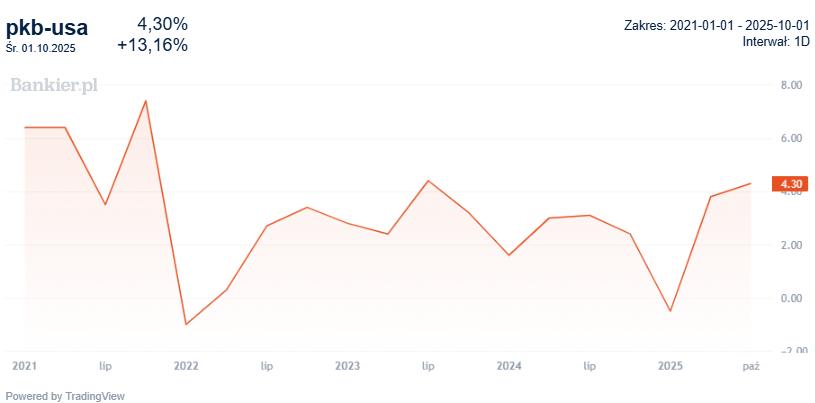
Although the report presented a largely positive picture of the economy, the reading did not receive much reaction from the markets because the data presented was in the past. Stock futures declined slightly, while Treasury bond yields remained higher.
Americans present GDP dynamics differently than Europeans – they annualize short-term data, i.e. they transform them into year-round data. In short, the monthly value is multiplied 12 times, and the quarterly value is multiplied 4 times. We wrote more about this topic in the text “What is annualized GDP? We explain”.
Consumption and exports drive the U.S. economy
Consumer spending, which accounts for about 70% of U.S. economic activity, rose 3.5% in the third quarter, after rising 2.5% in the second quarter. As Reuters pointed out, much of the acceleration in spending resulted from the fact that Americans started buying electric cars, wanting to get ahead of the withdrawal of tax breaks, which expired on September 30.
Government investment and orders rose 2.2% in the third quarter after falling 0.1% in the second quarter. The result was impacted by increased spending at the state and local levels and the federal government's defense spending.
Investment by private companies fell by 0.3%, led by a decline in investment in housing and non-residential buildings such as offices and warehouses. However, this decline was much smaller than the 13.8% decline recorded in the second quarter.
A solid growth was achieved by exports, which grew at a rate of 8.8%. Imports, which are subtracted from GDP, fell by another 4.7%.
Everyday problems of Americans
According to Reuters, research suggests that consumer spending in the US is now driven mainly by the wealthiest households, as the stock market boom has increased their wealth. Meanwhile, middle- and low-income consumers are struggling with rising costs of living, driven by President Donald Trump's tariffs but also by higher utility and health care bills. Economists call this phenomenon the K-shaped economy.
This phenomenon is also visible in business, where large corporations are increasing their spending on artificial intelligence and coping with additional costs resulting from import duties, and small companies are struggling with financial difficulties.
Although CPI inflation in the US slowed to 2.7% in November 2025, it still remains above the Fed's target of 2%. Despite this, the central bank decided to cut interest rates three times in a row at the end of the year, mainly out of concern for the labor market, which has been steadily losing momentum since spring.
Last week, the government reported that the U.S. economy gained a respectable 64,000 jobs in November but lost 105,000 in October. Additionally, the unemployment rate rose last month to 4.6%, its highest level since 2021. Economists say the U.S. labor market has become hostage to uncertainty related to global trade tensions. Businesses are also feeling the effects of higher interest rates all the time.
MM