White House envoy Steve Witkoff said on Sunday, December 21, that talks in Miami with both his Russian counterpart Kirill Dmitriev and Ukraine's national security adviser Rustem Umerov were “productive and constructive,” however, they did not produce any clear breakthrough that could have led to an end to the war.
“Ukraine remains fully committed to achieving a just and lasting peace,” Witkoff wrote in his statement. “Our common priority is to stop the killing, ensure guaranteed security and create conditions for Ukraine's reconstruction, stability and long-term prosperity.”
The summary capped a weekend of talks in Florida, which came weeks after the Trump administration unveiled a plan to end the war with an early draft of an agreement that Kiev officials and their supporters in the European Union deemed impractical and unrealistic.
Miami's lack of a breakthrough is just a piece of the bigger picture. In the background, there is a growing question whether the talks lead to peace or just buy time.
Negotiators from Russia, Ukraine, Europe and the U.S. continued working on the proposals in recent weeks, though The Ukrainian and Russian sides did not hold direct talks with each other — each met with American representatives separately.
Representatives of Russia and Ukraine published Witkoff's statements on social media on Sunday, but without providing any details about possible progress in the talks. Umerov published word for word the same version of Witkoff's statement regarding Ukraine on the X platform, while Dmitriev repeated the fragment regarding talks with Russia.
The gap between what the two warring sides demand remains huge.
President of Ukraine Volodymyr Zelensky said on Saturday evening: – The most difficult issues concerned and still concern the territories of Ukraine. He added that control over the Zaporozhye nuclear power plant, financing of post-war reconstruction and “several technical issues related to security guarantees” still constitute major sticking points.
Zelensky called on the United States to increase pressure on Moscow.
America must say clearly: if diplomacy fails, then we will apply full pressure – a very strong weapons package, very strong support for Ukraine, and the United States will impose comprehensive sanctions on the entire economy and all sectors that generate income for the Russians
– said Zelensky.
Yuri Ushakov, an adviser to Russian President Vladimir Putin, said most of the peace plans proposed in Miami were pushed by Ukraine and Europe and seemed “rather unconstructive.”
Dmitriev, a Kremlin envoy and businessman, said on Sunday that “talks were not interrupted by so-called war hawks,” insisting that “everything is fine,” Russia's TASS news agency reported.
The British, French, German and Polish embassies in Washington did not immediately respond to POLITICO's request for comment.
No consent, no decision
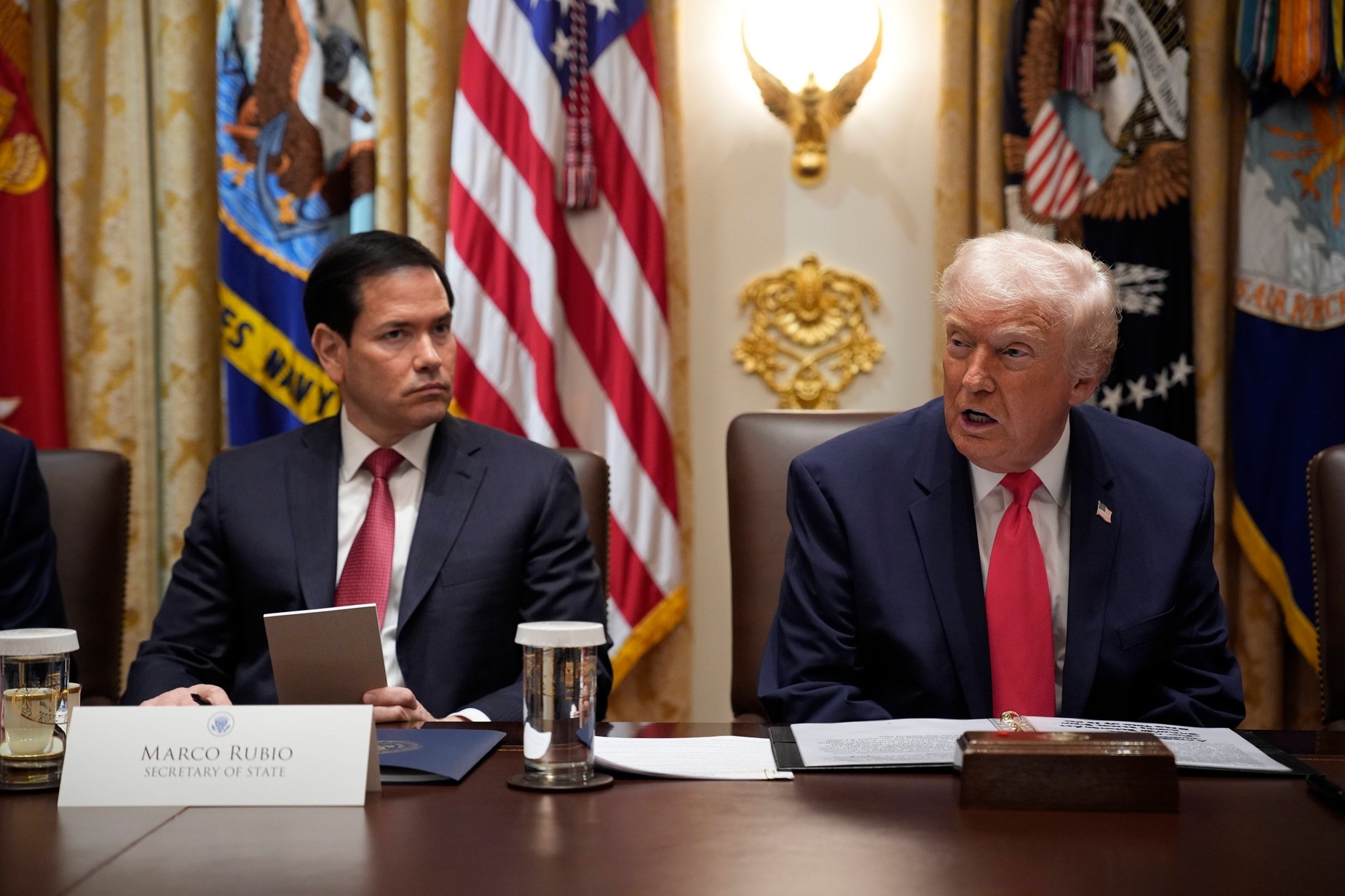
Secretary of State Marco Rubio told reporters on Friday, December 19, that “we still have a lot of work to do” before an agreement can be signed, adding that peace talks could drag on for several more months.
His comments dampened the optimism expressed on Monday, December 15 by Trump, who announced that the sides were “closer to reaching an agreement than ever before.”
Marco Rubio, Secretary of State, and Donald Trump, President of the United States. Washington, December 2, 2025EPA/YURI GRIPAS / POOL / PAP
Zelensky said U.S. officials had proposed a three-party meeting with Ukraine and Russia's national security advisers — the Kremlin declined on Sunday — but he wondered whether that could really speed progress in the talks.
On Sunday, French President Emmanuel Macron's office suggested he might be open to meeting Putin. “We will decide in the coming days what the best course of action is,” he said.
The statement came after European leaders agreed last week to provide a loan of 90 billion euros to Ukraine [ok. 378 mld zł] on joint debt after Belgium blocked a plan to use frozen Russian assets to finance Ukraine's war effort.
Narrative chaos
Moves in Washington to shore up support for Ukraine have had mixed results. A bill that would impose new, tougher sanctions on Russia did not gain sufficient support in Congress.
Senator Lindsey Graham [republikanin z Karoliny Południowej]one of the main authors of the bill, called on the Trump administration to increase pressure on the Kremlin if Putin refuses to participate in peace talks.
— “If Putin says no, we have to radically change the rules of the game, including providing Tomahawk missiles to Ukraine to hit the drone and missile factories in Russia,” he said in a Sunday interview on NBC's “Meet the Press” with Kristen Welker.
If Putin says no, I would go all the way
– he added.
Other administration officials were much less favorable to Ukraine. Over the weekend, speaking at Turning Point USA's AmericaFest in Phoenix, Director of National Intelligence Tulsi Gabbard accused “deep state in the intelligence community“about fear-mongering “as a way to justify continuing the war and undermining President Trump's peace efforts” — remarks that were praised by Dmitriev.
I’m Ashley Davis as an editor, I’m committed to upholding the highest standards of integrity and accuracy in every piece we publish. My work is driven by curiosity, a passion for truth, and a belief that journalism plays a crucial role in shaping public discourse. I strive to tell stories that not only inform but also inspire action and conversation.