Macabre business is flourishing in Russia. All because of Putin's war


They must be in the hall thousands of corpses. The desperate relatives of the fallen soldiers are waiting in front of the gate. This is how the Russian media in exile Werstka describes the atmosphere in the center for receiving, processing and transporting the fallen in Rostov-on-Don in southern Russia.
It is one of the largest morgues in Russia — and the last station for the unidentified dead from the front just a few hundred kilometers away. Relatives visit this place to find fallen loved ones. They want to bury them and come to terms with death. Moreover, the state pays compensation only if the body is identified without error.
The influx of new corpses continues — this is how employee Dmitry describes his daily work. “You open the door of the truck and there are 40 bodies inside, one next to the other,” he says. Most often, it is women who search corpses for distinctive tattoos, scars, teeth or jewelry, hoping to find their deceased sons and husbands.
There are groups on Russian social networks where photos of fallen soldiers circulate with reference to the appropriate mortuary.
Russia has a history of dying – and has done so for centuries, for example through mass executions under Ivan the Terrible or the Great Terror under Joseph Stalin. The 27 million deaths during World War II deprived an entire generation of men. It was a similar situation in the 1990s in the ruins of the Soviet Union, full of chaos, violence and economic uncertainty, combined with unprecedented alcohol addiction, which led to a decline in men's life expectancy.
Russian demography is getting worse
Today, the death rate in Russia is again at its peak. Society is aging and at the same time too few children are being born. The situation is made worse by the so-called special military operation, as the Kremlin calls the invasion of Ukraine. The war has been going on for almost four years and has been devastating hundreds of thousands of victims on the Russian side. Nobody knows how much exactly. Mostly young men from the provinces die.
Russia's vast rural areas are underdeveloped, and ubiquitous poverty is becoming a recipe for success for the Russian army. Outside the big cities, the country hides an almost inexhaustible wealth of disillusioned men who due to lack of money and prospects, they volunteer for military service. Every day, approximately 1,000 people join the army. new soldiers.
There are no traces of the war in the Russian capital. Moscow is in perfect condition. There is no garbage on the streets, the sidewalks are clean, fresh snow is quickly removed from the city. The degree of sterile order achieved by Russian metropolises is probably only possible in authoritarian systems. However, if a Ukrainian drone reaches the capital, its fragments are quickly removed.
The business of death
In this case, Russian Death is interesting primarily as a business idea. This is clearly seen in the example of “Necropolis 2025”, the largest funeral industry fair in Russiawhich took place at the end of November in Moscow.
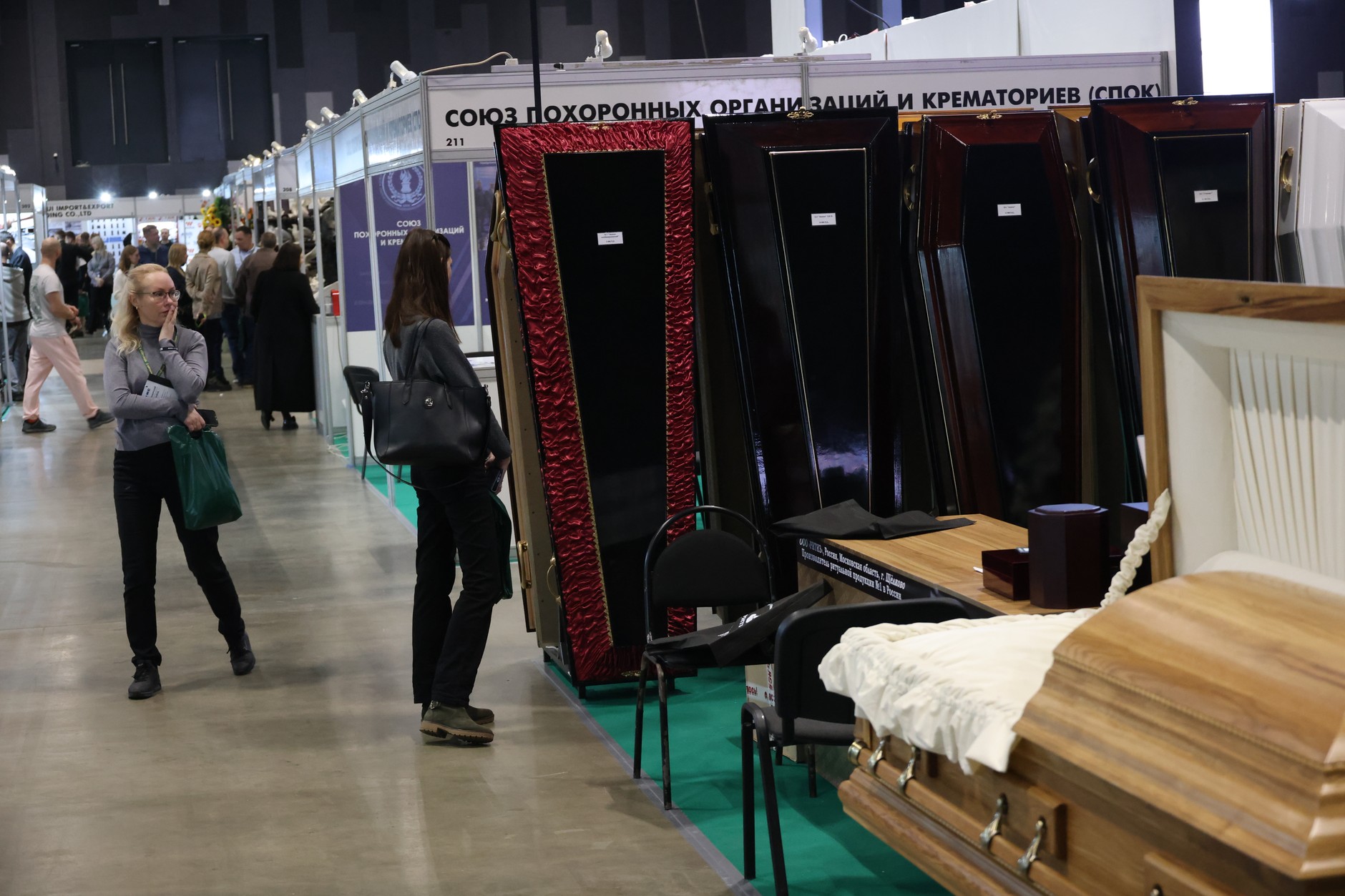
Funeral fair in Moscow, November 29, 2025Contributor/Getty Images
The industry is booming in Russia. In the first half of 2025 alone, the number of registered funeral homes increased by 16%. In the Moscow region, 57 new enterprises have been registered since January this year.
Many of them are exhibited at fairs. According to the event program, Demar presents exclusive coffin models. The fashion show presents the latest trends in funeral fashion. Psychologists provide advice on stress in the industry, and experts invite you to specialized lectures, such as “Advantages and disadvantages of the Russian cremation technique” or “10 trends that will change the Russian cremation market by 2035.”
Ivan Golunov, the only Russian journalist who regularly writes about the funeral industry in the country, is also present at the “Nekropol” fair. In the economics podcast, he details how the war in Ukraine fundamentally changed the funeral industry.
Funeral business
The large number of victims revealed numerous shortcomings: cemeteries in many places were neglected, and municipalities and communities across Russia had to make huge investments to renovate roads or tidy up overgrown graves. The state currently covers the costs of many funerals, and there is pressure in the industry to professionalize, which, however, is associated with a strong increase in income.
According to Golunow, the demand for funerals is also high conflict potential. In several cities, residents protested against the construction of new crematoria. The journalist describes the seasonal difficulties associated with digging in the permafrost of cities in northern Siberia. Moreover, corruption is a problem: places in cemeteries are rare, especially in large cities. Existing graves can often only be obtained by paying a bribe.
Additionally, Golunow talks about illegal cemeteries and undertakers who repeatedly used coffins and grave crosses. It is particularly enterprising businessmen who are criticized for their brazen actions. For example, in Novosibirsk, men competed with each other in digging graves.
During trade fairs, the approach is more relaxed. On the opening day, companies compete to see who can arrange the most beautiful funeral wreaths, prepare the tastiest funeral treats and design the most beautiful tombstones.
In Moscow, death is far away
The fair program includes a meeting of specialists on the next day they prepare the dead for display in a coffin in terms of aesthetics and hygiene. There is also competition here: who is the best at embalming? Basic knowledge can be acquired during lectures on post-mortem changes in the human body and presentations by Tanato-Lab, a manufacturer of thanatological cosmetics [do makijażu funeralnego].
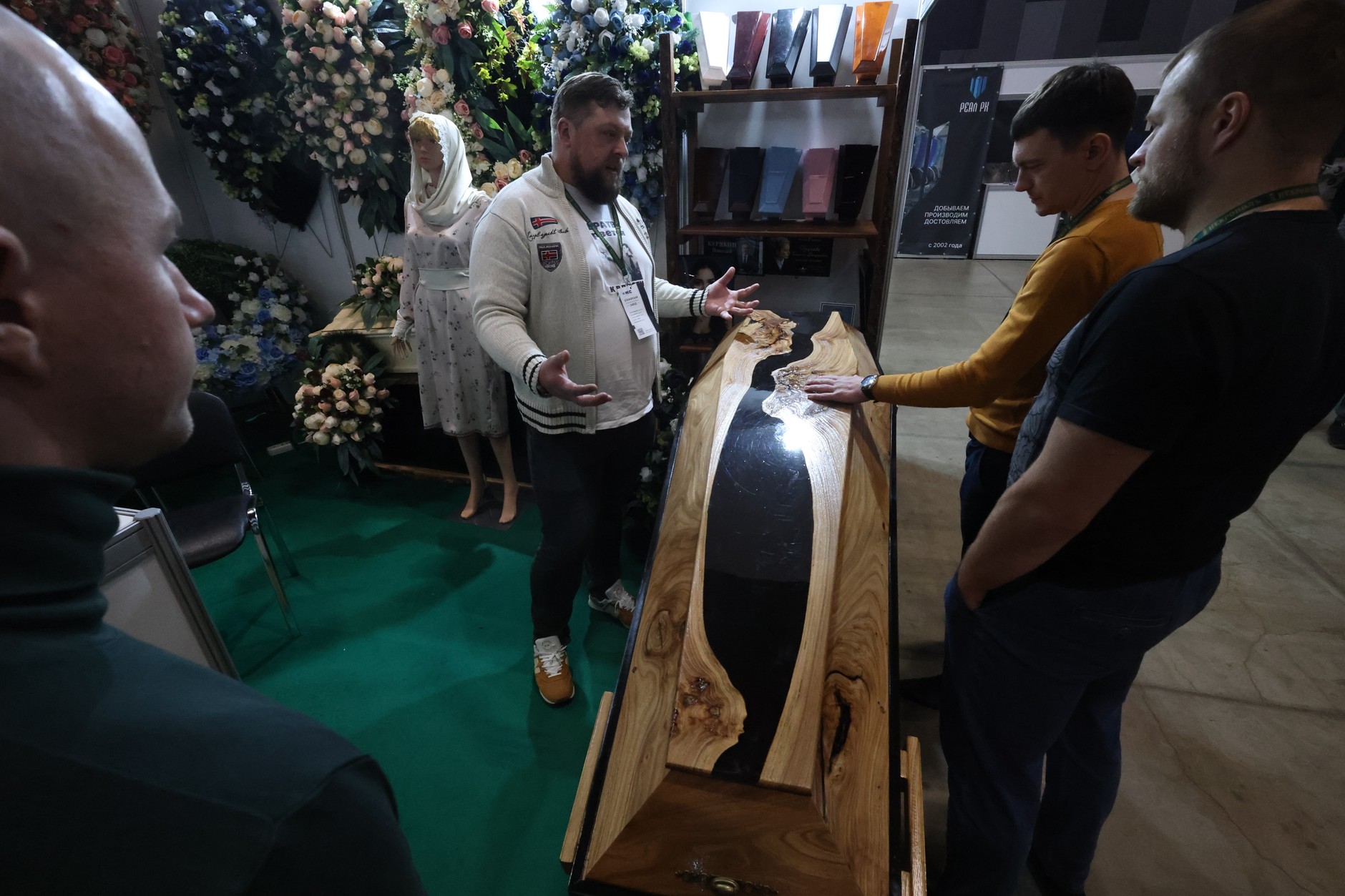
Funeral fair in Moscow, November 29, 2025Contributor/Getty Images
The next stage of the fair is competition “Best Master of Ceremonies 2025”. — Part of the competition is the spontaneous reading of an unknown funeral oration. The jury assesses how well the participants cope with it, one of the participants, who asked to remain anonymous, tells Die Welt. Everyone can come, watch and applaud, the performance will take place on the main stage.
Anyone who gets tired of competitions can talk to Chinese stone importers, try out fully equipped coffins or drink champagne at the bar. In Moscow, death is far away.
Coffins and plastic flowers
According to reports from the Bild daily, dark business in Russia also favors Alexander Lukashenko, a friend of Vladimir Putin. According to a report by Novaya Gazeta Political prisoners in Belarusian prison camps are forced to produce ammunition boxes, camouflage clothing, military bags and beds for the Russian army – and even coffins and funeral flowers. A former prisoner, watching a television broadcast of the “lavish funerals of 'special military operation heroes'”, noticed that these must have been the same coffins produced in his camp.
In one of the Belarusian penal colonies, prisoners have been producing plastic flowers for cemeteries since the beginning of the war – mainly carnations, roses and cornflowers. Standard: 500 flowers per person per shift. A total of 3,000 were produced. up to 6 thousand plastic flowers a day.
For Lukashenko, large Russian contracts came at the perfect time, reports “Bild”. Since the rigged presidential elections in 2020, the economic situation in Belarus has significantly deteriorated. The EU responded to the violence against protesters with sanctions – key export sectors collapsed and, as a result, economic output also fell.
Only in 2022 Belarusian gross domestic product shrank by 4.7%. But the Kremlin's war machine kept Putin's puppet state afloat — and Lukashenko in power.