I will try to use as little technical and non-legal language as possible in this material, with the desire to make myself understood by as many people as possible.
Thus, I was struck by the way in which such a large number of people (without legal studies) simply drew the conclusion or were convinced (through vile propaganda) that reading from Mihai Eminescu, the national poet, represents a criminal act, as a result of which the reader will go to prison.
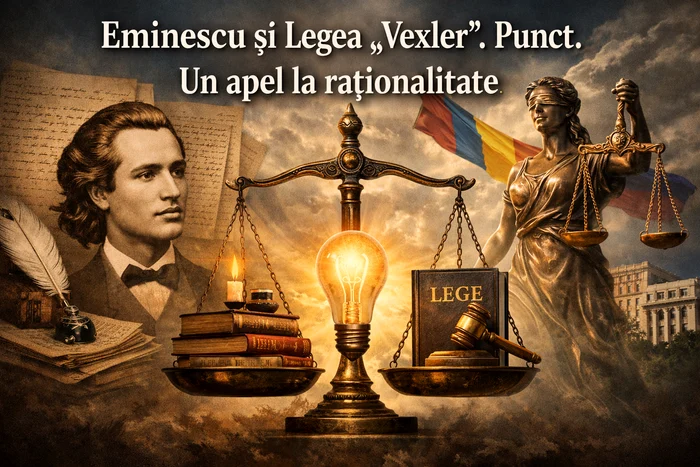
good people, this idea is an absurdity, a gross falsehood, a shameless lie. Stop! Stop rolling this idea which, among other things, makes a mockery of the issuer and her followers.
I want to make a confession to you. I read just today, in the quiet of my home, the poem “Doina” (uncensored version) and “Letter III”, both written by Mihai Eminescu. The act, in itself, of reading these two poems is NOT a crime, it is not a criminal act. Moreover, the law does not link any legal consequence to this fact of reading, it being an innocuous fact, i.e. devoid of legal consequences.
Offenses (criminal acts) in the category of those inciting violence, hatred or discrimination are characterized by the fact that they must be committed in public. And yes, online social platforms (Facebook, X, TikTok, etc.) are considered public space.
Obvious, your home is NOT a public space, but a private space, so, in the privacy of your home, you will be able to read Mihai Eminescu to exhaustion, including Adolf Hitler or Corneliu Zelea Codreanu, if this is your pleasure or passion.
In the light of the above, the natural question arises whether you will be able to read and/or quote from Mihai Eminescu in publicwithout the risk of being charged with a crime.
the answer, of principleis that you will be able to read/quote publicly from Mihai Eminescu without any fear that a criminal case will be filed against you.
However, in certain contexts, in certain particular circumstancesreading/citing Mihai Eminescu may meet the conditions to be considered a crime.
Concrete, when you publicly invoke the work (in whole or in part) and/or the authority of Mihai Eminescu to justify and/or propagate anti-Semitism, xenophobia, racism, hatred, violence or discrimination against certain categories of people.
see, things are much more complex when we are talking about a crimeexcept in the case of an innocuous gesture, such as reading, in one's own home, a volume of Mihai Eminescu's poems or even his press articles, some of them virulently anti-Semitic.
The law does NOT sanction the simple private act of reading anti-Semitic (or legionary, if you will) material, but possibly the way that person externalizes the read material in public.
Let's give some examples, to be better understood.
Named X reads, in the privacy of his home, the following verses from “Doina” (uncensored) by Mihai Eminescu, verses of obvious, embarrassing and disqualifying anti-Semitism (regardless of who their author is):
“Whom the Jidans brought to us/They no longer see day with the years/But let them take out their raven eyes/Let them stay on the road with the blind”
But X does not limit himself to this, but later posts (publicly) these verses on his Facebook page, adding a comment like: “The author of Romanian poetry was right”.
Undoubtedly, we are here in the presence of a crime, namely (at least) the act of the person to promote, in public, in any way, anti-Semitic ideas, conceptions or doctrines (art. 3 of Law no. 157/2018).
Even if X had not written any comment when posting those verses, he was liable for the crime of distributing or making available to the public, by any means, anti-Semitic materials (art. 4 of Law no. 157/2018).
There's no mistaking the year: The Law on the Prevention and Combating of Anti-Semitism dates from 2018, not 2025, as again you have been misled to believe.
Also, the normative act that sanctions organizations, symbols and acts of a fascist, legionary, racist or xenophobic nature, as well as the promotion of the cult of persons guilty of crimes of genocide, crimes against humanity and war crimes dates from 2002 (EOG no. 31/2002).
The so-called “Vexler Law” of 2025, in essence, only makes small changes, clarifications and terminological clarifications to Law no. 157/2018 and GEO no. 31/2002, but it does NOT come to incriminate new acts and does NOT sanction new crimes.
Thus, including this “Vexler law” scandal it is one artificially created by extremist interest groups that seek to create discord and inflame society.
Coming back, the question then arises whether all the above means that you will never be able to publish or post in the public space certain poems of Mihai Eminescu that have an anti-Semitic character.
And this time, the guiding criterion must be rationality, balance and avoidance of the absurd.
Public conferences, public discussions or public writings can take place about these poems or press articles by Mihai Eminescu, without any fear that you will commit a crime or that you will be held criminally liable, with the observance of an essential criterion: not only not to make anti-Semitic propaganda, but to disassociate and publicly distance yourself from everything that, in Mihai Eminescu's work, has an anti-Semitic, xenophobic or racist character.
A concrete example, to make us even better understood.
I, the undersigned, have written and published a work on the subject of anti-Semitism and its relations with the law. In the context of this work, I have cited, in context, the speeches and writings of fanatical and pathological anti-Semites, such as Adolf Hitler, AC Cuza, Corneliu Zelea Codreanu or Ion Antonescu.
In the preface of the work I wrote, in bold: “This book totally, absolutely and perpetually condemns any form of anti-Semitism, and nothing in its contents can be used and/or interpreted in a contrary sense.”
To the extent that I would have approved, confirmed or justified the speeches and writings mentioned, my deed would have met, justifiably, the constitutive elements of a crime.
We conclude here, sending for reflection (including for a better understanding of the purpose/rationale of laws such as those analyzed by us) the following lines issued by The Special Committee on Hate Propaganda in Canada in 1979but remain fully relevant today:
“In many respects we have less confidence in the twentieth century that the critical faculties of individuals will be activated in relation to the speeches and writings addressed to them. In the eighteenth and nineteenth centuries it was widely believed that man is a rational being, and that, if his mind is educated and freed from superstition, he will always distinguish between truth and falsehood, good and evil. Thus Milton said: let truth and falsehood face each other: who saw that the truth should ever lose in a free and open confrontation. We cannot share this belief today in such a simple form. Although we believe that in the long run the human mind rejects blatant falsehood and seeks the good, it is often true that in the short term emotion supersedes reason, and individuals perversely reject the truth presented to them and renounce the good they know. The success of modern advertising, the triumphs of reckless propaganda such as Hitler's, have drastically reduced our faith in human rationality. We know that under pressure and stress, in times of irritation and frustration, the individual is influenced and even overwhelmed of hysterical emotional appeals. We are acting irresponsibly if we ignore how emotion can drive out reason.”
I am open to answering all readers' concerns and fears on this subject, obviously as long as it is addressed in civilized language and under the auspices of good faith.