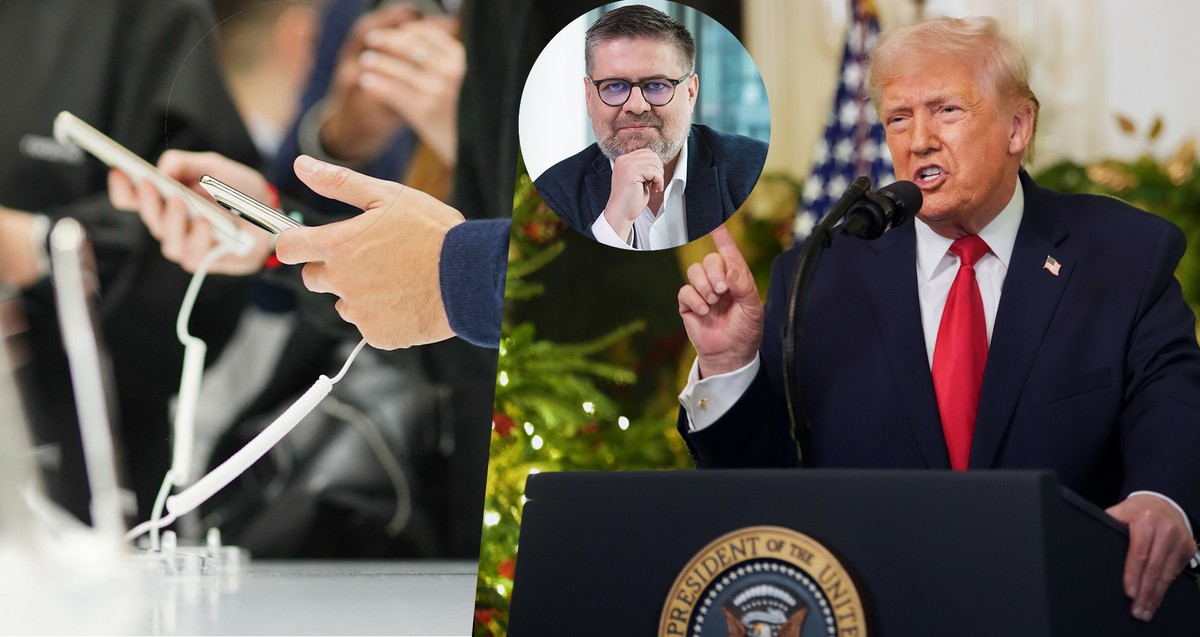
— The effect we see today in the automotive industry, i.e. the invasion of brands from the Middle Kingdom, was already experienced by smartphones about ten years ago, when Huawei was leading the way. Today, the strong position of Chinese suppliers does not surprise anyone, and they no longer want to compete only on price and are entering the premium segment, says Andrzej Gładki in an interview with Business Insider. “Everyone is starting to think about the stability of supply chains,” he adds.
The rest of the article below the video:
Smartphones under pressure from AI companies
– Taking into account price trends for next year, I expect price increases rather than price wars – says Andrzej Gładki. Why? In his opinion, the main reason will be the increase in component prices. Consumer electronics manufacturers feel pressure from AI companies.
— Everyone is trying to offer increasingly better devices with higher margins. It's obvious. But the key factor leading to price increases will be access to components.
— AI companies are draining the market of memory chips. There is fierce competition for supplies. The demand for memory chips is extremely high because they require computing power. As a result, there is a problem with production capacity in the world – the most specialized systems used by a smartphone compete for access to components with the AI industry, which is now in the center of attention and is currently leading a technological race between corporations – says Gładki.
It's not just chips from Taiwan that are calling the shots
— Manufacturers in Taiwan who produce processors for various partners have their own priorities. When problems with the availability of components or raw materials begin, each manufacturer of components – processors, memory, displays – has its own list of priorities, and you can easily imagine who is at the top. Historically, it was an American tycoon in the production of smartphones, but today I think that AI companies are at the top of the priorities, he says.
— At the end of the day, we all have to go to Taiwanese producers. Regardless of the country of origin of consumer electronics manufacturers, at the end of the day we are talking about using processors produced by TSMC and MediaTek, says Gładki. – says Gładki.
But he points out that while everyone is paying attention to the world's dependence on chips from Taiwan, the industry is also seeing changes in the distribution of production capacity for other key components. — When it comes to memory, displays and batteries, the situation is more complicated. There is a more diversified distribution there, especially in batteries and displays – many Chinese players are close to domination – he estimates.
As he points out, in Europe, the effect of price increases may be strengthened by regulations – beneficial for consumers, but affecting prices. — In June, the EU regulation on the so-called ecodesign. On the one hand, it excludes the cheapest designs from the market, and on the other hand, the imposed requirements make smartphones more durable and useful for longer periods of time, says Gładki.
However, it indicates that the Old Continent should change its attitude towards the perception of its market. — I think that Europe should stop thinking only about itself and look at the world more broadly. I don't want to discredit it, because it is still a very rich and attractive market due to the concentration of values. But looking at the scale – Indonesia has a population almost equal to Europe, India is a completely different level. This must be taken into account because the world is changing very quickly, he argues.
Will the rivalry between China and the US affect smartphones?
Although the US and China have recently been on the verge of a total trade war, and Beijing has warned against an embargo on rare earth metals, Gładki estimates that he does not expect a fierce fight between the superpowers that would lead to restrictions on electronics trade. In his opinion, the industry is not threatened by the fate of Huawei, which has collided with the US sanctions regime.
— Smartphones are not a direct target of superpower rivalry. Huawei's problem backfired because it wasn't about smartphones – it was mainly about other areas, such as infrastructure or automation. Huawei survived this over time, but smartphones actually suffered. I think that players focused only on consumer products have nothing to fear. Geopolitical competition does not concern this sector, he says.
— I think it would be very bad for the whole world if we simply had a new technological iron curtain. And the US-China tech war could end the global smartphone market as we know it. Then the world would be divided into two technological camps – the Western world with its own ecosystem, operating systems, and the different rest of the world. But this is a radical scenario, just like talking about nuclear war, he adds.
— When we look at the premieres of new devices, we can see a lot of cooperation despite this technological competition. This is business. Google was happy with Huawei's problems? I think not. And the market was remodeled, but the biggest beneficiary were other Chinese players, he says.