However, it is a great support for Ukraine itself. Its revenues in the amended budget of 2025 are approximately EUR 51 billion and expenses EUR 94 billion. The Budget Act for 2026 assumes an increase to EUR 59 billion and EUR 98 billion, respectively.
EUR 90 billion in loans for Ukraine from 24 EU member states
— We will urgently grant a loan supported by the European Union budget. This will meet Ukraine's urgent financial needs, and Ukraine will repay this loan only after Russia pays reparations in the form of assets to repay it, said Antonio Costa, President of the European Council.
These funds will come from new common EU debt, obtained on capital markets and secured by the EU budget, and not from a direct takeover of frozen Russian assets, as originally planned. However, this case is not closed, because EU leaders have authorized the European Commission to continue work on a reparations loan based on immobilized Russian assets.
— Ukraine will return the funds from the EU loan to the European Union only when it receives reparations financed from frozen Russian assets, Prime Minister Donald Tusk announced on Friday, commenting on the summit's findings.
The common debt to finance the loan to Ukraine will be taken out by 27 Member States except three. — The EU cannot proceed with a budget deficit, so the funds for loans of EUR 90 billion referred to in yesterday's document are to come from the so-called budget reserve. Financing is to be obtained on capital markets, but the bond issue will not be a formal financial obligation of the Czech Republic, Hungary and Slovakia, says Arkadiusz Balcerowski, an economist at mBank.
How will the loan to Ukraine affect Polish finances?
— Polish public finances should not suffer because of the just approved EU aid for Ukraine, there will be no increase in our deficit. This will not be a great or sudden burden on the Polish budget. The issue of Eurobonds will probably be based on a similar principle as obtaining funds for the National Reconstruction Plan. The cost of servicing this debt will probably be covered by EU funds. This will likely be reflected in an increase in future membership fees – says Piotr Bielski, director of the Economic Analysis Department at Santander Bank Polska.
He adds that this is unlikely to be reflected in the 2026 budget, which was recently approved and will probably not change. — We are approaching negotiations and discussions on the medium-term financial perspective of the EU and then perhaps there will be a proposal to increase membership fees. It is difficult for me to imagine that the cost of increasing debt would limit the revenues of individual countries from EU funds, it would be a politically sensitive topic and would fuel anti-European sentiments, which are increasingly visible anyway.
Read also: See the list of 10 things you can benefit from before the end of 2025.
According to Piotr Arak, chief economist at VeloBank, Poland's share in the new European debt will probably be proportional to its participation in the EU's GDP, which is 4.5%. — Taking into account that three small countries will not participate, we may get about 5-5.5 percent. from the new EU debt. This may translate into a slightly higher contribution paid to the EU from 2028, but this amount will not be large. This means that The issuance of new European debt will not significantly affect Polish public finances – he points out.

Commissioner Antonio Costa during a conversation with Prime Minister Donald Tusk during the summit in Brussels on aid for Ukraine.
|
Thierry Monasse / getty images / Getty Images
— These loans are to be repaid by Ukraine only when it receives war reparations from Russia, which most likely means a very long time horizon. Until repayment, frozen Russian assets in the EU are to constitute a guarantee of the potential repayment of the loan. Therefore, I do not think that this aid poses a risk of limiting payments from EU funds to Member States – says Arkadiusz Balcerowski.
How much will it cost Poland to participate in the loan to Ukraine?
Piotr Arak points out that EUR 90 billion of new debt is not a large amount on the EU scale, but it will add to the existing obligations of the Community. The yield on the new debt – if its tenor were identical – may be slightly higher than the bonds of leading euro zone countries, such as Germanywhich is over 2.8 percent. in the case of 10-year securities. The new Eurobonds will probably have tenors of 15-20 years, which means the need to pay a slightly higher coupon (in current conditions it may be around 3.5%).
If Poland had 5.5 percent share in the new debt (which would mean almost EUR 5 billion, or less than PLN 21 billion) and the profitability of these securities would be 3.5%, our annual interest cost would be approximately PLN 730 million.
— The planned issue of Eurobonds may be important because it adds to the already large supply of debt, so it does not make it easier to attract money to all those entities that have large borrowing needs. However, this is not direct competition for Poland, but rather for countries with a higher financial standing and issuing securities in euro – says Piotr Bielski.
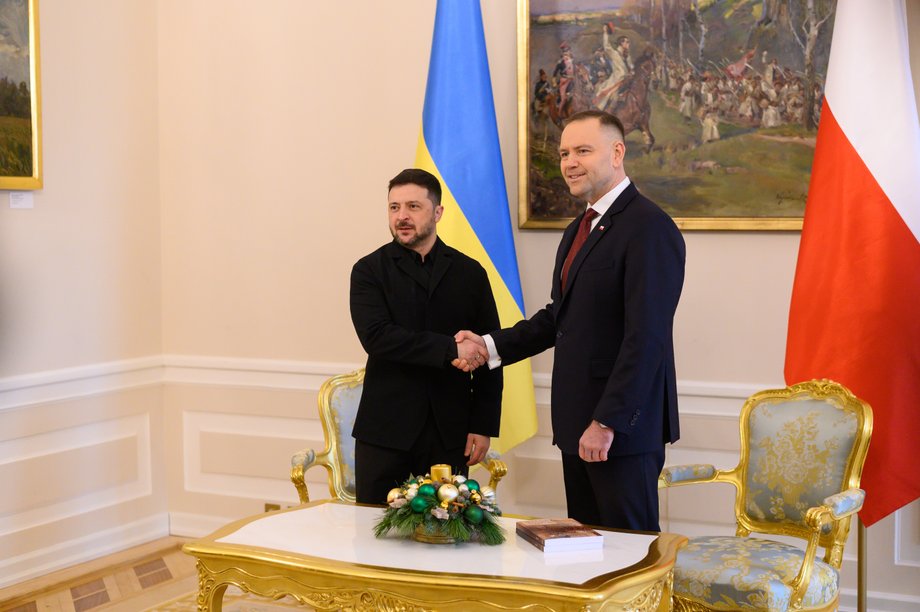
The Ukrainian president met on Friday in Warsaw with Karol Nawrocki, the head of the Polish state.
|
Aleksander Kalka/NurPhoto via Getty Images / Getty Images
According to Piotr Arak, the new European bonds are unlikely to be significant competition for Polish treasury securities, because the banks operating in Poland – and this is the largest group of buyers of the Ministry of Finance bonds – are not very interested in euro instruments.
— This will compete with other high-rated securities denominated in euro. There should be demand because it is an attractive product: safe and the profitability is close to that of Germany. Germany's fiscal expansion has increased the attractiveness of common debt. EU bonds used to be riskier than German ones, but today they are almost no different, says a VeloBank economist.
He adds that the very fact of making the decision to mutualize debt once again in history is symbolic, but it also shows significant divisions within the EU, because three countries broke away.
— The political aspect may be important: we are one of the countries that has agreed to bear the additional costs of maintaining the Ukrainian state and its war effort, for which we will pay a slightly higher EU membership fee. For now, only interest, and from 2028 we will also repay the bonds, which will not be rolled over as in the case of national securities. This is important in the context of growing pro-Russian, anti-European and anti-Ukrainian sentiments in Poland. It would be better to use Russian assets, but there is no consent for this in Europe – says Piotr Arak.
Author: Maciej Rudke, journalist of Business Insider Polska