Energy from the Baltic Sea in the spotlight. Experts on the advantages and costs of offshore


The auction, the results of which were announced by the President of the Energy Regulatory Office on the afternoon of December 18, selected projects from the so-called the second phase of the development of offshore wind energy in Poland – intended for implementation after 2030. For the first time, investors applied for public support as part of a competitive procedure (support under the first phase was granted by way of an administrative decision).
The rest of the article is below the video:
These are bilateral contracts for difference, i.e. an agreement between the producer and the state regarding the price of energy sold. When it is cheaper on the market, the state, through the Settlement Administrator, will subsidize the manufacturer up to the level agreed in the contract. However, when prices go up, the producer will pay the state. Obtaining a contract for difference is, in fact, a necessary condition for starting an investment in offshore wind farms – without it, the risk would be too high.
Read also: The first auction for offshore wind farms has been resolved. Here are the three winners
The state buys energy for the long term
Three projects with a total capacity of 3.3435 GW won the auction. These include the Baltic East Offshore Wind Farm, developed by Orlen Neptun, with a contract of PLN 476.88/MWh and a capacity of 900 MW, the Baltica 2 Offshore Wind Farm (PGE Baltica project, contract for PLN 489/MWh, 975 MW) and the Bałtyk I Offshore Wind Farm (Polenergia and Equinora project, contract for PLN 492.32/MWh, 1560 MW). The fourth starting project, i.e. the Baltica 1 farm of PGE Baltica, was lost. Support is to be granted for a quarter of a century, from the moment energy is introduced to the grid (beneficiaries were given seven years for this).). Prices will be indexed to the average annual inflation target.
Financing for farm owners in the case of prices lower than those in contracts for difference will come from the renewable energy fee that we all pay in our bills.
— There is no point in cheating; Offshore electricity will not be cheap – comments Michał Smoleń, head of the Energy team at the Polish Economic Institute. The costs of producing windmills at sea are higher than those of their onshore or photovoltaic counterparts. Nevertheless, the expert draws attention to the advantages of the mechanism.
– The instruments that support the development of our new, clean energy are called support systems, which sound like permanent subsidies. In practice, however, as a country, we simply contract for the purchase of a certain amount of energy on a long-term basis – explains Smoleń.
– It is important to remember that contracts are bilateral – if market energy prices turn out to be high, a stable rate will protect consumers. The state will then be able to spend the surplus revenues returned by producers, for example on some stabilization measures, he adds.
Read also: Offshore windmills are costing Poland more and more. Experts answer what's next
Offshore will fill the gap left by photovoltaics
He adds that without a guarantee of revenue at a certain level, investments would not be made, but we simply need them. – Competition in auctions has had positive effects; final prices are slightly lower than expected, says Smoleń.
The advantages of offshore, which our interlocutor points out, include more stable production than in the case of other weather-dependent renewable sources, but also its time profile.
– Wind energy will complement each other well photovoltaics. Today, we can produce electricity very cheaply on sunny days, but on cloudy days and in the winter months, the usefulness of PV sources is very limited. Offshore will largely fill this gap, especially given the difficulties in accelerating the development of wind farms on land, explains Michał Smoleń.
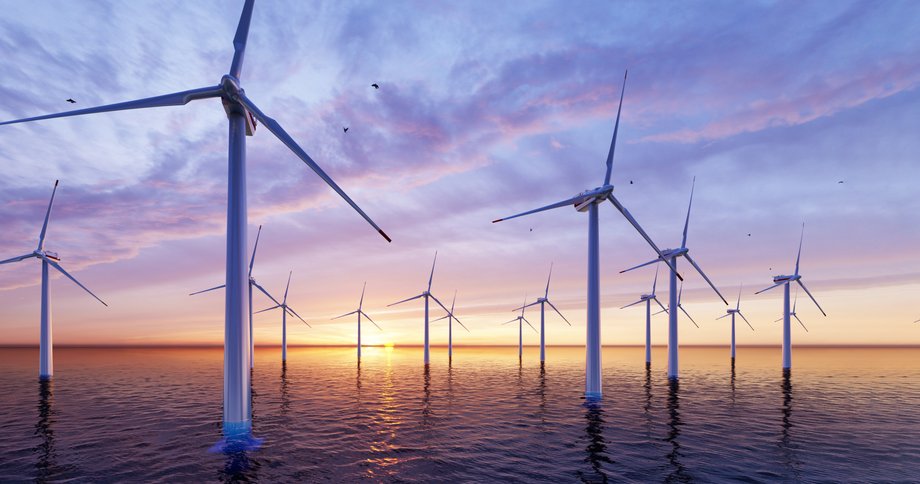
Offshore wind farm
|
ShutterDesigner / Shutterstock
He reminds us that, as a rule, the efficiency of offshore windmills is higher than that of land-based ones.
— Let's take a difficult, not very windy winter night after a cloudy day, e.g. in 2034. Benefits of photovoltaics – none, nuclear still under construction, wind on land: poorly. However, at sea the wind is more stable. This is when the electricity generated by offshore wind farms will be of particular value, along with gas and coal power, meeting the high demand for electricity. — the expert illustrates probable scenarios of the situation in the Polish energy sector.
How does offshore compare to nuclear?
A high share of offshore in the mix will support the electrification of heating and district heating – heat pumps, both in homes and large-scale ones in heating plants, will need a lot of electricity.
After the European Commission's decision regarding state aid for the first nuclear power plant, including the contract for difference, we now know that offshore and nuclear – two large energy sources located in the north — they will be relatively close in cost.
Read also: Will a green steelworks be built in the north? In Poland we can have clean steel
— Each of these sources has its advantages and limitations. A nuclear power plant can operate stably all year round – both on winter evenings that are difficult for the system, and on a June afternoon, when photovoltaics would be enough to meet the entire demand – says the expert. Offshore generation is variable and weather-dependent, but will play a particularly important role in winter.
He also adds that the advantages of offshore include shorter construction time, lower risk of delays and scalability. The first phase projects, which are to be ready by 2030, will achieve a total power higher than the nuclear power plant in Choczewo by 2040.
— Ultimately, the wind, both on land and at sea, the sun and the atom, will get in each other's way a bit and will not always be able to meet our needs. To balance the system, we will still need energy storage facilities, as well as available gas sources that can be switched on quickly and operate for a short time a year, he says.
“Wind energy up to the challenge”
We also asked the leader of the main industry organization to comment on the auction. – Wind energy has once again risen to the challenge. The auction went very smoothly, and the prices obtained guarantee an appropriate level of competitiveness on the Polish electricity market – says Janusz Gajowiecki, president of the Polish Wind Energy Association (PSEW).
He also adds that the construction of new farms will enable further development of the supply chain for the offshore industry, consisting largely of Polish companies.
— There is little talk about it, but the auction resulted in the establishment of further industrial plants working for offshore wind energy in our country. The “local first” principle that the government is talking about today will therefore be able to be implemented. Subsequent auctions in the coming years will strengthen impulses that will benefit the entire Polish economy – says Gajowiecki.
Offshore is more expensive than other renewable energy sources
According to PWEA, the added value of offshore investments for the Polish economy may amount to PLN 284 billion, with over PLN 55 billion in budget revenues. As for the future prices of electricity from offshore farms, analysts from the Bank Pekao Brokerage House also shared their predictions.
The experts took into consideration the so-called average unit cost of electricity generation (LCOE – levelized cost of energy), taking into account all cost components from the construction of the source, through its operation and future decommissioning. The analysis shows that with an LCOE of PLN 530/MWh, offshore wind energy is more expensive than photovoltaics (PLN 440/MWh) and onshore wind farms, which in this approach cost PLN 340/MWh.