Ursula von der Leyen takes a step back, after the violent protest in Brussels. The decision taken regarding the controversial EU-Mercosur agreement


The head of the European Commission, Ursula von der Leyen, informed the European leaders present at the EU summit, held in Brussels, that the signing of the trade agreement with the Mercosur countries has been postponed, three sources told the Reuters news agency on Thursday.
The publication Politico first wrote that the signing of the free trade agreement between the EU and the states of the South American bloc Mercosur has been postponed until January, a fact confirmed by two sources.
Two diplomats of the community bloc specified, for the publication from Brussels, that Ursula von der Leyen told the European leaders at the summit on Thursday that the agreement with Mercosur will not be signed on Saturday, as planned, but will be postponed until next month.
Brazil's President Luiz Inácio Lula da Silva announced that he had accepted Italian Prime Minister Giorgia Meloni's request to delay the signing of the agreement so that the head of government in Rome could assure the peninsula's farmers that they would not be affected by low poultry and beef prices, Ursula von der Leyen told the group of leaders, according to one of the diplomats quoted.
The last-minute move by Meloni derailed a self-imposed goal of signing the accord on December 20 with the Mercosur states, which include Brazil, Argentina, Uruguay and Paraguay.
But European countries backing the Mercosur deal, led by Germany, are pressing for guarantees that a new date will be set for signing the document.
“A date could be set in mid-January if the signing is delayed to 2026,” an EU official told Politico.
Meloni asked the Brazilian leader for more time for her to back the deal, Lula da Silva said Thursday, so the Italian prime minister could garner domestic support for the trade deal.
Several countries backing the deal, led by Germany, have warned in recent days that any further delay in implementing the deal could ultimately kill the trade deal. They are concerned that a further delay could embolden opposition in the European Parliament or complicate next steps when Paraguay, which is skeptical of the deal, takes over the presidency of the Mercosur bloc from current holder Brazil at the end of the year.
In an attempt to ease the concerns of farmers across the EU bloc, EU institutions rushed on Wednesday evening to approve additional text that would reimpose tariffs if Latin American poultry and beef imports destabilize European markets.
Violent protest by farmers in Brussels
Thousands of European farmers gathered in Brussels on Thursday for a protest against the free trade agreement between the EU and Mercosur bloc states, a protest that degenerated into confrontations with the police and acts of vandalism, Belgian media and AFP previously reported.
Demonstrators set fire to tires and threw potatoes and other objects at law enforcement, who responded with water cannons and tear gas.
A large police presence was deployed to protect European institutions, while the EU summit was also held in Brussels. The atmosphere was particularly tense in the Place du Luxembourg, in front of the European Parliament.
According to Brussels police, around 7,300 people took part in the authorized demonstration, with participants accompanied by around 50 tractors marching through the Belgian capital in what was initially a peaceful protest. But another 950 tractors gathered in the European quarter, where they blocked several streets.
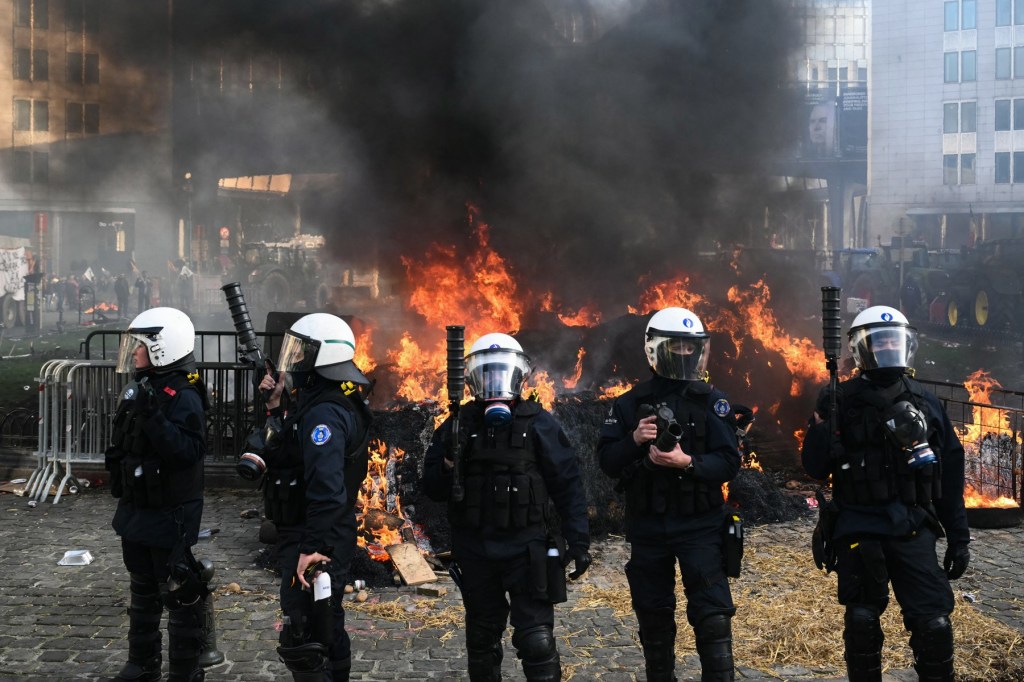 VIDEO Violent scenes in Brussels. The protest that gathered thousands of farmers from Europe degenerated into street fights near the European institutions
After some demonstrators became aggressive, the police resorted to water cannons and tear gas to disperse them, while the burning of tires and bins from which rose columns of black smoke visible from a distance amplified the image of violence of the protest. Masked individuals also broke several windows of a European Parliament building.
The interviewed demonstrators mentioned among their grievances the agreement with Mercosur and the reform of the Common Agricultural Policy (CAP), according to Agerpres.
The agreement with Mercosur has divided EU countries
The European Commission wants the free trade agreement with Mercosur to be adopted by the EU states by the end of the current year and has thus divided the document into two parts, one of which deals exclusively with trade, which allows it to ensure the adoption of the text only with a qualified majority (that is, at least 15 of the 27 member states and which together add up to at least 65% of the population of the community block) and eliminate the possibility of a veto by any member state, such as by for example, France, which is asking for the postponement of this vote until next year, in order to negotiate solid guarantees for European agriculture.
Instead, Germany, a country with an economy focused on the export of industrial products, is among those interested in concluding a trade agreement with Mercosur, which would facilitate the access of these products to the South American market, this being also an argument of the European Commission in favor of the agreement.
 Warning from Berlin: Without the EU-Mercosur trade deal, blocked by several states, Germany will not be able to pay more to the EU budget
On the other hand, South American agricultural products, which generally benefit from a cost advantage over European ones, will be able to enter the EU market more easily by virtue of this agreement, a situation that disadvantages European farmers and EU states with strong agricultural sectors.
The European Commission's proposals regarding the Common Agricultural Policy (CAP) represent another cause of dissatisfaction for European farmers, since in the future multiannual European budget (2028-2034) the funds allocated to this policy would be reduced by 20% and in addition the CAP would merge with the cohesion policy.