The document with security guarantees for Ukraine has been finalized, but Zelensky says “we decided not to publish it” / Sharp messages from Moscow


The document in which several countries detail what kind of security guarantees they are willing to offer to Ukraine after the end of the war with Russia, including a possible deployment of troops, has been completed, Ukrainian President Volodymyr Zelensky announced on Tuesday, who specified that this document will be made public only after a truce comes into force, informs the Spanish news agency EFE.
Meanwhile, Moscow has said that a ceasefire will only be possible if a peace agreement is reached, and it has reminded that under no circumstances will it accept the deployment of NATO forces in Ukraine.
Regarding security guarantees, “we have drawn up a document, but we decided not to publish it,” Zelenski said at a joint press conference in The Hague with Dutch Prime Minister Dick Schoof, according to Agerpres.
Zelensky, who met in Berlin on Monday with several European leaders at a meeting that also addressed security guarantees for Ukraine, said that the countries that make up the so-called “Coalition of the Willing” (or “Coalition of the Willing” – that is, countries that provide military aid to Ukraine and are also willing to provide it with one form or another security guarantees after the end of the war) will activate their commitments in this regard only “after the armistice.”
“Many countries are ready to help”
“It was a joint decision, we will then see what each country can offer” for these guarantees, depending on the legal and constitutional framework of each state, said the leader from Kiev.
According to Zelenski, the joint plan is being developed under the leadership of France and the United Kingdom, but “many countries are really ready to help” and insisted that the planned safeguards cover various areas, but not all countries will contribute troops, some could help, for example, with intelligence operations.
“It's about land, air and sea security,” Zelenski indicated.
He noted that the United States would hold talks with Russia on security guarantees and the reconstruction plan for Ukraine, and American negotiators would present Moscow with the 20-point Ukrainian plan, the latest counter-proposal by Kiev and its European allies to the 28-point American peace plan drawn up by Washington last month, which angered Ukraine and its European backers as it took up a number of demands of to Russia, including ceding to it the entire eastern province of Donbas (consisting of Donetsk and Luhansk regions).
Moscow's position
But Moscow has already rejected the changes that consultations held in Berlin in recent days between Kiev and Washington brought to the peace plan initially formulated by the US, even before receiving the plan in writing.
“I don't know what will result on paper after these consultations. But I don't think it will be anything good,” said Russian President Vladimir Putin's foreign policy adviser, Yuri Ushakov.
Putin is still waiting for US envoys Steve Witkoff and Jared Kushner, who held talks with Zelenskiy on Sunday and Monday in Berlin, to present his proposals following those talks.
Russian assets, in the eyes of the EU
But in the meantime, Ukraine's European allies are taking steps likely to amplify Moscow's negative reactions and complicate peace efforts.
Thus, the European leaders will try this week at the EU summit to reach an agreement to finance a loan of 90 to 165 billion euros intended for Ukraine from the Russian assets frozen following the sanctions, and they also announced a commission to deal with the payment of war “reparations” by Russia, which has already described such an initiative as illusory, reminding that only the losers in wars I pay for repairs.
Ukraine's European allies, who Putin has said are making unacceptable demands on Russia in advance so they can accuse it of not wanting to make peace, also insist on deploying troops to Ukraine as part of a peace deal, although Moscow has repeatedly said — and reiterated it Tuesday — that it opposes any presence of foreign troops on Ukrainian soil.
The messages sent by the Kremlin
Russia will not accept “under any circumstances (…) the presence of NATO troops on Ukrainian territory”, reminded Russian Deputy Foreign Minister Sergei Ryabkov on Tuesday, adding that the same position of Russia is also valid in the case of a deployment of troops from the countries of the “Coalition of the Will”.
Moscow also refuses, in addition to Ukraine's NATO membership, for it to receive security guarantees similar to Article 5 of the North Atlantic Treaty, the type of guarantees that, according to some sources, are already included in the document Zelenski talked about.
Russian Foreign Minister Sergei Lavrov reminded Europe that “when we talk about security guarantees, we cannot limit them only to Ukraine.” He thus referred to a long-standing Russian demand for a rethinking of Europe's security architecture, arguing that the West had “fooled” Russia by reneging on a NATO commitment not to expand eastward after the collapse of the Soviet Union.
In addition to the idea of deploying troops to Ukraine, another insistent demand of Ukraine and its European allies, now reaffirmed once again by Zelenski, is the conclusion of a truce before actual peace negotiations, a request always rejected by Russia.
This time, Zelenski and German Chancellor Friedrich Merz called for a Christmas truce, but the refusal from Moscow came immediately.
“We want peace, not a truce that would give the Ukrainians a break and allow them to prepare to continue the war,” Kremlin spokesman Dmitry Peskov said.
The only condition on which Russia would accept a truce, according to Putin's statements, is for Ukraine to completely withdraw its troops from Donbas.
Russian troops currently control more than 80 percent of Donetsk province and almost all of Luhansk province, and the complete takeover of Donbas under Russian control is a key condition for Moscow to make peace.
Merz's announcement about security guarantees
Under the post-ceasefire guarantees given to Ukraine by the United States and Europe, peacekeepers could, under certain circumstances, repel Russian forces, German Chancellor Friedrich Merz said in an interview with public broadcaster ZDF, adding that this remained a distant prospect, according to Reuters.
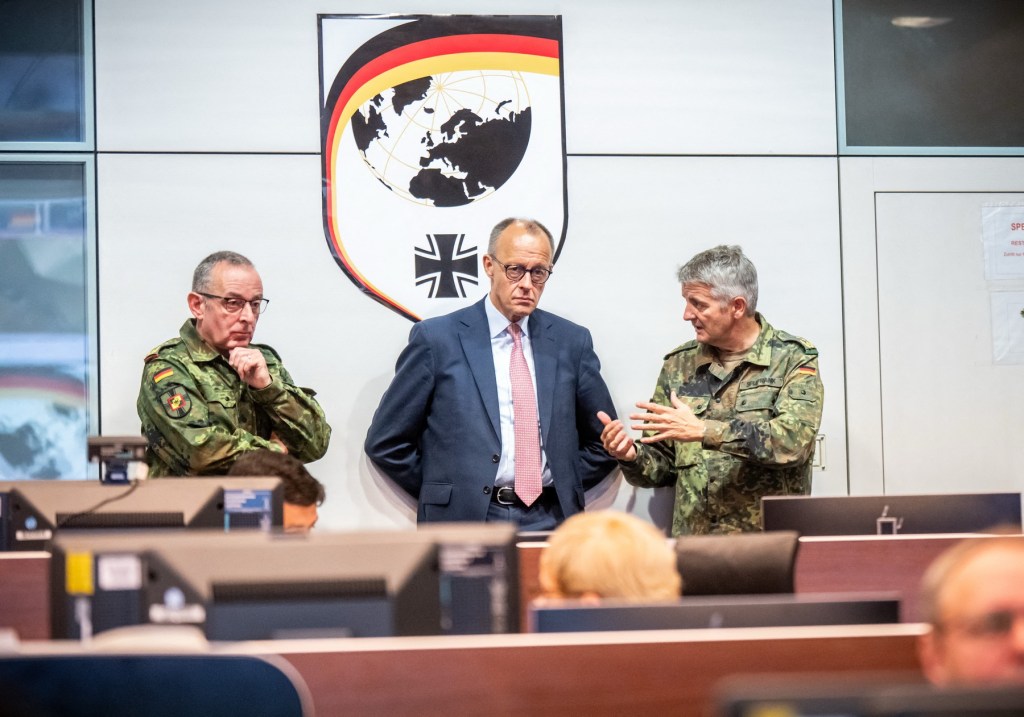 Chancellor of Germany, announcement about the security guarantees granted to Ukraine by the US and Europe. The role of Western troops after an armistice
“We would secure a demilitarized zone between the warring parties and, to be very precise, we would also act against corresponding Russian incursions and attacks. We are not there yet,” the federal chancellor said.
“The fact that the Americans have made such a commitment — to protect Ukraine in the event of a ceasefire, as if it were NATO territory — I think is a remarkable new position for the United States of America,” Merz added.