There's a moment every day when you realize you're not tired anymore, you're just tired of making decisions. I'm not talking about the choices that change your life, but the small ones: if you leave the heat on, if you turned off the light, if you forgot something in the socket, if there is any point in starting the washing machine at this time or rather the next day. They are decisions so small that you don't notice them, but many enough to throw you off your feet on a daily basis.
At CES 2026, the biggest technology fair in the world, where we usually see what our lives will look like in a few years, Samsung came up with solutions exactly for this area of invisible nerves. Not just with another gadget, not just with the “largest diagonal” or the “thinnest screen”, but with the idea that in a house of the future there is no longer a need for every device to constantly ask you what you want, if it can “read” what you want from your actions. SmartThings, Vision AI, AI Home and Bespoke AI are the pieces of an ecosystem that starts to understand the context in which you live and move with you. Let's explore together the house of the future piece by piece.
Home starts before you get home
There's a small, repetitive, almost invisible moment when you can tell if a home is truly “smart” or just full of devices: the moment you walk out the door. If you have to backtrack to check the light, if the question of the iron left in the socket lingers in your head, if the thought hits you that you left something on, then the house still works like it did in 2012, just with a more modern interface. And here comes the idea of AI as a partner, not as a feature, because the difference is not in the number of gadgets, but in the way they start collaborating without calling you every second to report.
In the logic of the ecosystem, SmartThings is no longer just a place where you see information about devices on the screen, but an infrastructure that connects them and makes them behave coherently. Basically, the house starts to organize itself around you and your routines, with the promise that it can save you time, energy and nerves, the very real currency of everyday life.
The hall, the place where the house knows when you're gone
The hall is the room where it is decided, in fact, whether a house is really smart or just full of gadgets. Here you throw your keys, open the door and leave. In the classic version, this means that somewhere in the back there are lights, sockets, heating, appliances that use electricity and a door that you hope is locked. In the version that Samsung shows at CES 2026, this moment becomes a signal for the whole house.
With SmartThings and AI Home, leaving home is no longer a series of checks, but a change in operating mode. When the home detects that no one is inside, it can turn off the lights, lower the temperature, turn off non-essential outlets and activate security systems. Not because you pressed a button, but because the system learns your routine and recognizes the pattern: you left, you don't come back immediately, the house automatically goes into away mode. All to enjoy a lower bill and probably less anxiety.
The kitchen, where AI starts to cut your expenses
The kitchen is the room where technology is not allowed to be slow, complicated or pretty. Here you want things that work fast and save you wasted money and wasted time. In the Samsung ecosystem, the kitchen is where Bespoke AI begins to be seen most concretely, especially through the new Bespoke AI Family Hub refrigerators presented at CES 2026. They can recognize what food you have in the refrigerator, track expiration dates and suggest recipes from what you already have, so you don't buy duplicates and throw forgotten food back on the shelf.
This is also where efficiency comes in, not just comfort. SmartThings-connected appliances can be programmed to turn on at cheaper power consumption intervals, notify you when an appliance is using more than it should, and show you where you're losing money without realizing it. In a classic kitchen, these are things you discover on the bill. In a kitchen designed as an ecosystem, you see them in real time and correct them without doing any more calculations or clicking ten apps.
The living room, the place where the TV becomes the nerve center of the house
In the home model that Samsung is promoting in 2026, the TV is no longer just a screen for Netflix. The new generation of Samsung TVs with Vision AI and state-of-the-art screens, including the new Micro RGB models presented at CES, become the main interface through which you see what is happening throughout the home. Through SmartThings, the TV shows you if you forgot something turned on, how much electricity the house is consuming in real time, which appliances are running and if any security alerts have appeared. Practically, the living room becomes the room from which you can see everything related to the house without living in applications.
The interesting part is that the same screen also starts to optimize the way you waste your time. Vision AI no longer just promotes what's popular, but adapts recommendations to your routine: what you watch in the evening, how long you stay, what type of content you abandon and what you finish. The result isn't a smarter TV, but one with less time spent fumbling through menus and more time actually watching something you care about.
The bedroom, the room that begins to fix your sleep
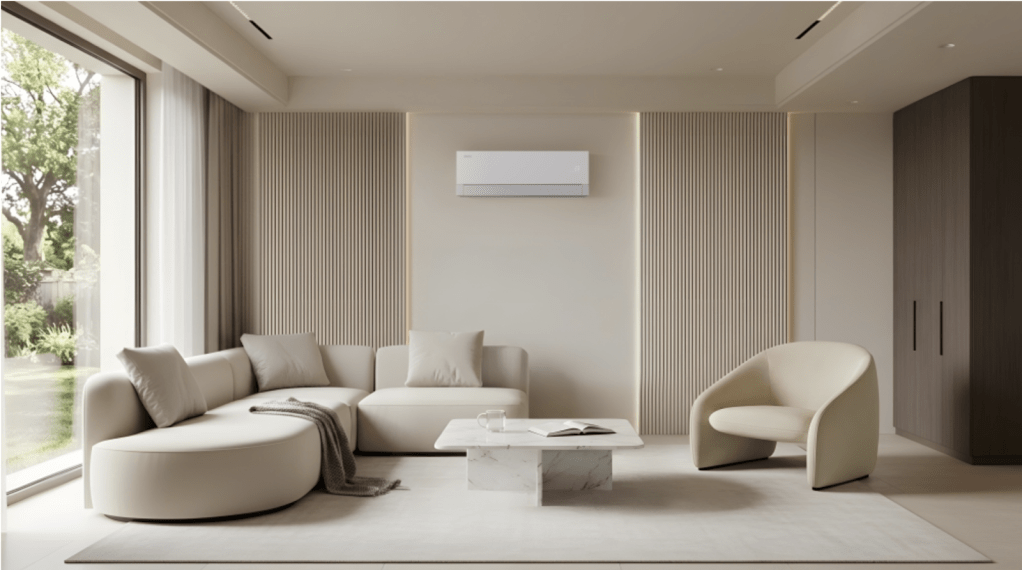
Through AI Home and SmartThings, lights, temperature and ventilation can be automatically adjusted based on the time, season and your sleeping habits. If you consistently fall asleep at the same time, the system starts to gradually dim the light and temperature without you having to set manual routines or open any apps.
In the air conditioning area, Samsung is pushing at CES 2026 the new Bespoke AI WindFree appliances, which cool and heat the room without direct air jets and automatically adapt their operation according to presence, temperature and time of day. Translated into real life: you no longer wake up at night because the air is blowing, you no longer sleep with the air on for fear of overheating, and you no longer forget to turn on the air conditioning when you leave home. The system learns your sleep routine and adjusts the room to be stable, not just cold or warm.
In the morning, the house can do exactly the opposite: the light gradually increases, the temperature returns to a comfortable level, and the appliances can be prepared to start in the cheaper consumption intervals. It's not just a smart trick, it's environmental control that starts working in your favor without turning you into a settings administrator. The result is not a more wow home, but one where you sleep better and consume more efficiently, without even thinking about it.
The bathroom, the room that cuts your waste of water, detergent and electricity
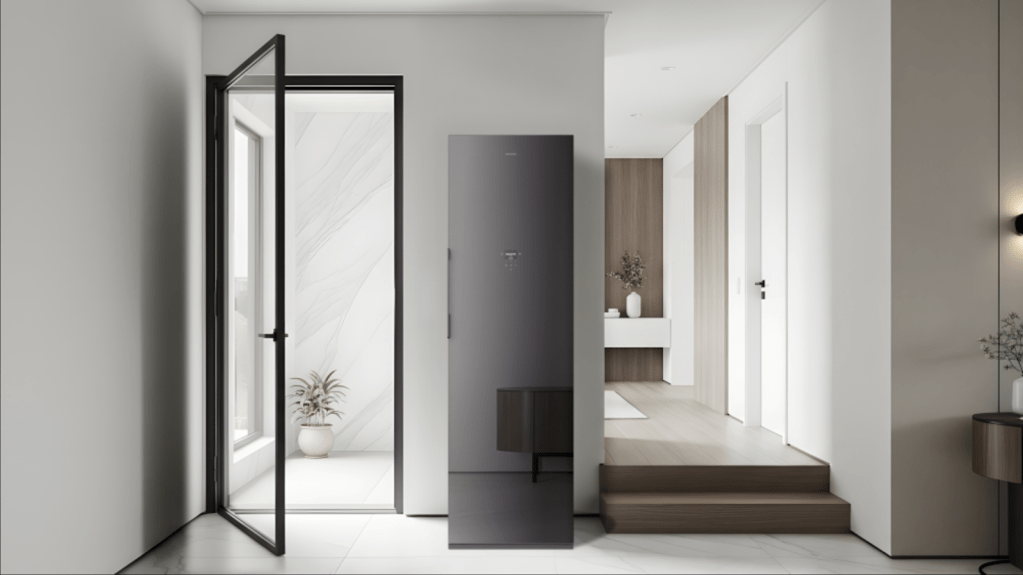
In the bathroom of a house thought of as an AI ecosystem, the first thing that changes is not the light, but the new Samsung Bespoke AI Laundry Combo washing machines presented at CES 2026. They no longer wash according to the schedule, but after you actually put in them: they weigh the load of laundry, analyze the type of fabric and degree of soiling, and automatically adjust the amount of water, detergent, duration and temperature of the cycle. In translation: less detergent thrown away, less water used and less electricity wasted with each wash.
Through SmartThings, the washing machine can be programmed to start in the lower rate ranges and shows you exactly how much each cycle consumes. It's not a gimmick, it's the difference between washing some clothes and knowing exactly how much the washing cost me. And when you connect it to the same system as the dryer or the AirDresser, the house starts synchronizing its cycles by itself, so that you no longer have appliances that consume a lot, stupidly and all at once.
In 2026, the home of the future proposed by Samsung at CES does not look like a showroom. It looks like a day when you don't triple-check the door, leave the heat on by mistake, throw food, and sit in the evening with the remote control in your hand not knowing what you want to watch. It looks like a home that starts to behave like an ecosystem that works for you, not like a collection of gadgets demanding your attention all at once. And of all the tech promises we've heard at CES over the years, this is one of the few that actually sounds like something that leads to a simpler life.
Article made in partnership with Samsung