Eastern half of Ukraine and Kiev 'close to total blackout' after intense Russian attacks in recent months


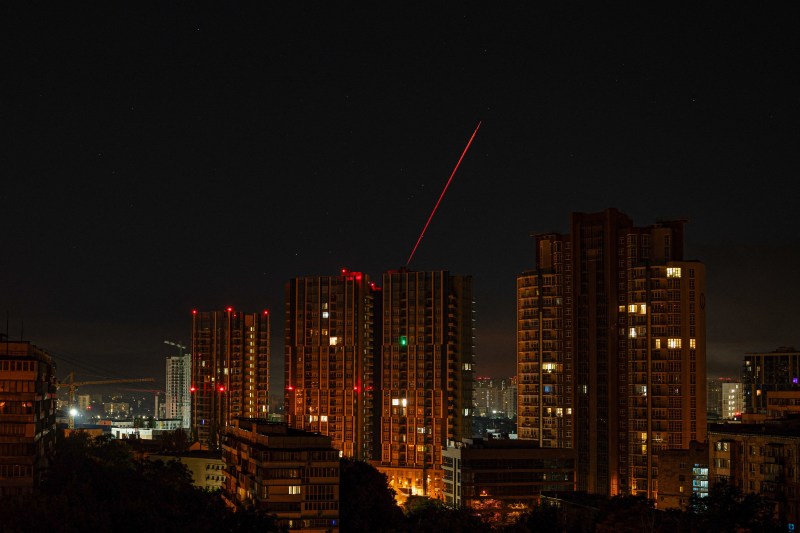
Ukrainian air defense activity during a Russian attack on Kiev, Ukraine, July 2025. Credit line: Middle East Images/ABACA / Abaca Press / Profimedia
Russia has attacked Ukraine's energy sector every winter, but this year the attacks are more intense and the power outages are worse than ever, the Washington Post writes.
Intense Russian bombing in recent months has brought Ukraine's energy grid to the brink of collapse, according to officials and analysts familiar with the situation, as Moscow seeks to demoralize Ukrainian society amid peace talks with the US.
Drone and missile attacks targeting energy infrastructure began in October and have since caused major power outages across the country as the cold snap sets in.
The attacks threaten to completely disable the systems that carry electricity from the west — where most of Ukraine's electricity is currently produced — to the east, which would effectively split the country, several people familiar with the crisis said.
“We are, if not one step away” from a total blackout in the east of the country, “then very close to it,” said a senior European diplomat who spoke to the Washington Post on condition of anonymity.
Russia does not want an energy truce
Ukraine, which has long suffered from attacks on its energy infrastructure, is in one of its worst situations ever.
In Kiev, residents already have to endure up to 16 hours a day without electricity, and businesses mostly run on generators.
One solution proposed by Kiev could be a partial truce, in which Russia would cease attacks on energy infrastructure and Ukraine would end attacks on Russia's oil and gas infrastructure.
But Moscow said last week it was unwilling to consider such a measure. Kremlin spokesman Dmitry Peskov said Russia was working for “peace, not a truce.”
5,000 drones and missiles in November
While blackouts are a regular occurrence in Kiev, this winter the attacks seem more consistent and targeted.
Deputy Energy Minister Mikola Kolisnik said Russia launched nearly 5,000 drones and missiles in November, compared with 2,000 a month earlier in the year, including hundreds of drones and dozens of missiles aimed at power plants, the transportation network and gas infrastructure, often focusing on a specific region.
Aerial attacks are not only stronger, but also more frequent, and that leaves less time to repair damage.
In early December, power workers managed to reduce the duration of power outages in Kyiv to 2.5 hours a day, Kolisnik said. But a major attack on the night of December 5 again severely damaged the power grid, and Kiev's electricity supply dropped drastically.
“We are one step away from a total blackout in Kiev,” a person familiar with the energy crisis told the US daily.
But in 2022, during a total blackout, major repairs took just two days.
If Ukraine gets the materials to make quick repairs and Russia doesn't repeatedly bomb the same locations, repairs could be made quickly and it won't be “the end of the world,” added the person, who also spoke on condition of anonymity.