Szymon Majewski, Business Insider Polska: How do companies in Poland approach electromobility?
Radosław Kitala, Senior Consulting & AMO Manager at Arval Service Lease Polska – a company specializing in vehicle rental and modern mobility solutions: Today, our customers use approximately 6.5 thousand fully electric cars. These are representatives of various industries, from large international companies to small and medium-sized enterprises. Many of them use the “NaszEauto” program or the previous “Moj Elektryk” program. There is also the public sector, which is obliged to increase its fleet of electric vehicles, among others. requirements of the Electromobility Act. However, private businesses or simply consumers are increasingly choosing this solution.
The rest of the text is below the video:
Why?
Today, companies are starting to care about building energy transformation strategies and reducing their carbon footprint. ESG issues play a significant role here and are emphasized here. Replacing company vehicles is often an important step towards zero emissions. Of course, this usually can't be done in one go – companies use a gradual replacement schedule for larger fleets.
An example of a brand that decided to take a bold step is AstraZeneca – a company from the pharmaceutical industry with over 1,000 cars in Poland, according to the company's declarations – by the end of this year. all company vehicles will be zero-emission. Initially, many companies found fleet electrification difficult and complicated, much more so than today; the infrastructure was less developed, cars had shorter ranges and probably not all employees were delighted with this decision.
For many electric car models, the so-called total cost of ownership (TCO). Many customers note lower operating costs and the fact that electric cars need to be serviced less often. Service intervals only occur after 30,000. kilometers traveled, or when the car itself decides that it is high time. In my case, the vehicle performed such self-diagnosis after 67,000 km. km and mainly because two years have passed since its registration. With my previous company car, I would have visited the service center four times during this time. Therefore, for many companies it is a matter not only of financial costs, but also of time savings.

Radsław Kitała
|
Arval / Arval
Electric cars are serviced less often
There are no difficulties?
There are many myths surrounding electromobility. People often have not experienced driving electric cars themselves and are afraid that they will not have a place to charge them or that it is simply complicated. Meanwhile, the infrastructure is not only solid – but also dense. Of course, there are still some difficulties, but you have to get used to electromobility because the situation is really good.
The infrastructure is now not only solid – but also dense
I drive almost 40,000 kilometers a year. km by electric car. Although in winter it is sometimes difficult to travel more than 300 km on one charge, it is a challenge of sorts. Two years ago, when I started using my current car, there were no car models on the market whose actual mileage would be over 500 km and would not require frequent stops. Today, such models are already available.
Read also: They checked the distances between electric chargers. Data from Poland are surprising
When choosing an electrician, the company should take into account additional factors, such as the mentioned range, battery capacity, but also the technology used, in particular affecting the charging time. Charging itself also requires the preparation of a separate strategy – whether the car will be charged, e.g. at the employee's place of residence, and the company will settle accounts with the employee for this. Other options to consider are charging at the company's premises or on a public network. There are additional tasks that show that the company needs to work a little harder when choosing electricians. Everything also revolves around business needs and what the company needs.
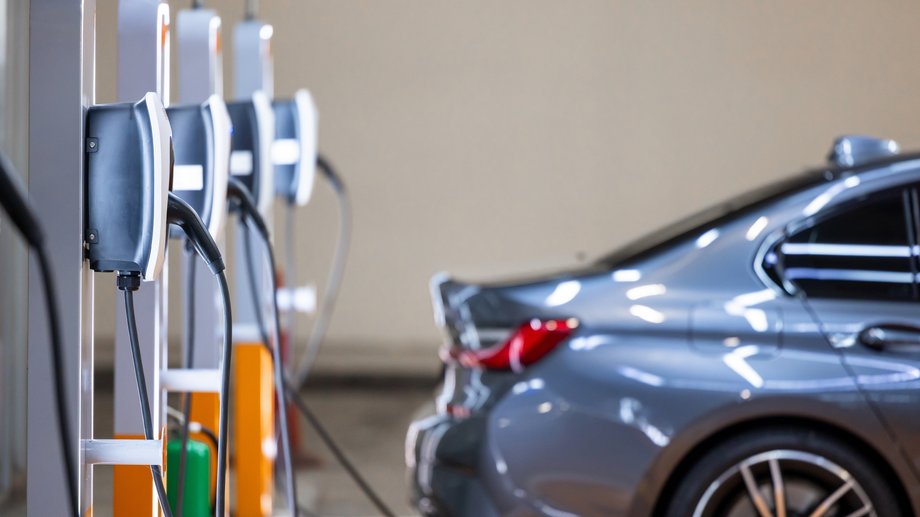
When choosing electric vehicles, a company must consider, among other things, where to charge them
|
Mayy Contributor / Shutterstock
At Arval, we attach great importance to education and building user awareness. Our offer includes, among others: Arval Flex service, which allows you to rent a car for just one month – both for individual customers and companies – so that they can check how the vehicle is driven and what the charging process looks like.
Many people fear that charging an electric car is complicated or requires a million apps. Today, one card is basically enough to use the entire network. Companies, in turn, must invest in infrastructure and meet the requirements in this area.
One card is enough to use the network
What are these requirements?
The Electromobility Act and the Public Procurement Act require companies participating in tenders to have at least 10 percent. zero-emission fleet registered to carry out the task provided for in the procedure. This is another argument for electrification. The Electromobility Act also imposes obligations to prepare a certain number of charging points for developers creating residential buildings and office buildings.
For at least 20 parking spaces, the owner must provide access to electricity for cars. The regulations are not tight enough; there are no appropriate control tools and sanctions. Despite this, companies are actually starting to invest in infrastructure and today this is one of the key challenges they face in the area of electromobility development.
Many enterprises are not afraid of electric cars, but are concerned about the possibility of effective and cost-optimal charging. The cheapest way is to charge it at home, then at the company tariff, and only finally in public infrastructure. These are differences from PLN 0.80 gross per kilowatt hour in the cheapest solution to almost PLN 4 in the case of a very fast public charger. However, the market is developing dynamically. In July we already reached 100,000. registered fully electric vehicles, and the expansion of charging infrastructure is progressing (over 11,000 points)
Can companies benefit from any support for the electrification of their car fleets?
After the end of the “My Electrician” program at the end of 2024, direct purchase subsidies for institutional customers no longer apply. Its successor, the “NaszEauto” program, apart from consumers, can only be used by micro-entrepreneurs. Large companies that have fleets have been omitted. Many banks offer green loans/loans or preferential interest rates if a given investment meets sustainable development goals. Even if it is not co-financing for the purchase of the fleet itself, companies often use the aid to build their own renewable energy sources, their own charging infrastructure, and then power electric cars at a lower cost.
Among our clients, we have examples of companies that, using their production buildings or simply their own headquarters, installed photovoltaic panels, which also allow them to power vehicles. I really like this approach, which increases the company's energy self-sufficiency and actually reduces emissions.
Companies can later officially demonstrate this by reporting the reduction of their carbon footprint?
Various regulations – EU directives relating to sustainable development, but also those related to, among others, air quality and reducing CO2 emissions – are becoming more stringent. It is true that the Omnibus package slightly relaxed and postponed the requirements for sustainability reporting, but many companies are implementing decarbonization strategies anyway. For many service companies that do not conduct manufacturing activities, the car fleet is often the largest source of carbon dioxide emissions – often up to 70%.
When used, electric cars do not emit CO2, but EU regulations require that the entire life cycle of the vehicle be taken into account, including the current used to charge it or the emission intensity associated with its production. Compared to other countries, the emission intensity of our electricity sector per kilowatt hour is still high. Fortunately, renewable energy is increasing, but it is still a challenge. In order to actually reduce their carbon footprint, companies can buy electricity from sellers with guarantees of origin that confirm that the energy sold is green. Then our electric fleet will actually become “clean”.
The need to report emissions based on measurable indicators is the main difference between ESG and the previously dominant CSR (corporate social responsibility – editor's note), which was much more declarative. What matters now is not words, but specific numbers – indicators. Companies are asked about them, for example when applying for financing. Companies also look at their supply chain, and as Arval we also receive such inquiries about our activities. Fortunately, we belong to the 1 percent. companies rated highest by EcoVadis. Our rating confirms that as a supplier partner we consistently implement the ESG strategy.
What is the “White Paper” you are preparing on the total costs of ownership (TCO) of vehicles and fleets in companies and their electrification?
This is a document based on real data collected by Arval Mobility Observatory from June 2020 to June 2025 in 15 European countries, including, of course, Poland. We show how in this period the costs of owning combustion cars in some areas increased by almost 30%. We note the division between fixed and variable costs – the former constitute only 40%. TCO. Variable costs include primarily fuel and energy costs. With the increase in fuel and energy prices in recent years, it often turns out that a combustion car costs us more per month than its electric counterpart.
Read also: Biofuels can be useful in decarbonization. But first they must be affordable
We want to show the evolution of costs over time and, on this basis, help optimize company energy transformation strategies. We included nearly 60,000 in our analyses. calculation. We hope that people managing company fleets will find information in our White Book that will facilitate conversations with company owners.