publication
2025-11-14 22:15
Friday brought a strong, over 2 percent, depreciation of gold. This happened after the rate of the “barbaric relic” tried to make up for losses after a rather drastic correction at the end of October.
On Friday at 10:14 p.m., the most active gold futures series on the New York Mercantile Exchange was trading at $4,080.81, 2.7% below the reference price. This is the strongest daily decline in the yellow metal in nearly three weeks.
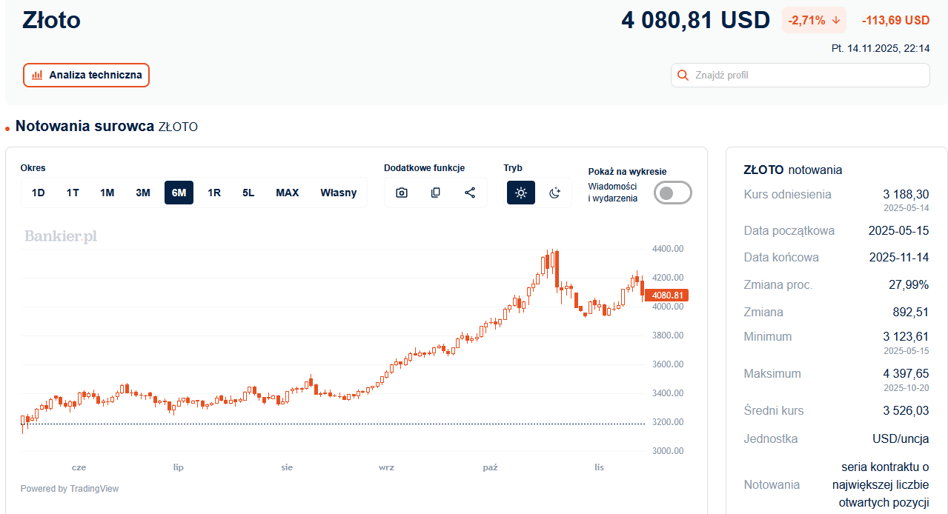
So we have a sequence of events. First, the end of August, the entire September and most of October were marked by a very strong appreciation of gold in relation to the dollar. In two months, the price of an ounce of the precious metal increased by over a thousand dollars, or almost 31%, to set an all-time record on October 20 of almost USD 4,4400/oz.
This version of the gold bull market ended in the atmosphere of a global shopping frenzy: people in Europe and Asia stood in long queues for physical bars and coins. There was also a huge inflow of cash into ETFs, which convert investors' money into gold bars. Not only the investing “street”, but also professionals from investment banks got carried away by the gold rush. At the end of October, Goldman Sachs forecast gold at USD 5,000/oz. in 2026 (this forecast still has a chance to come true).
This could end in no other way than a healthy and violent correction. Its first phase took place in the last decade of October, bringing the price of the royal metal temporarily even below USD 4,000/oz. The 10.7% decline occurred in just 7 sessions, which shows the dynamics of this corrective movement. Last week, however, the gold price went up again and on Thursday it reached almost USD 4,250/oz. We end the week at over USD 160/oz. lower.
Is the Fed behind everything as usual?
The “official” pretext for the decline in gold prices was the change in market participants' perception of the December decision of the Federal Open Market Committee. Just a month ago – when gold prices were rushing “north”, breaking all records along the way – the December interest rate cut by the Federal Reserve was practically considered a foregone conclusion. The futures market estimated her chances at over 95%.
But today (i.e. on Friday evening), the probability of a 25-point reduction implied by futures contracts is only 46%. It's almost like flipping a (fair) coin, where the odds of getting heads or tails are 50/50. Moreover, the possible lack of continuation of the series of rate cuts by the US central bank may raise concerns whether the Fed will cut rates in 2026 as willingly as market participants had been betting on until recently.
“The idea that we will see a lower likelihood of a December Fed rate cut has taken some of the wind out of the sails of gold and silver,” said David Meger, head of precious metals trading at High Ridge Futures, speaking to Reuters. It is known that gold, as a non-interest-bearing asset, usually performs well in an environment of low or decreasing real interest rates in the United States. Therefore, a possibly higher rate path in the Fed could actually thwart the goldbugs.
At this point, technical analysis with Elliott wave theory enters the scene, in which the classic correction takes place within the ABC pattern. This means that after the first wave of declines, there is a corrective rebound and then a “recovery” down in wave C. If this were to be the case this time, the bottom of wave C should be below USD 3,928.85/oz – i.e. the minimum of the October wave of declines.