In the big cities of Romania, the prices of real estate properties have registered constant increases in recent years, reaching in some cases to double the level of 2019, which is also directly reflected in the rent prices requested by the owners, according to a market analysis.

Rents have risen substantially in recent years. Photo by Shutterstock
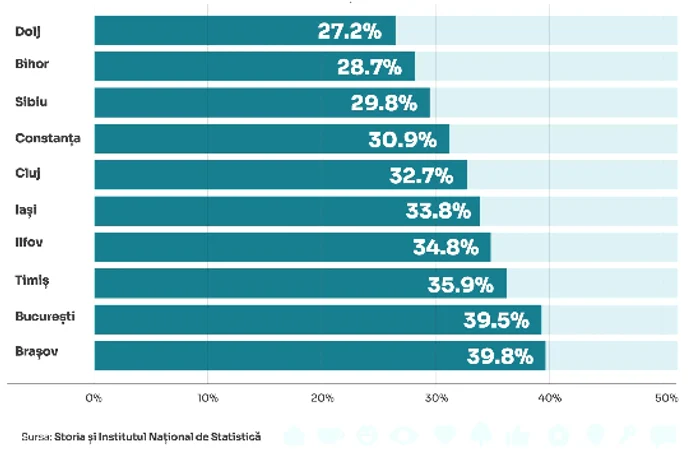
People living in Bucharest and Brașov allocate approximately 40% of their average net salary to pay rent for a studio apartment, more than residents of any other large county in the country, according to an analysis by Storia – the most visited real estate platform in Romania.
“Compared to the evolution of the average net salary, in certain counties such as Iași or Constanța, rents have become more affordable for residents, while in Bucharest or Brașov it is more difficult to afford rent compared to three years ago. On the other hand, there are some counties where rents have remained as affordable as in 2022”said Monica Dudău, Head of Marketing Real Estate Europe, OLX Group (Storia and OLX Real Estate in Romania).
The degree of affordability of the real estate market
The affordability of rents in the main counties of the country was calculated based on the average price requested by owners for renting studios, two-room apartments and three-room apartments in the advertisements published on the Storia real estate platform in October of the years 2022, 2023, 2024 and 2025.
The rents were correlated with the value of the average net salary from the respective month in the counties included in the analysis, according to the data published periodically by the National Institute of Statistics (INS). It is important to specify that for the rents requested in October 2025, the average net salary per county from September 2025 was taken into account, as these are the latest data available from the INS.
Also, the rents expressed in euros in the announcements were converted into lei based on the average exchange rate of the respective month published by the National Bank of Romania (BNR).
Finally, based on these parameters, rent affordability was calculated as the percentage of the average net salary in the respective county that a resident must allocate to paying rent for a studio, two-room apartment, and three-room apartment.
The analysis took into account the affordability of rents in Bucharest and the most important 9 counties of the country from the perspective of the development of the real estate market or the economy of the respective county: Bihor, Brașov, Cluj, Constanța, Dolj, Iași, Ilfov, Sibiu and Timiș.
Bucharest and Brașov currently have the least affordable rents in Romania
According to data on rents from October 2025 and average net salaries from September 2025, the least affordable rents are in Bucharest and Brașov county, where residents allocate almost 40% of their average net salary to paying rent.
It is important to note that while rents are the least affordable in Bucharest, the Capital has the most affordable housing when it comes to purchasing: residents need the equivalent of 4.3 average net annual salaries to buy a studio apartment, according to a recent analysis by Storia.
At least a third of the average net salary is allocated for the rent of a studio apartment by the residents of the counties of Timiș (36%), Ilfov (35%), Iași (34%) and Cluj (33%). Also to rent a studio, the inhabitants of Constanța allocate 31% of their average net income and are closely followed by the inhabitants of Sibiu (30%) and Bihor (29%).
Among the counties included in the analysis, the most affordable studio apartments for rent are in Dolj, where the residents allocate a little more than a quarter of the average net salary (27%), especially as a result of the income obtained by the residents of the county seat, Craiova.
On the other hand, although it is the second most affordable county for renting a studio apartment, Bihor is the least affordable county for renting a two-room apartment, as residents here pay a rent equivalent to 61% of the average net salary. In contrast, residents of 4 other counties pay approximately half of the average net salary to rent a two-room apartment: Bucharest and Cluj (52%), Brașov and Sibiu (51%), while Iași (44%) is at the top of the list of affordability.
For a 3-room apartment, Bucharest residents pay the equivalent of 63% of the average net salary, a slightly higher percentage than in Cluj (59%), but lower than in Brașov (67%). However, the largest share of income is allocated by the residents of Ilfov (95%), as most of the housing in the county is houses, while the most affordable counties for a 3-room apartment are Timiș (48%), Sibiu (50%) and Iași (54%)
In the last 3 years, the share of rent in salary has increased in Bucharest, Brașov and Timiș
One of the explanations why Bucharest and Brașov currently have the least affordable rents for studio apartments is that they have grown at a faster pace compared to the average net salary.
Thus, in 2022, the people of Bucharest paid 33% of the average net salary for the rent of a studio apartment, but the percentage increased to almost 40% in an interval of only 3 years. Meanwhile, in Brașov, the share of rent in the average net salary increased from 36% in 2022 to 40% currently. The only other important county where the share of rent in income has increased in the last 3 years is Timiș, from 28% to 36%.
Meanwhile, rents have increased at a similar rate to salaries in two counties: Cluj residents still pay around 33% of their salary on the rent of a studio apartment, while the share of rent is slightly higher in Ilfov county: 35%, also constant over the last 3 years.
On the other hand, in the other 5 analyzed counties, the residents currently allocate a smaller share of their salary to paying the rent. This is especially the case in Constanța county, where the share of rent for a studio apartment in the salary dropped steeply from 40% in 2022 to 31% in 2025.
Also, in Dolj county, the share of rent in salary decreased by 8 percentage points, from 35% in 2022 to 27% in 2025, and another example is Bihor county, where in 2022 residents paid 35% of their income for rent, to now allocate 28%. A smaller reduction in the share of rent in salary is also noticeable in Iași (from 38% to 34%) and Sibiu (from 33% to 30%).
The data also show that Dolj and Iași counties are the only ones in which, in the last three years, the share of rent in the average net salary has decreased for both studios and two- and three-room apartments.
On the other hand, the data shows that, in some counties, the situation is different for 2-room and 3-room apartments. An example is Brașov, where the share of rent in salary has decreased in the apartment segment, even though it has increased in the studio segment. Also, in Bucharest and Timiș, very small variations are observed in the share of rent for apartments, even if the share has increased in the case of studios.
However, there are also diametrically opposite situations, in which the share of rent for apartments with at least two rooms has increased, simultaneously with a decrease in the share of studios. Examples include especially Bihor, where the share of rent in salary for a two-room apartment increased from 47% in 2022 to 61% in 2025. Similar situations, but with slightly smaller variations over the last 3 years, also exist in Sibiu and Constanța.
Rents in Bucharest are almost as affordable as in Budapest or Prague
Strictly related to the value expressed in euros, rents in Bucharest are among the most affordable among the capitals of the European Union, according to the data published in the Property Index 2025 study carried out by the consulting company Deloitte, which took into account the average value of rents during 2024.
The Deloitte report expresses rents in euros per usable square meter. To find out the approximate value of the rent according to the type of housing, we have taken into account the legal minimum areas for studios and 2- and 3-room apartments, as mentioned in Annex 1 of Law 114 of October 11, 1996, also known as the Housing Law. Specifically, the legal minimum area is 37 square meters useful for a studio, 52 square meters for a 2-room apartment and 66 square meters for a 3-room apartment.
Thus, based on the data from the Deloitte report, the average rent in 2024 for a studio in Bucharest was 381 euros, and a lower value was recorded only in Sofia (296 euros). In contrast, all other European capitals have higher rents, including those in the region: Budapest (444 euros), Bratislava (570 euros), Prague (611 euros), Rome (644 euros) or Warsaw (931 euros). Meanwhile, in Paris or Madrid, rents for a studio exceed 1,000 euros.
An atypical situation is recorded in Vienna, where the data indicates a rent of only 400 euros for a studio apartment, as a result of the high proportion of social housing owned by the municipality, whereby rents are more or less kept under control. Also, the data indicates a rent of 681 euros for a studio apartment in Berlin, far below the values in other Western European capitals. Both the high stock of social housing and the regulation of the market by limiting rent increases, officially known as the Mietpreisbremse, contribute here.
On the other hand, if we also take into account the average net salaries in these European capitals, as mentioned on the Numbeo platform, it can be seen that in this respect Bucharest is approximately at the same level as many capitals in the region.
Thus, according to the correlated data from the Deloitte report and the Numbeo platform, Bucharest residents pay almost 28% of their salary for the rent of a studio apartment. For Bucharest residents, the share of rent in income is higher not only compared to Sofia (18%), but also compared to Prague (26%). Values close to Bucharest are also recorded for the residents of Budapest (29%) and Rome (29%).
And here it is worth noting the low share of rent in the average salary in Berlin (26%) and especially in Vienna (11%). At the opposite pole, the largest shares of rent in the average salary among the analyzed capitals are borne by the inhabitants of Paris (31%), Warsaw (32%), Madrid (38%) and, above all, Lisbon (46%).
The capital has the second lowest rent for studio apartments in the EU
The share of rent in the average net salary has not registered a unitary evolution at the national level during the last three years. In some counties such as Sibiu, Iași or Constanța, the average net salary grew at a faster rate than rents, which allowed the share of rent in wages to decrease.
On the other hand, in Bucharest, Brașov and Timiş, salaries have not kept up with the evolution of the rents requested by the owners, so it is more difficult for the residents to pay their rents.
At the European level, the data indicates that Bucharest is the capital with the lowest rent for a studio apartment, with the exception of Sofia. On the other hand, there are capital cities like Prague or Budapest where the share of rent in salary is very close.
Direct comparisons are influenced both by the higher salaries that residents earn in other capitals and by regulations in some cities such as Vienna or Berlin.