Russia is changing its tactics for Romania on the fly, the risks are increasing. “It's a new, more skillful model based on cognitive warfare”


Russia is adapting and perfecting its strategy on the fly to destabilize European NATO member countries, including Romania, warns professor Corneliu Bjola, from Oxford University. Romania is among the most vulnerable countries to Russia's hybrid actions, the expert claims.
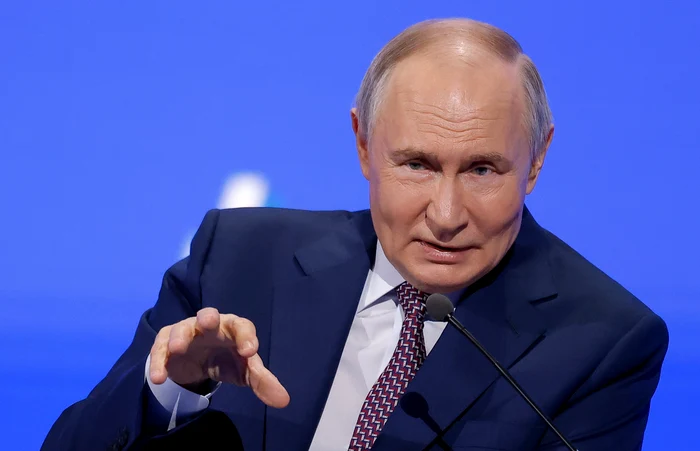
Putin's Russia will come up with an even more complex approach to the EU and Romania. PHOTO: EPA EFE
Romania and Europe in general have had a period of relative calm regarding Russia's hybrid actions. In recent weeks, Russian drones have flown somewhat less frequently over the airspace of NATO states, but it could be the calm before the storm.
Political scientist Corneliu Bjola, professor of diplomatic studies at Oxford University and director of the Oxford Digital Diplomacy Research Group, explains for “Adevărul” that Moscow is actually preparing for a new hybrid assault on Europe and Romania.
Russia is getting smarter
“I would say it's a new model, it's a more skillful, kinetic, hybrid model, based even more on a cognitive war. It has already been tested in Poland, but it will be further adapted, remodeled depending on the country where it is put into practice“, warns Bjola.
The expert also explains what Russia's next moves could be against Romania and the EU. Starting from the actions of the Russians in Poland, since the beginning of September, the Kremlin experts are preparing a real hybrid offensive, of what it means cognitive war, on Romania and other European states. It's an online front, but no less effective than a real one with tanks, drones and missiles. This is because Moscow realized that a military action against NATO would not give the results desired by Putin, but the most effective way to annihilate Europe is to weaken the EU and NATO member states from within.
“We remember that while the Russian drones were entering Poland, only a few minutes ago the online environment of this country was full of fabricated video images, so-called satellite pictures and many pictures that supported the idea that Ukraine and NATO would have launched those drones, and then they blamed the Russians. It was not an ordinary propaganda act, but an act of cognitive warfare, an effective one, because many Poles actually believed that Ukraine and NATO were staging them. As an absolute novelty, I would say it was the first time such a hybrid operation was directed at a NATO member state. And it was a success, because according to the first polls in those days, one third of the Poles blamed Ukraine and NATO. That was exactly what the Russians were after, and the confusion created shows that they achieved their goal.”says the expert.
What the expert anticipates
Cornel Bjola is convinced that Russia will repeat the actions in Poland and in other countries, and Romania will be among the first targeted. Romania's position towards the war, the support given to Ukraine and the geographical proximity make the only question to be when exactly the Russians will act. And if in Romania those who believe that there will be a war with missiles and tanks, Corneliu Bjola is of a completely different opinion.
“It is unlikely that Russian tanks will start going all the way to Paris or Berlin. The suspicion is that somewhere on the eastern flank, something will happen. Something will happen in the pattern we know. Very possibly with drones, maybe some rail sabotage, this kind of hybrid action that would lead to some altercations. That will be the first step, because the Russians want to test the American reaction as well. If the United States thinks that it has barely escaped Ukraine doesn't want to get involved and react to what they consider minor incidents. And they can do something new, unprecedented, to surprise us. And hence the fear that Russia will try to exploit this window of opportunity that it seems to have and expand its influence even further.“, says Bjola.
A complicated end to the decade for the EU
A time horizon in which the situation could become even more complicated, and Europe and Russia could enter into a collision, would be the years 2028-2030, Corneliu Bjola believes. This does not mean that it will necessarily lead to a military confrontation, but the risks will not be negligible.
“I would give a second element about time. Why 2028? Why 2030? At the moment, and this will be discussed at this European Council in December, they are going to try to get this approval for the roadmap, which was announced by Kallas (no – Kaja Kallas, the vice-president of the European Commission) in October, and which extends in four dimensions, starting from the drone wall project, on the eastern side, linked in end and of a certain airspace, which needs to be fixed. All this should in principle, at least the drone wall and the signaling or monitoring part, of raids, be completed somewhere around 2025-2026“, believes Bjola.
Russia cannot passively watch as the Europeans arm themselves to the teeth and will seek in every way to disrupt this process. On the one hand, the Russians will try to convince European nations that they do not need to arm themselves and that the money could be used for other purposes. For this, Moscow will work intensively with its intelligence agents and various politicians more or less officially affiliated.
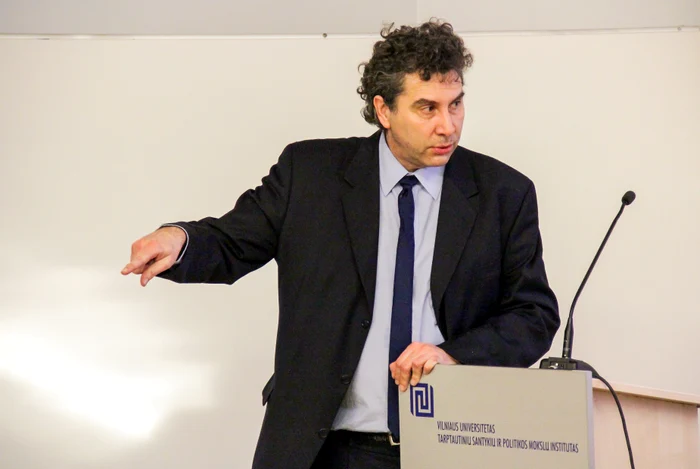
Corneliu Bjola
“If you are Russia, you don't want to wait until the European Union is endowed and has strong weapons. So the Russians will not sit idly by and act in a cognitive war in which they are improving more and more“, says Corneliu Bjola.
The course of events depends on the US
At the same time, the Russians will continue to take advantage of the cracks in the transatlantic relationship and widen them. Russia will also seek to validate the idea that a peace in Ukraine, regardless of the terms imposed on Kiev, is best at this time, so that allies will accept it willingly and out of necessity. The 28-point plan intensively debated in Romania is a good example.
“I would also note, for example, that nefarious plan mentioned with the 28 points. There are two very important points, point 2 and point 4 in that plan, which talked about the fact that at the end of the war in Ukraine, Russia will have to discuss with Europe, immediately, possibly, all the ambiguities of the last 30 years. Practically, in this way, Russia puts on the back burner the discussions from the end of 2021 and 2022, through which it wanted to achieve a series of maximalist objectives, reducing NATO's presence in the east of the continent. There is also a certain window of opportunity for them at the moment, and it's a pretty wide one, given that there is an isolationist faction in Washington. And this faction is perhaps less heard in some moments, due to the fact that there is still a Marco Rubio and there is still a category of people, including in the US Congress, who do not agree with the abandonment of Ukraine”Bjola also points out.
Thus, the camp led by JD Vance, which campaigns for the idea that the US should detach itself from the Europeans, is not completely decided, even if it has an ascendant. “
“It will also be important to what extent the Congress will do its duty, because this will directly affect the countries of Eastern Europe, including Romania, but also the United States of America. We see that the United States has changed its strategic option, and America has a confused strategic trajectory, absolutely confused, because for 70 years they have defined themselves as a, let's say, maritime power. What does this mean? They, being a continent, are trying to project their power, developing capabilities through naval forces, so that their presence can be demanded in different parts. The United States has never been a continental power, as it is, because Washington has not been threatened. But what we see at the moment is that the United States, with the Trump administration, is moving towards this paradigm of territorial power, in Venezuela, in Canada that changes this whole paradigm. Now, in the USA, there is a struggle between two visions, determined also by certain economic constraints. The big problem is that at the moment Europe is in the middle. And there are problems especially with Eastern Europe, which traditionally does not have great strategic clarity, with the exception of the Baltics and, to a certain extent, the Poles.”claims Bjola.
Romania, just as pale, devoid of ideas and confused
The bad news is that Romania continues to lack ideas, it is confused, and the new national security strategy is not realistic and is not adapted to the times and the big challenges, says Corneliu Bjola. This makes it vulnerable to Russia's subversive actions and shows its Western partners that far from being a country that contributes to the security of the area, Romania is one of the most vulnerable states.
“Looking at the defense strategy, I see absolutely no signal sent by Romania that shows that we have what is called strategic clarity. And this is a big problem. Strategic clarity always remains deficient with us and it is aggravated even more by this new concept, which seems to me quite problematic, of solidary independence. At the moment when you have to close ranks, this is the worst signal that Romania can send to the world”concludes Corneliu Bjola.