Budgeters justify their inefficiency by complaining about bureaucracy, corruption and favoritism in the administration

Bureaucracy, thick legislation and a lack of digitization are the biggest problems of the public sector, which state employees have identified in the institutions where they work, according to a nationwide survey of public sector employees.
Budgeters complain about corruption and favoritism in the administration
A nationwide survey conducted by the APSAP Training Center, in which public administration employees answered key questions about how they work, what confuses them, what motivates them and what they expect from the system in which they work, shows that the top three problems they face are related to excessive bureaucracy – 62% of employees; thick and contradictory legislation – 47% of employees and lack of digitization – 37% of employees. These three aspects are perceived by most employees as major causes of administrative inefficiency and the difficulty of providing fast and modern services to citizens.
However, the survey also highlights other significant structural problems that affect the performance of the public sector:
• Inefficiency and lack of accountability – 31%
• Corruption and favoritism – 30%
• Lack of motivation and professional training of employees – 29%
• The interference of the political factor – 26%
• Underfunding and poor management of resources – 25%
• The gap between central and local administration – 12%
“The answers confirm, unequivocally, that public sector employees are extremely aware of both the limits they face on a daily basis and the directions in which the administration needs to evolve. They indicate very clearly that simplification of procedures, real digitization and a coherent and enforceable legislative framework are the essential pillars of genuine reform. These priorities can no longer be postponed if we want a modern, efficient administration capable of providing quality public services”, declares Bogdan-Costin Fârșirotu, president of the APSAP Training Center.
The employees who identified these problems overwhelmingly work for a long time at the state: 33% have worked for more than 15 years in the same institution, 8.2% for 11-15 years, 17.6% for 7-10 years, 18.4% for 1-3 years, 15% for 4-6 years, 7.5% for less than a year.
“A man who has been in the same institution for 15 years will inevitably continue to reproduce what he learned at the beginning of his career, in the context of a world that no longer resembles the one in 2008 or 2010. You cannot ask for digitization, innovation, openness and change in a system where 40% of people work in exactly the same place since the fax machine was used. You cannot have dynamic institutions when half of the staff have never changed office, department or type of activity“, explained Fârsirotu.
Huge consumption of paper sheets in the age of digitization
The lack of digitization remains a major problem, given the evolution of technologies. Asked if there are frequent queues at counters or public work points at the institution where they work, more than 47% answered almost never, 24% very rarely, 20% only on certain days or time slots and 8% daily.
Digital signatures are not often used in the public sector either. Although more than 65% of respondents said they have a qualified digital signature, very few actually use it, even though the price of such a device is quite low. Specifically, 40% said that in the last year they did not use a digital signature for any document, and 35% signed between 1 and 10 documents with a digital signature.
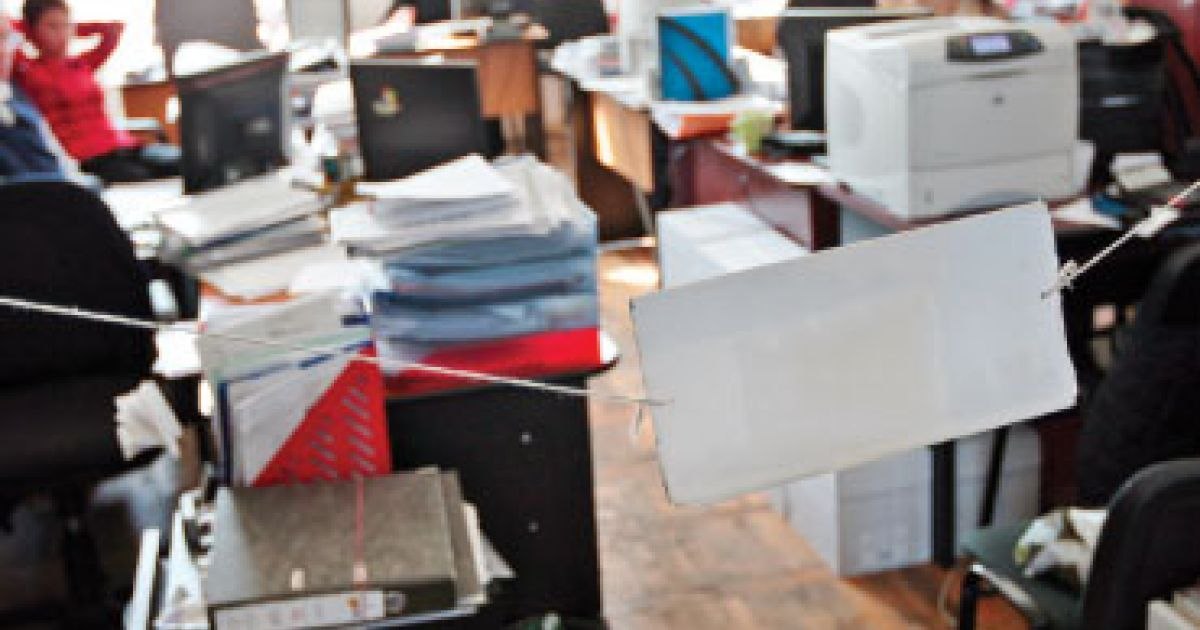
In a world where digitization is accelerating and more and more processes are becoming digital, paper consumption in Romania has remained the same, say 31.3% of respondents, it has increased especially in the last 2 years according to 20% of respondents, respectively it has increased significantly, say 18% of budget managers. At the opposite pole, a small percentage, 9.4%, say that the consumption of paper has decreased significantly.
Thus, over 51% of state employees mentioned that they use monthly between 100 and 500 sheets for printing documents, in their daily work. Also in more than 50% of cases, the same amount of printer paper is consumed as 3 years ago or slightly more in 2025. In 20% of cases, the consumption of paper sheets decreased slightly.
“The survey data clearly shows that the lack of digitization is not only related to the infrastructure of the institutions, but also to the level of skills of the employees. Four out of ten respondents say they only have basic digital skills, and over 60% do not hold any certificate attesting to their levell”, added Fârsirotu.