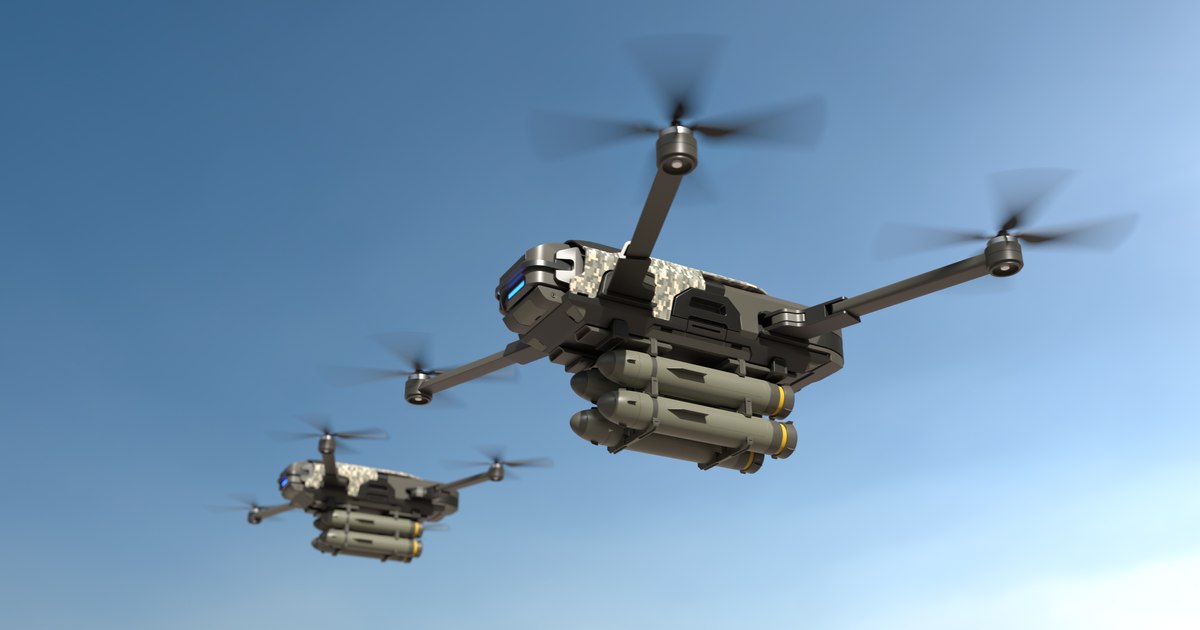
The dramatic rise in the importance of drones in the conflict in Ukraine is transforming both the way battles are fought and the entire industry. According to comments from Kiev, nearly three-quarters of Russia's losses on the battlefield are caused by drones. On the other hand, advances in technology and tactics have played a role in Russia's increased offensive in recent months.
The war in Ukraine strongly developed the drone industry. Photo by Shutterstock
This is “the first drone war“, with widespread use, says Richard Fontaine, director of the Center for a New American Security in Washington. In the Middle East and Africa, drones play a visible role in conflicts, believes XTB analyst Claudiu Cazacu.
Production of such equipment has accelerated in recent years, with a growing number of startups, and for companies in the field with government contracts that are listed on the stock market, investor enthusiasm has been unstoppable, at least until recently. In the U.S., shares of AeroVironment (symbol AVAV ) are up 64.8% this year, but that's after declines that erased more than half of their nearly 162% advance from their October peak.
Talk of peace fueled the continuation of corrections that began in October for defense stocks in the stock market on both sides of the Atlantic Ocean and even in Asia. In Europe, Rheinmetall shares are down 27.1 percent from their Sept. 29 peak.
Rheinmetall, which makes both drones and anti-drone systems and has plans for specialized guns and high-energy lasers, was the star of the German stock market this year, with its shares up from 604.6 euros to nearly 2,000 euros at the end of the third quarter. Even after the corrections, stocks were up 140.8% on the year Tuesday morning. Its profit margin is expected to increase from 15.7% this year to 17.2% next year and 20% in 2029.
For many of the other European and American manufacturers, including Leonardo, Lockheed Martin, Saab or BAE Systems, profit margins are expected to remain stable between 11 and 12 percent in 2029 and 2030. While they are appreciated by investors, too high profit margins could attract the displeasure of taxpayers. The subject would, however, become truly pressing as these margins increase towards 2030, while in the short term the focus remains on increasing defense capabilities.
The adjustment of quotations in the capital market and the passing of the period of maximum enthusiasm was also seen in the case of the company spun off from ThyssenKrupp, which was listed on the stock exchange this year. Shares in TKMS, the naval and submarine division of ThyssenKrupp, fell 23.2 percent from the close on the first day of trading. The company makes several types of drones, including attack submarines and mine clearance vehicles.
The need to protect against an ever-increasing number of drones with rapidly developing technology has driven the search for defense solutions, and a lesser-known Australian company has been a major beneficiary. DroneShield stocks have advanced 9 times this year at their peak. Here too, however, the wind has changed since the beginning of October, and continued on a downward trend with the plan to end the conflict discussed by the US.
Since the peak, losses have reached 70.2%. However, since the beginning of the year the shares are on a “respectable” advance of 162%. The A$1.7 billion company announced in November a deal with a European distributor of A$5.2 million for anti-drone equipment.
More and more types of drones are appearing, with varied attributions
On the battlefield, the initial advantages of the Ukrainians' use of drone technology have begun to fade. Russia, for its part, has begun using fiber-optic connected drones, avoiding the jamming of the electromagnetic signal used in earlier versions. At the same time, a new explosive charge managed to destroy anti-drone protective nets used to secure roads and other targets.
The losses forced a launch of drones from greater distances behind the front, limiting the region accessible to Ukrainian attacks.
The complexity of the products is also increasing: in addition to reconnaissance and attack drones, there are also those used to relay signals, with the mission of covering the real position of the operators. Their vulnerability has become a key aspect in the recent clashes in Ukraine.
Also, beyond the small or medium-sized ones, they increase the capabilities of the large ones, one of them managing, according to a recent announcement by Baykar, to shoot down aerial targets with autonomously launched missiles beyond visual range. In addition to aerial ones, drones used on water or underwater are growing in importance, both for reconnaissance and attack missions. Two oil tankers were recently attacked by Ukrainian drones near Turkey, and a third vessel carrying sunflower oil from Russia to Georgia was attacked on Tuesday.
A new stage of development based on artificial intelligence, with swarms of drones controlled by a single operator, or even acting completely autonomously, could rewrite the rules of war in the not-too-distant future. Talks about peace in Ukraine mean pressure on headlines driven by perhaps too much investor excitement in the first three quarters of the year. Smaller, less diversified companies with high prior valuations have recently been the most exposed to declines.
The relative importance of drones, however, seems to increase as technology advances. Both the large companies with divisions building drones and anti-drone technology, as well as some of the new names, small but specialized and competitive, could receive the attention of long-term investors, given the growing budgets for the defense sector, despite some very volatile episodes on the stock market this year, adds Claudiu Cazacu.