EXCLUSIVE The survey kept secret by the PNL and its role in the elections. How many people were undecided until the last moment


A survey carried out for the PNL by Novel Research and which has not been made public until now managed, a week before the vote for the Capital City Hall, to most faithfully capture the order and scores for the main candidates. HotNews spoke with Marius Marcu, director of Novel Research, about this survey and the role of sociological research in the context of citizens' elections.
All the big polls that appeared publicly before the elections for the Capital City Hall failed to accurately capture the scores of the candidates. Whether we are only talking about the estimated scores for some candidates, or the final order of the candidates, or the magnitude of the lead that the winner Ciprian Ciucu would eventually have over his opponents.
HotNews centralized 18 large polls published in recent months, and an analysis of the average scores placed Ciucu in second place with a score of almost 22%. In reality, Ciucu won with 36.16%.
Nor was the order of candidates generally correctly predicted. According to the average of the polls, Băluță was the favorite with 25% (she finally got 20.5%), and Alexandrescu was seen in 4th place with 17.5% (in the end she ranked 2nd with 21.94%).
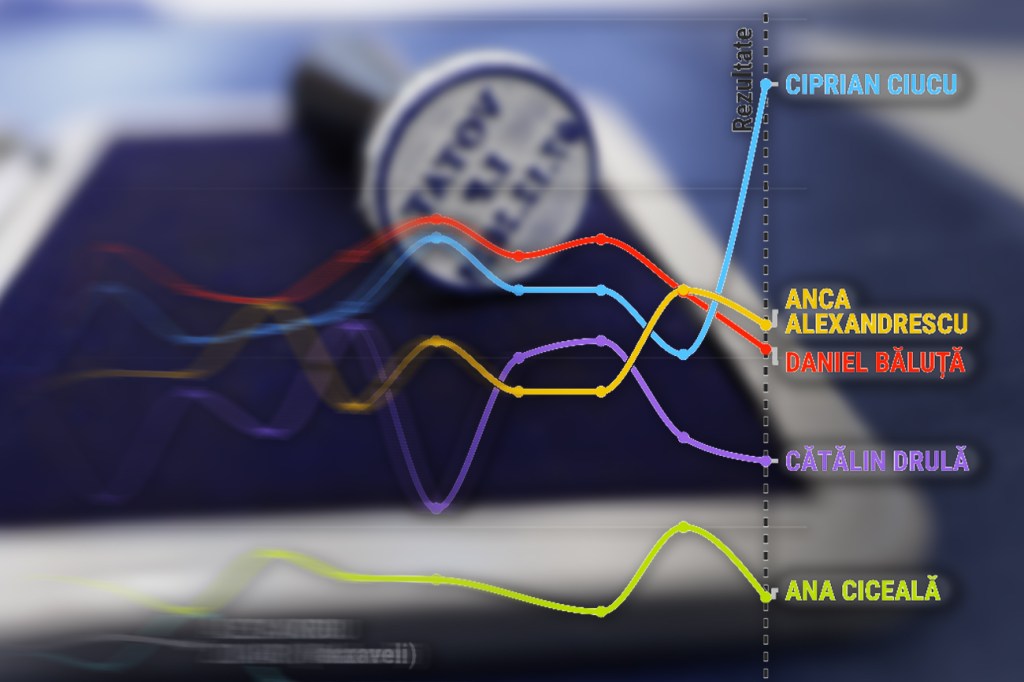 INTERACTIVE How wrong the polls were, again, in the elections in Bucharest. What Italy did after a similar situation / Examples from other European countries
The closest scoring poll has not been made public
However, there was a survey conducted in the market, but not made public, that provided the closest figures to the final score.
Not only did he give the correct order of the candidates, but he gave Ciucu the clear winner, even if in this case a little underestimated compared to the final result.
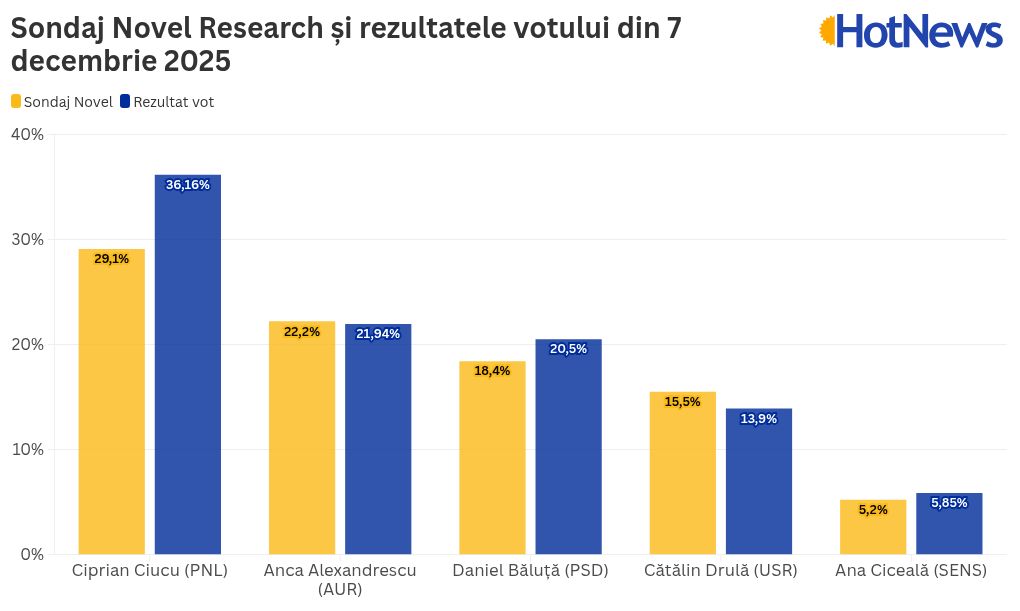
The survey obtained by HotNews was conducted between November 24-28, a week before the elections) by Novel Research for the PNL. The survey was not made public by the PNL, although the party had previously published the results of a survey conducted by the same institute at the end of October.
The Novel Research poll was conducted by telephone, on a sample of 1,001 people, with a margin of error of +/-3%.
The poll showed the following score by voters likely to go to the polls:
- Ciprian Ciucu (PNL) – 29.1% (election result: 36.16%)
- Anca Alexandrescu (AUR) – 22.2% (election result: 21.94%)
- Daniel Băluță (PSD) – 18.4% (election result: 20.5%)
- Cătălin Drula (USR) – 15.5% (election result: 13.9%)
- Anca Ciceăla (SENS) – 5.2% (election result: 5.85%)
Marius Marcu, director of Novel Research: “There is no magic in the middle”
How did this poll manage to catch the ashes so close to the final results when most polling institutes were pretty much wrong about the candidates.
“There is no secret in what we do, there is no magic in the middle. The same thing happened in 2020 when the elections were held and Nicușor Dan won, and then we fell within the margin of error. We also fell within the same margin of error in 2019 at the European Parliament, without any problem,” Marius Marcu, director of Novel Research, answered HotNews' questions.
“I tell you what we do, I don't know what others do. When you respect the methodology and all the working principles that are also on the ESOMAR website and all the procedures are correct and audited and everything is done according to the book, the numbers come out without any problem. You need a little order and discipline in what you do”, explains Marcu.
They expected a larger turnout, “but the bad weather made the turnout drop evenly everywhere”
He also says that he expected that from the date of the survey until the day of the vote there would be more changes, especially in the case of Ciprian Ciucu because “he was on an upward trend”.
At the same time, he also says that the estimates for a high turnout have been decreasing in the last days before the vote. Forecasts showed a possible 10 percentage point higher turnout even a week before.
“It is also obvious that this aspect can alter the results. Now the reasons for the decrease are varied. This time, the bad weather made the non-participation decrease uniformly everywhere, but apart from that, there is still a rather large difference in Ciprian Ciucu (No. Higher result compared to the score in the survey) which means an evolution there. The trend was upward. How far it could increase we could not estimate at the time when we did the research,” he says Mark.
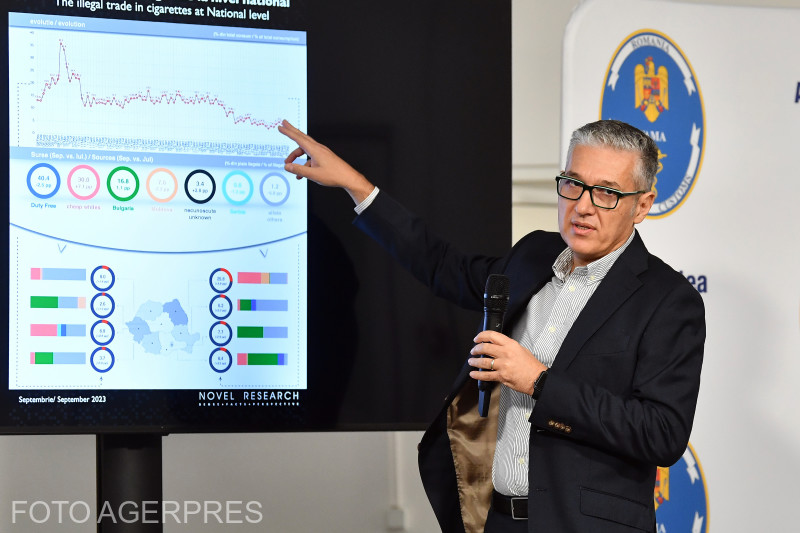
Was it a “useful vote” in Ciucu's case?
The director of Novel Research also says that, in general, in electoral campaigns “evolutions are quite volatile” and can lead to changes, but he does not believe only in the theory of the “useful vote” given to Ciucu as the simple reason for the very high score obtained by the liberal candidate.
“I don't think it's about a useful vote here, but rather I think it's about the way Ciprian Ciucu positioned himself during the whole period. That is, a fair man, a man put to work, everyone knew him to be put to work”, says Marcu
“Actually, you always have a combination of factors, not a single influencing factor. It would be wrong, from my point of view, being a statistician by trade, I'm not a sociologist, let's just talk about a useful vote. I'm a statistician and I can tell you that there is always a combination of factors. There is not just a useful vote.”
“That's the biggest mistake we can always make. It's an accumulation of factors that are quite intercorrelated with each other. And it may also be a useful vote, it may also be his positioning, which was a very good one, it may also be a stronger voter turnout, a stronger mobilization of his voters compared to the others. It's certainly not a single factor, that's very clear,” says Marcu.
30% of survey respondents were likely to switch their vote from one candidate to another
He draws attention to the fact that in the survey conducted a week before the vote, there were two indicators that measured the degree of undecidedness and the possibility that some of the voters would change their vote to another candidate.
This is in the context of the hypothesis that some voters would have been undecided until the last moment with whom to vote, with Cătălin Drula or Ciprian Ciucă, and they chose close to the day of the vote to vote for the candidate with better chances.
In the survey, the percentage of undecideds was 3.4%, “quite small”, says Marcu. “In principle, an average level is somewhere around 6-7%. Anything above 7% is already problematic.”
The other indicator showed the average vote volatility, measured in the Novel research survey at 32.5%.
“This shows the possibility of moving votes from one candidate to another. Now there was a normal degree of volatility, it happens in any type of election, it was not out of the ordinary for Bucharest. In general, you can reach 50%. When you have 50%, for sure [situația din sondaj] it will not remain valid for one week. When you have 30%, it's a normal average”, explains the founder of Novel Research.
Many people are undecided until the last moment?
He says that he does not believe the theory that there was a large enough core of voters who stayed until the last moment, undecided with whom to vote between Drula and Ciucu.
“Basically, in the last week there are fluctuations. But it doesn't necessarily come from undecideds. People simply have a main and a secondary voting option. Usually the probability of changing it decreases in the last days. That is, the option crystallizes, but there is this 30 or so percent that indicates the possibility of changing the voting option. There is this probability that they will change it, but that does not mean that they will change it,” says Marcu.
The low attendance at the elections, and against the backdrop of negative campaigns, believes the director of Novel Research
The turnout in the elections in the Capital was 32.17%, the lowest turnout that led to the election of a mayor so far. A week before the vote, sociologists estimated from the data of that time a much higher turnout. Why, after all, was the level of attendance so low?
“It's hard to say. The same. There are a lot of factors that correlate. One, probably, is the state of the weather. The second is the fact that there were quite a lot of counters in this campaign. This is probably also an advantage of Ciprian Ciucu, that he didn't attack, he didn't come with a negative campaign. And, probably, people built the mobilization on his positive campaign as well.
Negative campaigns do this, to decrease mobilization. If we look historically, speaking from 2000 onwards, the demobilization of people comes against the background of scandals and against the background of negative campaigns. Always when the campaign is positive and everyone communicates positively, the presence is very high and this can be seen in countries where this thing happens”, says the director of Novel Research.
Andrei Roman, AtlasIntel: “The polls had a very important role from the point of view of democracy to guide the voters to make a rational choice”
Marcu claims that, according to the school of thought he joined as a sociologist, the publication of so many polls before the elections is harmful, “you risk creating conflict in society”.
Of course there are several schools of thought in sociology relative to surveys.
For example, Andrei Roman, from AtlasIntel, whose survey correctly gave the order Alexandrescu – Băluță, but missed Ciucu, admitted his errors, but claims that the public has the right to be informed about trends in society. Roman's argument is that “the polls had a very important role from the point of view of democracy to guide the voters to make a rational choice”.
“Before we blame the polls because there were last-minute changes between preferences related to various candidates, I think it is good to understand what could have happened if these polls had not been conducted. If these polls had not been conducted, for example in Bucharest, the right-wing electoral pool could have remained perfectly divided, cannibalized between three options, without any transparency on the candidate who would have, who actually had a relatively higher preference compared to the other two,” the CEO of Atlas Intel also said.
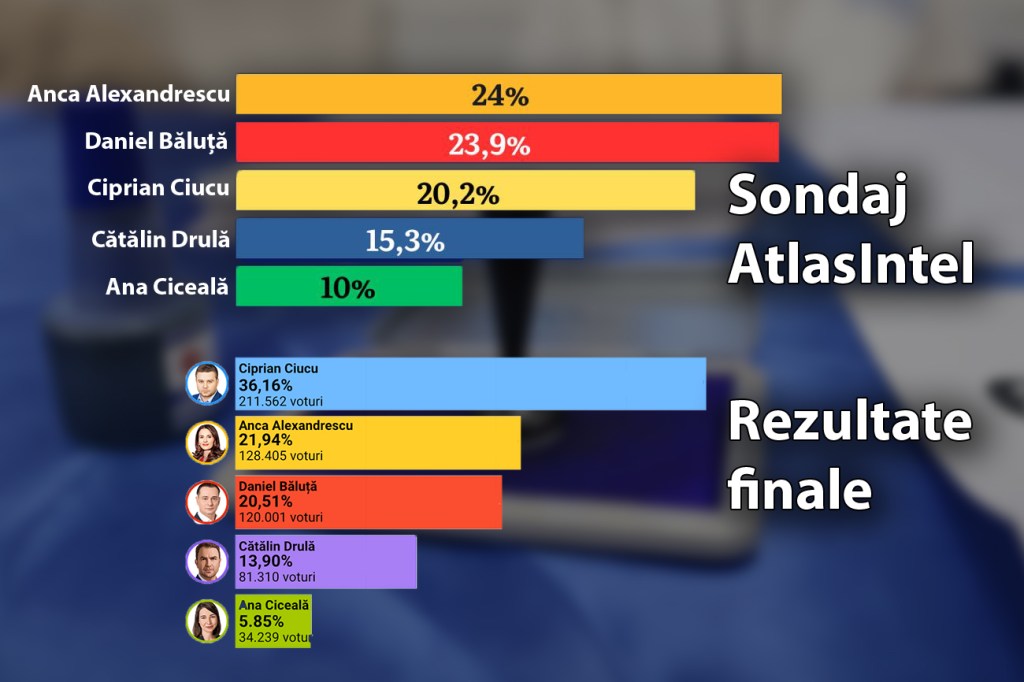 How the head of AtlasIntel explains the last survey for HotNews in which Alexandrescu was slightly ahead of Băluță, and Ciucu was underestimated by 16%
Marcu: “Polls are not made to be published in the press, otherwise we end up knowing everyone like in football”
On the other hand, Marius Marcu, director of Novel Research, does not agree with the publication of surveys.
“We are reaching a phase of this where the survey becomes like football. Everyone is good at surveys, but we are talking about surveys as an analysis and decision tool in the end, not how to be contested like on the football field,” says the sociologist.
“Polls are not made to be given to the press. Polls are made to make some decisions based on them, because they are quite difficult to interpret, there are many indicators there, many numbers. They are directional indicators to see where they move, how they can move. If you don't interpret them in the total general context of all the indicators, you can draw the wrong conclusion,” he says.
“From my point of view, the surveys are for internal use, to analyze the data and make decisions based on them, because otherwise you risk creating conflict in society. You do not present an indicator of direction and volatility because no one understands it or the majority of the population does not understand it. Only those who are used to these data know how to interpret them,” said Marius Marcu, director of Novel Research.