2025-12-10 06:00
publication
2025-12-10 06:00
After two years of circumnavigating Africa, there is a chance for the return of container ship traffic through the Red Sea on the horizon. The suspension of attacks on merchant ships by Houthi rebels in response to the ceasefire between Hamas and Israel has opened up the prospect of unblocking the Suez Canal. Nevertheless, shipowners are waiting.
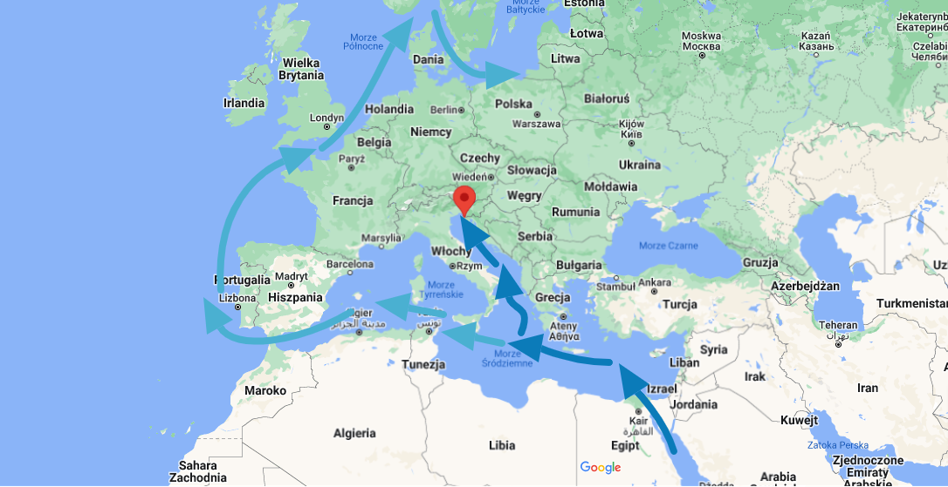
One of the most important maritime transport routes has been closed since November 2023, when attacks by Yemen's Houthi rebels forced shipowners to reorganize their routes. The crossing of the Red Sea and the Suez Canal shortens voyages between Asia and Europe by over 3,000 nautical miles and about 10 days compared to the route around Africa. As a result, it is much cheaper, saving companies between USD 30 and USD 50 per container (TEU).
Before sailing is suspended, Goods worth USD 1 trillion flowed through the Suez Canal annually, which would amount to approximately USD 2.7 billion per day. The route handled up to 15% of world trade and had twice that share of global container traffic. According to the online magazine ThinkChina, Chinese goods worth USD 280 billion (PLN 120 billion in imports and USD 160 billion in exports) flow through there every year.
There is also a sea route through the Red Sea of great importance for Egypt, which achieved over $10 billion in revenue in 2023 thanks to the Suez Canal. Due to Yemeni Houthi attacks on ships, this value dropped by 60% a year later. It is therefore not surprising that the country's authorities want to return shipping as soon as possible. At the beginning of November, Admiral Ossama Rabiee, president of the Suez Canal Authority, met with representatives of the 20 largest shipowners, assuring them of improving safety in the Red Sea. Egypt also regularly offers discounts to carriers. However, companies prefer to wait.
The silence on the Red Sea continues
– Shipowners still do not want to bear the high risk associated with freight through the Suez Canal – a single container ship is worth hundreds of millions of euros, plus the value of the cargo – comments Michał Madej, Sea Freight Import Manager at DSV: Global Transport and Logistics.
As the expert emphasizes, currently, apart from local feeder connections (routes operated by smaller units transporting containers between large and local ports), there is only one year-round service between Asia and Europe on the Suez route and few carriers decide to use this route. According to Michał Madej, none of the large Asian shipowners sent their vessels through Suez this year, and the route is used sporadically, e.g. on return flights to make up for delays in European ports.
Stabilization in the region is too fragile to risk returning to the Red Sea route. According to DSV sea freight analysts, in the short and medium term the actions of the Suez Canal Authority will not bring the expected results. The operation of reorganizing the routes would require a huge organizational effort and would involve high costs. After two years of operation of the route around Africa, economies and businesses have already adjusted to the extended transit times.
– For the sea freight sector, predictability is the foundation. Implementing changes to current operations that would be necessary to restart the Suez Canal route is too risky because stability in the Red Sea region is too fragile. The potential benefits in terms of shortening transit times or reducing CO₂ emissions are not yet sufficient. We must also remember that the good intentions of shipowners are not enough to rebuild shipping. The key issue is to reduce the cost of insurance policies, which will not happen unless there is a lasting reduction in the number of incidents in the Red Sea region – says Michał Madej.
European ports may be blocked
ING analysts also wrote about the importance of the insurance rate for the return of shipping through Suez in a report published on December 1. According to them, carriers will probably start testing the route when returning from Europe to Asia with less cargo. Another issue that is keeping shipowners from returning to the Red Sea is the fact that after a year of tensions and restructuring in the industry, schedules based on the route around the Cape of Good Hope have stabilized. Delivery reliability has improved and no one wants to risk switching between routes multiple times.
At the same time, ING analysts emphasized that while returning to the Red Sea route would be a logical move, it is also the “elephant in the room.” Returning to the old route will not be without disruptions. “Earlier-than-expected ship arrivals may cause congestion at ports, which in turn may again clog container terminals and cause delays in the movement of ships and empty containers in supply chains. Container lines may suspend sailings to mitigate this effect, but overall freight rates may increase, especially if this change coincides with the Chinese New Year,” the ING report said.
– In the first weeks after the resumption of shipping, we would probably experience a significant increase in the load on European ports, which are already struggling with congestion. At some point, there could be a situation in which vessels using a shorter route, as well as those sailing around Africa, would call at the port. The issue of port workers who regularly go on strike remains an important risk factor. In conditions of increased load, an intensification of this type of activities cannot be ruled out – comments Michał Madej.
This would pose serious challenges for Europe. Today, key ports such as Rotterdam, Antwerp and Hamburg have their yards filled to 70-90%. The accumulation of goods would make this problem worse. However, analysts agree that everything will eventually return to normal. “After cruise schedules stabilize, significant pressure to reduce rates is likely,” ING analysts believe, adding that the planned introduction of new ships into service and the forecasted low growth volume in container traffic should also contribute to reducing transport costs in 2026.
Prepared by MM