Behind-the-scenes talks between the US and Russia reveal a systemic void. Peace in Ukraine and the future of Europe are decided by “Trump's personal emissaries” [OPINIA]


US President Donald Trump continues to try to end the war in Ukraine. After another cooling of relations with European partners, tougher rhetoric towards Kiev and the leak of transcripts of friendly US-Russian talks, Steve Witkoff flew to Moscow as if nothing had happened – this time accompanied by Jared Kushner.
In Moscow, they quickly sensed that American diplomacy was going into overdrive today. Europe, sidelined and held in a waiting room, watches with growing frustration as unmandated envoys take on the role of negotiators with the Kremlin.
And the more decisions are made outside the official circulation, the bolder we become Moscow is pushing the limits of what it counts on in talks with the West.
Steve Witkoff's position in the American foreign policy decision-making system remains peculiar and difficult to clearly classify. The only thing that can be said for sure about his role is that he ate fried crab dumplings in a Moscow restaurant. Formally, he does not even have the status of an official negotiator on Russia. His previous experience is primarily related to the Middle East, where the US has actually achieved measurable successes.
Who exactly is Mr. Witkoff?
Witkoff has no diplomatic powers: he is neither an ambassador extraordinary and plenipotentiary, nor an envoy for special tasks. He did not undergo the confirmation procedure in the Senate, nor did he agree with influential congressmen on the scope of issues he was to deal with in Moscow. He was also not accepted by Congress, so – unlike a classic special envoy – does not represent the multi-layered US political system.
The situation is further complicated by the fact that the United States does not currently have an ambassador to Russia — and there is no indication that one will be appointed soon.
In practice, Witkoff acts as a personal emissary of President Trump.
Initially, this format apparently suited Congress. However, after the leak of the “28-point project” and the subsequent disclosure of information about an extremely confidential conversation between Witkoff and Ushakov, dissatisfaction with his actions is becoming more and more visible in the ranks of Republicans.
Until Trump came along, the big question was under what conditions Vladimir Putin is ready to end the war. Now there is a new unknown: what model of peace Donald Trump expects – through Witkoff, and now also through the US president's son-in-law Jared Kushner, who, significantly, does not formally represent anyone.
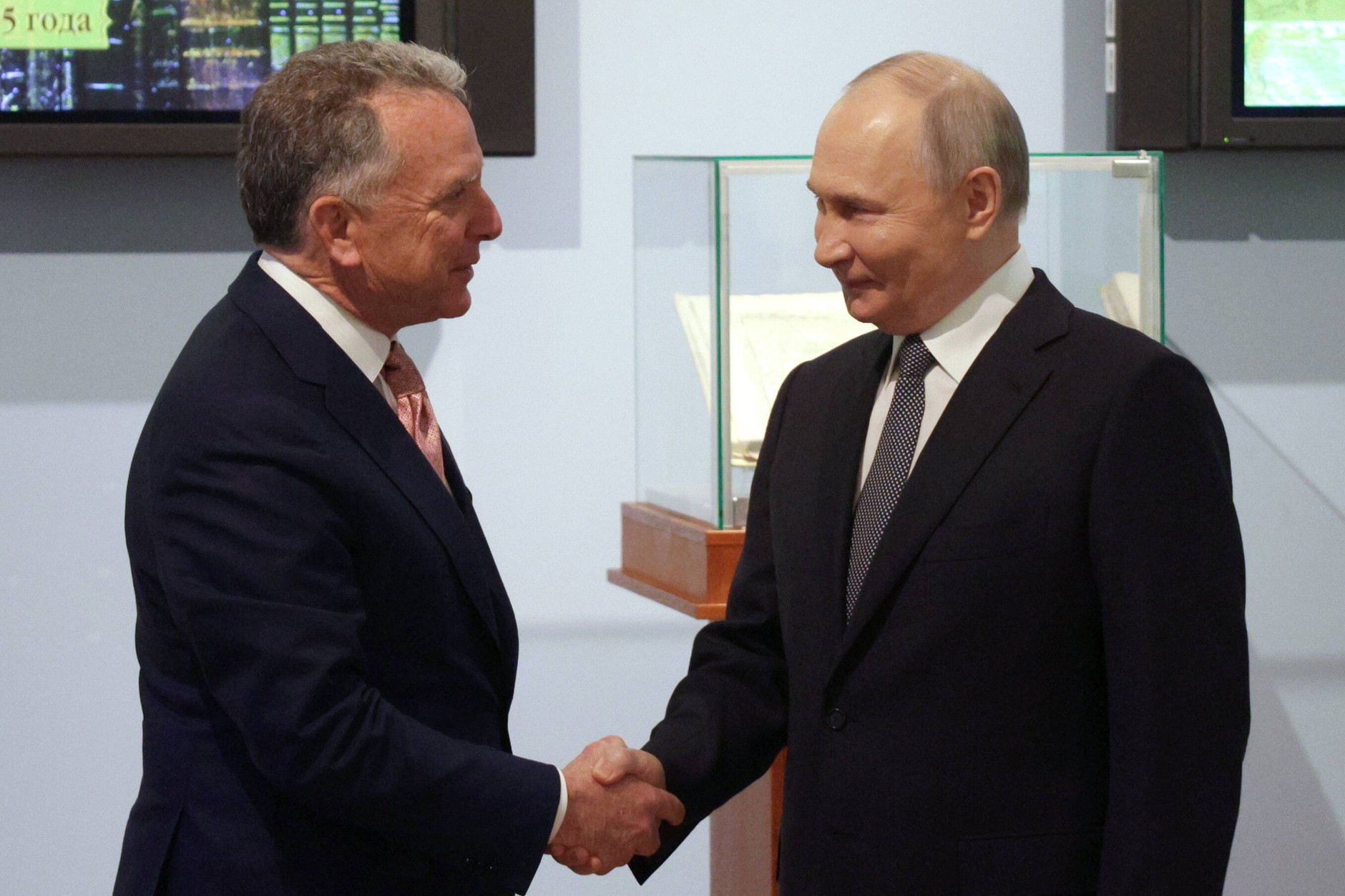
From the left, US special envoy Steve Witkoff and Russian President Vladimir Putin during their meeting in Saint Petersburg. Russia, April 11, 2025GAVRIIL GRIGOROV/SPUTNIK/KREMLIN POOL / POOL / PAP
Behind-the-scenes tricks
It is obvious that Trump is trying to negotiate favorable economic conditions for the US. In return, he is trying to formulate a peace proposal that would be acceptable to both Russia and Ukraine. For Trump, the issue of sanctions is not an insurmountable obstacle – rather, he treats them as a pressure tool. Loosening them could make Russia economically dependent on the US, open access to its resources and at the same time make it
cooperation with American business would become more attractive to the Kremlin than continuing the war.
It is precisely around the policy towards Russia and the war in Ukraine that the Congress – rarely seen recently – was born. bipartisan agreement between Democrats and Republicans. This is actually the only topic that does not cause heated disputes – except perhaps the issue of the publication of materials regarding the Epstein case. Formally, the Congress cannot directly influence the negotiation process because traditional diplomatic mechanisms have been significantly limited. However, after the leak of the “28-point project” and information about the Witkoff-Ushakov conversation, congressmen began to demand that the talks be subject to parliamentary control.
This pressure becomes even more important as at least four new provisioning bills are being prepared in Congress tightening sanctions against Russia.
Kushner comes into play
In the context of the Moscow talks in early December, Jared Kushner's debut drew particular attention. His appearance in the negotiating group sparked mixed reactions. For some, he is the “heavy artillery of behind-the-scenes diplomacy”, a person capable of engaging in the most delicate and closed areas of foreign policy. It is clear that for Trump it is crucial to end the hot phase of the conflict.
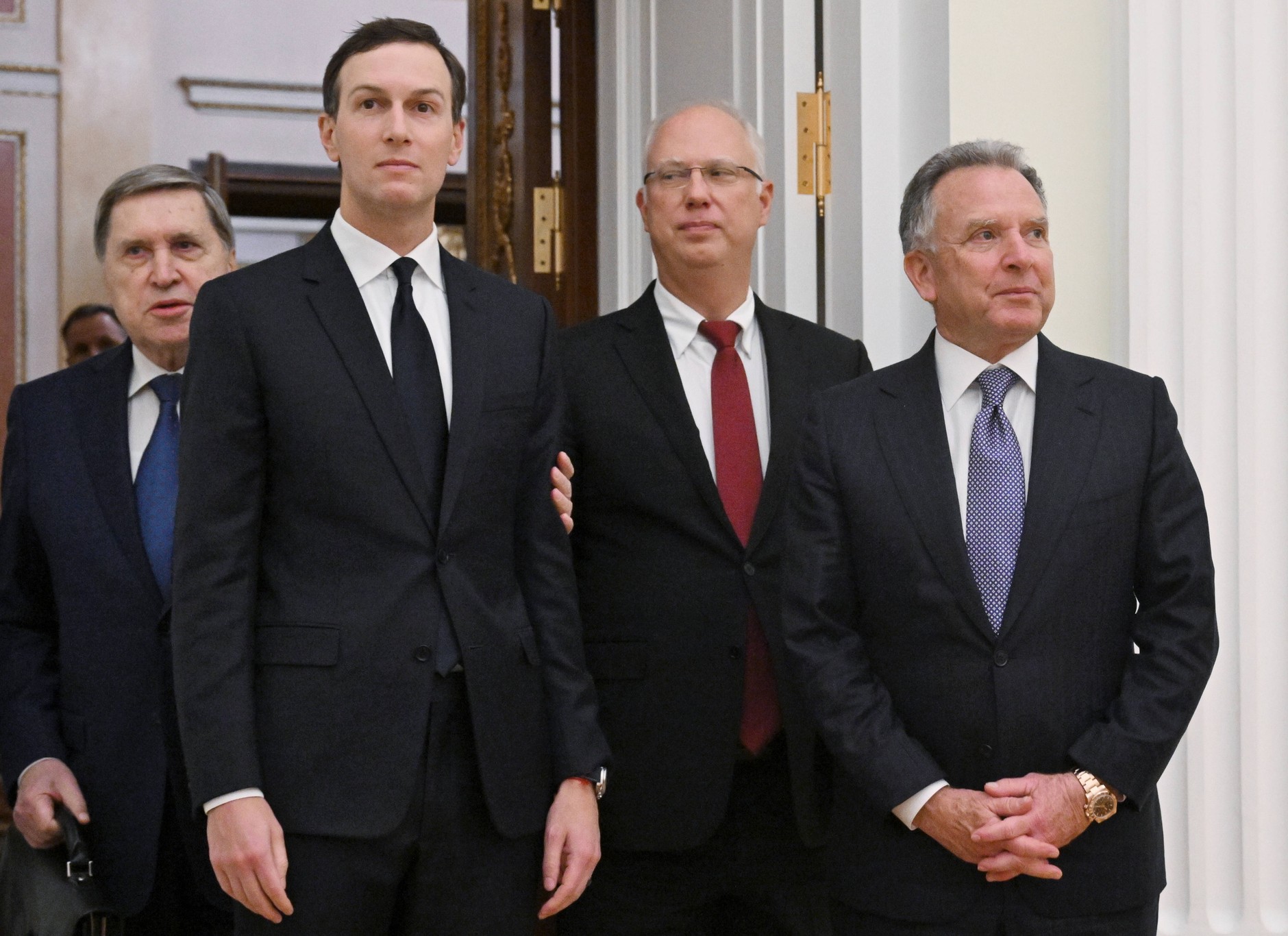
Advisor to the Russian president Yuri Ushakov, Trump's son-in-law Jared Kushner, special representative of the Russian president for investments Kirill Dmitriev and special envoy of the US president Steve Witkoff. Moscow, Russia, December 2, 2025KRISTINA KORMILITSINA / SPUTNIK / KREMLIN POOL / PAP
Following this logic, putting pressure on Ukraine is much easier than on Russia. However, Kushner himself – a participant in the Middle East trials – is not considered a supporter of tough pressure on Kiev. His style is rather about looking for political combinations that avoid direct pressure and create scope for agreements that can be sold as mutually acceptable.
Others, however, believe that his presence was necessary to keep Witkoff in check.
The key issue in the peace talks remains the issue of territorial recognition. And this raises an obvious question: How could Trump (or Kushner, or Witkoff) even formalize such recognition?
In his first term, Trump used the mechanism of a presidential proclamation to recognize Israel's sovereignty over the Golan Heights and Morocco's sovereignty over Western Sahara. It can be assumed that he would also use a similar tool in the case of Ukraine – towards Crimea and Donbas.
However, such a proclamation could be revoked by the next US president, making it a politically high-profile but legally unstable solution.
Which side is the US on?
It is clear that Europe will never support changing Ukraine's borders at the UN forum. Mike Waltz, representing the US at the UN, will probably ensure that the issue does not reach the General Assembly or the Security Council at all. The dynamics of recent months also show that Trump is not striving to fully meet Ukraine's expectations. Many interpret his broader strategy as an attempt to weaken China by changing the balance of power in Russia-US relations.
It is also interesting that when Putin received Witkoff and Kushner in the Kremlin, Minister Sergei Lavrov was negotiating in parallel with the head of Chinese diplomacy Wang Yi.
It is difficult to consider this a coincidence – Americans have certainly noticed this similarity.
Rubio remains a key U.S. channel of communication with European partners. The Secretary of State, who combined this function with the role of national security adviser, was considered one of the most pro-Ukrainian people in Trump's entourage.
Relations with Europe have clearly cooled in recent weeks. Russia is trying to present Europe as the party that is allegedly sabotaging the peace process. Trump, in turn, publicly reprimands Europeans for purchasing Russian gas; this was coupled with Rubio's refusal to attend a NATO ministerial meeting.
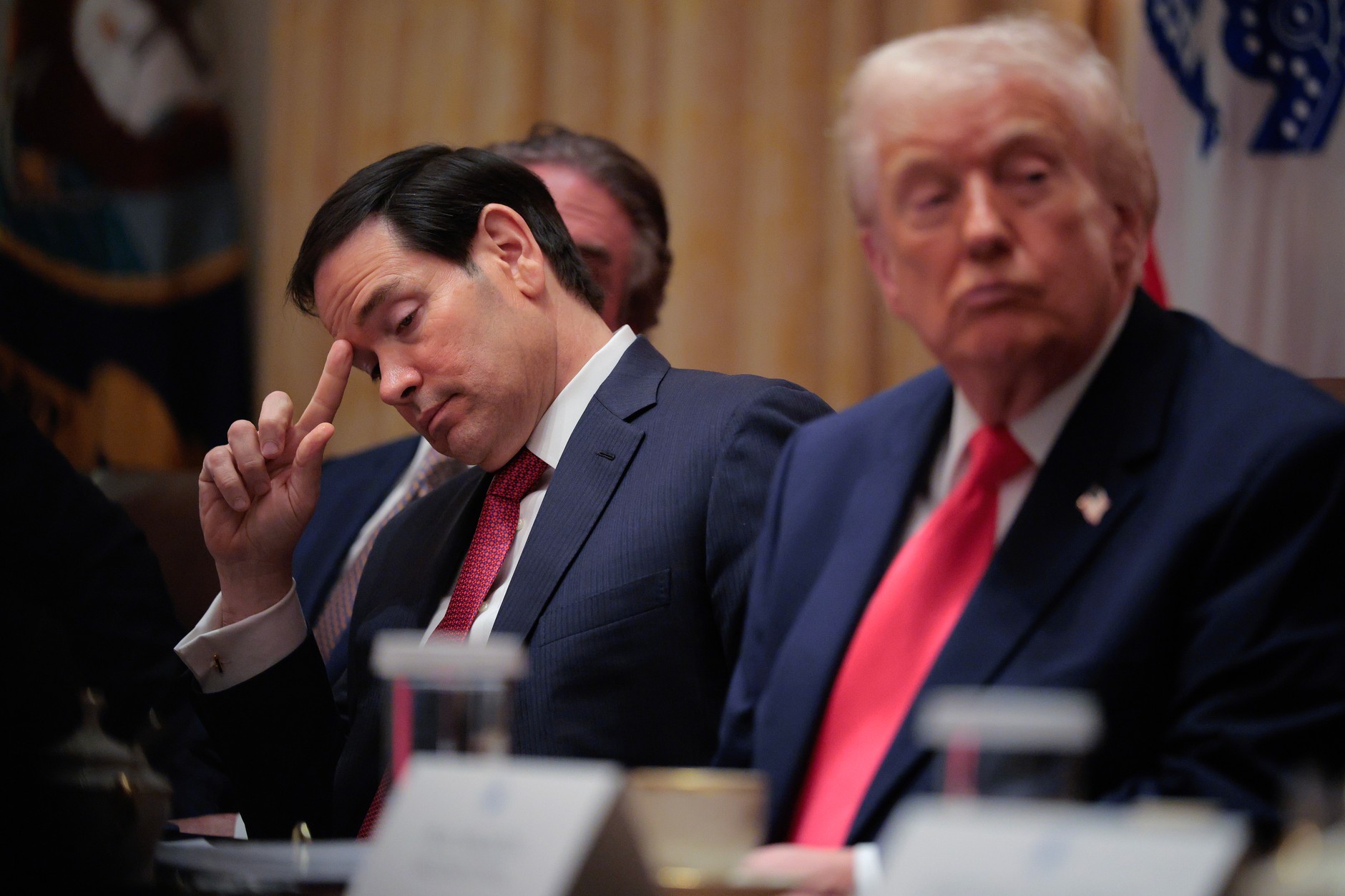
U.S. Secretary of State Marco Rubio (left) and U.S. President Donald Trump during a cabinet meeting in the Cabinet Room of the White House, December 2, 2025.Chip Somodevilla / Getty Images
Rubio is still on Russia's sanctions list. Still in March 2025 [rzeczniczka Ministerstwa Spraw Zagranicznych Rosji] Maria Zakharova reminded that the sanctions against the former senator, current Secretary of State, had not been lifted.
It is therefore not surprising that Rubio took part in the talks in Geneva, but did not go to Moscow. However, he actively cooperated with the Ukrainian delegation in Florida, where, together with Witkoff and Kushner, he discussed the preliminary parameters of a possible agreement. It is also known that just before Witkoff's visit to Moscow, he had a telephone conversation with Volodymyr Zelensky, who was in Paris at the time.
Although their direct meeting ultimately did not take place, the fact of contact proves one thing: To say that the US has clearly switched to Russia's side is premature, to say the least.
The war is not coming to an end
There is an increasingly clear asymmetry in the Russian-American negotiations, which undermines the principle of “mirror” selection of partners on both sides of the table. Rubio, as the head of US diplomacy, is responsible for all foreign policy, while Witkoff is solely responsible for Russia.
In Russia, the roles are distributed differently.
Kirill Dmitriev becomes Witkoff's partner and does not limit himself to bilateral topics: he comments on the development of investment cooperation with China, relations with the Persian Gulf countries and other global initiatives. His broad competences look quite unusual in the context of negotiations regarding the war in Ukraine.
Rubio's two functions mean that on the Russian side his natural partners should be not only Foreign Minister Sergei Lavrov, but also Secretary of the Security Council Sergei Shoigu. However, after the corruption scandal, Shoigu has a special status, so his role was taken over by Putin's foreign policy adviser, Ushakov.
The search for compromises continues. Washington is trying to maintain communication channels not only with Moscow, but also with Kiev. Despite the resignations and internal crises in Ukraine, Rubio, Witkoff and Kushner met with Ukrainian representatives in Florida. After the talks, a joint statement was published and the Ukrainian delegation expressed satisfaction. The USA also participated in the discussion of the “28-point project” in Geneva.
Meanwhile, after another round of talks in Moscow, the planned meeting between Witkoff and Kushner with Zelensky was canceled. This can be interpreted as a signal that the proposals discussed with Russia are not to be imposed on Kiev.
Moreover, the United States did not issue any official statement after the Moscow meeting.
Positive comments appeared only from the Russian side. The date of the expected Trump-Putin meeting has not been set – despite previous speculations.
After returning to Washington, Witkoff and Kushner reported to Trump about their conversations with Putin. The very next day, Trump announced that the negotiations had gone “very well” and that he believed Putin actually wanted to end the war. However, he has already repeated such declarations many times, which makes them sound like a routine formula.
Rubio presented a much tougher and more specific stance in an interview with Fox News. He emphasized that Ukraine must receive security guarantees that will prevent renewed Russian aggression, and that on the Russian side, the decision to end the war can only be made by Putin. And – as we know from his own statements – the Russian leader is not eager to stop military operations.
Currently, another meeting with the Ukrainian delegation is being prepared – this time on US territory.