
The Thessaloniki–Bucharest highway and railway, between promises and reality. Expert: “Bureaucracy and lack of European legislation, the big obstacles”

The strategic project signed by Romania with Greece and Bulgaria, which provides for the construction of a highway and a railway on the Thessaloniki-Alexandroupolis-Bucharest route, promises miracles, but would rather have limited effects. Claudiu Degeratu, security expert and former head of the Defense Section within the Permanent Delegation of Romania at NATO Headquarters in Brussels, talks about the limits of the agreement signed by the 3 countries and the obstacles that stand in the way of its implementation.
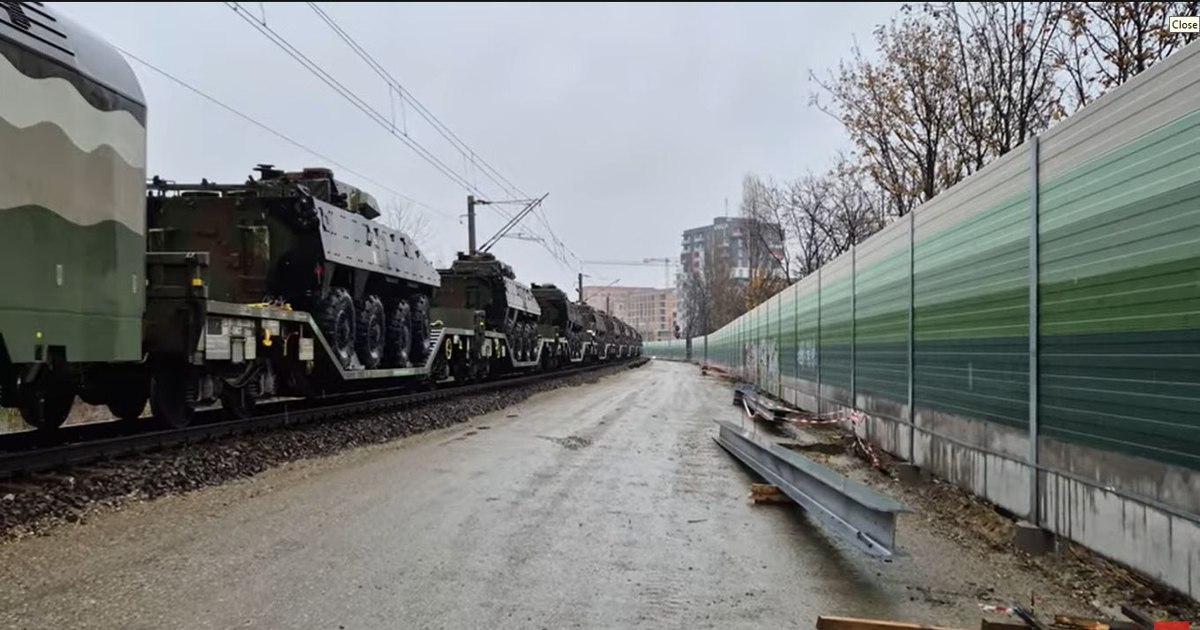
Trains with military equipment hardly cross Europe. PHOTO: Video capture
On Thursday, December 4, Romania, Bulgaria and Greece signed a transnational agreement on the Aegean-Black Sea Vertical Corridor. The aim of the project is to improve road and rail connections between the three countries. On the other hand, it is also a European security project, intended not only for civilian mobility and trade flows, but also for troop movements and easier access of military equipment from one point to another.
Former director general for defense policy and planning, responsible for NATO and EU policies and Head of the Defense Section within the Permanent Delegation of Romania at NATO Headquarters in Brussels, international relations and security expert Claudiu Degeratu expresses certain reservations about this project, in an analysis for “Adevărul”. He is not necessarily impressed and sees in this transnational agreement “a reheated soup”, alluding to the fact that the discussions on this topic are very old and the progress is minimal.
Where do the main obstacles for the three countries come from?
Last but not least, Claudiu Degeratu has doubts about the capacity of the three states, Romania, Bulgaria and Greece, to implement the project and contribute financially. The infrastructure in Romania and Bulgaria leaves much to be desired anyway, and the two states are facing deep crises, even if they are different. Romania currently has serious problems of an economic nature, given that its economy is suffocated by the enormous deficit and inflation, chapters to which it has no rival in Europe. At the same time, the neighboring country to the south of the Danube is facing a genuine political crisis, which has become chronic in the past three years. And this crisis could in the future influence the political will to accelerate the development of the project and its implementation.
“It is rather an attempt to reheat the soup, the project, because so far there has been a lot of talk on this topic, but achievements, in the true sense of the word, are missing. So, they are not necessarily new elements“, says Degeratu.
The three countries found it somewhat difficult to understand each other, and the discussions were often difficult, including due to some differences in agenda, although each of them wanted this agreement. In the end, the parties were able to reach an agreement, but not as quickly as they would have liked. Moreover, the Bulgarians were not very convinced at some moments of the usefulness of this project, and the problems caused by the internal crisis in this country also affected the negotiations. In the same way, certain doubts also appeared in Greece, but in the end all three states managed to reach a common denominator, also guided by Brussels, and sign the agreement. However, there are still enough impediments so that we don't get drunk with cold water and consider that once signed, this project will be lightly put into practice. Claudiu Degeratu also talks about these challenges and possible complications.
Brussels bureaucracy and the lack of adequate legislation are holding us back
“Our problem was to decide to do it, to sign. But the issue is that we didn't get along with either the Bulgarians or the Greeks. The Greeks have a more engaging calendar, like that, more serious. So, of course, pompous, optimistic inaugurations and declarations, they were. But, I repeat, there are quite a few impediments related to the coordination of the three states. They probably tried to relaunch the project under stricter coordination from the Commission. It is very possible. But I don't see a magic solution, because Romania, for example, as is well known, also has great problems to secure financial contributions on our side for various European projects. And so, this seems to me just like that, an attempt, but not a guarantee that an excellent job will be done.” says the expert.
Claudiu Degeratu also commented on the rumors according to which Brussels is trying to speed up the project in order not to have unpleasant surprises from Hungary, in case the Europeans need to send troops to the East to defend Romania or another country from Russia. Rather, Claudiu Degeratu believes, the European project comes as a result of the fact that transport from the West to the East is very slow, evidenced by the fact that at the last international military exercise in Romania, French tanks and military equipment needed 14 days to cross Europe and reach Romania, due to the poor infrastructure, including at the European level.
“This can also be said possibly, because a dose of mistrust in Hungary exists in Brussels, but not necessarily. And I say not necessarily, because I personally do not think that the transit of troops through Hungary would pose any problem. And if there could be a problem at some point, it would be in the scenario where the activation of Article 5 of NATO would be discussed, in the most serious way. But otherwise, for crisis situations or to strengthen the deterrence capacity, Hungary will not oppose,” points out Degeratu.
In reality, the big problem is related to European bureaucracy, which makes military transit across the continent, even through EU member countries, a chore and takes weeks. For that, Brussels should, says the expert, adopt a law that would simplify military transit on the territory of the European Union, a law that would later be implemented in all member states. Basically, these would be the big challenges that should find their solution.
“The main problem is related to bureaucracy, but also to the lack of European legislation implemented in all countries. That is, in other words, there are quite a few national bureaucratic impediments. Another argument for which the European Union wants this project implemented is the fact that the Mediterranean route, and then the Balkan route, could be shorter for military convoys or military equipment than passing through Central and Eastern Europe”says Claudiu Degeratu.
As seen from Brussels
The transnational agreement signed by the three countries, with the aim of improving infrastructure and road and rail connections between them, is also a European security project. On paper, the project looks flawless. The European Commissioner for Sustainable Transport and Tourism, Apostolos Tzitzikostas, claims that the signing of the agreement will allow work to begin immediately on the Thessaloniki-Alexandroupolis-Bucharest rail and road routes.
“Today we have laid the foundation stone from a political point of view. Starting tomorrow, we start building. During 2026, we will present a joint plan that will map the central, western and eastern axis, the priorities will be set and the integrated financing plan will be presented. And the cooperation agreement constitutes the political commitment of the EU and the three countries for the realization of this important project, the most strategic transport link in Europe for its south-eastern part. It constitutes a real first line of defense for our security, for our internal market, for our three economies and above all for our citizens”the Greek said, according to Rador, which cites ERT News.


