Marathon talks in Miami between the US and Ukraine. The first conclusions after two days of negotiations


American and Ukrainian negotiators had the second round of talks in Miami on Friday on the topic of the peace plan of American President Donald Trump. The talks will continue over the weekend, according to a Ukrainian official quoted by Axios. After the first day of talks, the delegations agreed that any lasting peace deal “depends on Russia's willingness to show a serious commitment to long-term peace,” the Kyiv Independent reports.
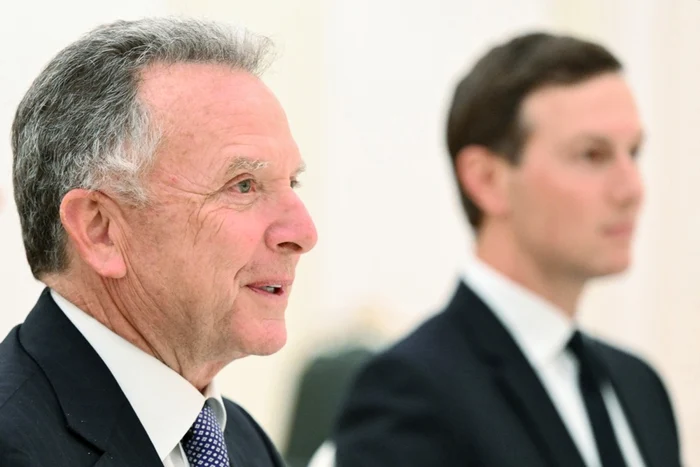
The American delegation is led by Steve Witkoff and Jared Kushner photo epa-efe
The Miami talks follow a five-hour round of talks between Trump advisers Steve Witkoff and Jared Kushner and Russian President Vladimir Putin in Moscow on Tuesday. The American president later declared that the talks with the Russian side were “very good” and emphasized that his emissaries came back with the impression that Putin wants to make a deal.
However, no immediate progress was announced – both Moscow and Washington remained silent on the details of the peace talks.
The Ukrainian delegation in Miami is led by Chief Negotiator and National Security Adviser Rustem Umerov and Chief of Staff of the Ukrainian Army, General Andrii Hnatov. They met with Witkoff and Kushner on Thursday evening for two hours and resumed the discussions on Friday morning, according to news.ro.
The public positions of Ukraine and Russia seem irreconcilable, but American officials are confident that a compromise can be reached even with regard to the most sensitive issue, that of territory.
Witkoff and Kushner briefed the Ukrainians in detail about the meeting with Putin and new ideas to try to bridge the differences between the sides, according to a well-informed source cited by Axios.
An American official told the American publication that Thursday's talks between the Ukrainian and American delegations were “positive” and that they will likely continue over the weekend.
“Both sides agreed that real progress towards any agreement depends on Russia's willingness to show a serious commitment to long-term peace, including taking steps to de-escalate and stop crimes,” Witkoff said in a statement posted on social media.
Shortly after the statement was published, Russia again struck Ukraine's energy infrastructure, affecting substations, generating facilities and disconnecting one of the power lines feeding the Zaporizhia nuclear power plant.
According to the Air Force of Ukraine, Russia launched 653 Shahed attack drones, 36 cruise missiles and 17 ballistic missiles at targets across the country. 60 hits were recorded in 29 locations.
“The American and Ukrainian sides emphasized that the end of the war and the taking of credible measures for a ceasefire and de-escalation are necessary to prevent further aggression and allow the implementation of the comprehensive plan for the reconstruction of Ukraine, aimed at making the nation stronger and more prosperous than before the war,” the statement added.
The negotiations entered an accelerated phase
A US official, in a statement to the Kyiv Post, said the Trump administration is “trying to build a corridor through which a real negotiation could materialize at some point – even if Moscow is not ready yet”.
Another Western European diplomat was more blunt: “Everybody knows the Kremlin is the bottleneck. The question is whether Washington is prepared to force the issue.”
According to the US statement, Umerov reiterated Kiev's main red lines: preserving sovereignty, ensuring civilian safety and a security architecture strong enough to prevent a second invasion.
He also signaled openness to other US proposals – which Western officials see as a reflection of the pressures Kiev faces as battlefield pressure mounts.
The talks also touched on “the recent meetings of the American side with the Russians,” but American officials did not provide details.
A Western official familiar with the contacts previously told the Kyiv Post that the talks were “exploratory, not transactional,” adding that “no one is discussing territorial concessions.”
Doug Klain of Razom, a US-based organization that advocates for Ukraine's interests, told the Kyiv Post that there was “some reason for optimism”, noting the scale of the meetings and the explicit acknowledgment in the US statement that Russia is the driving force behind any deal.
“Six meetings in two weeks between the US and Ukraine is a great achievement, and it is clear that Ukraine wants to reach an agreement,” Klain said. “Importantly, the US statement acknowledges that both sides agree that any deal depends on Russia.”
Klain added that for a peace deal to succeed, action must come “from either the United States or Russia.”
“Either Russia stops the massacres, or the United States understands that Moscow is the problem, not an ally, and puts pressure on the Kremlin on the battlefield and in its treasury,” he said. “We know the Ukrainians want to stop fighting, but they are not going to lay down their arms and let the Russians conquer them.”
Moderate confidence
Despite the optimistic tone of some Ukrainian officials, not all Western diplomats are convinced that the US strategy will pay off immediately.
A senior Central European diplomat told the Kyiv Post that the allies “support diplomatic exploration” but warned that “Moscow feels leverage” and could extend the talks to buy time.
Another Western official described the process as “an initial outline of something that could matter later — but only if Washington is willing to impose costs on Russia.”