— The development of suburban areas is a trend that is gaining momentum as the availability of credit and communication infrastructure improves – says Marek Wielgo, expert of the RynekPierwotny.pl portal. — Lower prices are just the beginning. The suburbs offer peace, access to greenery and increasingly better social infrastructure – nurseries, schools, kindergartens. Moreover, public transport in many places is more efficient than on the outskirts of the city.
A spectacular example is Mińsk district, bordering Warsaw from the east. Just 10 years ago, development construction practically did not exist here. Today, new housing estates are sprouting up like mushrooms after rain. According to the Central Statistical Office, in 2024, developers started building nearly a thousand apartments here.
The rest of the text below the video
Data from BIG DATA RynekPierwotny.pl show that within 10 months of this year, 246 premises were sold in Mińsk Mazowiecki – 32% more than in the previous year. more than a year earlier. The average price per square meter of new apartments is PLN 11,200. PLN, which is much less than in Warsaw itself, where the average per m² is almost PLN 18.1 thousand. PLN (JLL report Q3 2025).
Suburban apartment offer
|
Primary Market
See also: The tax office provided specific data. This is the earnings of the 1%. the richest [KWOTY]
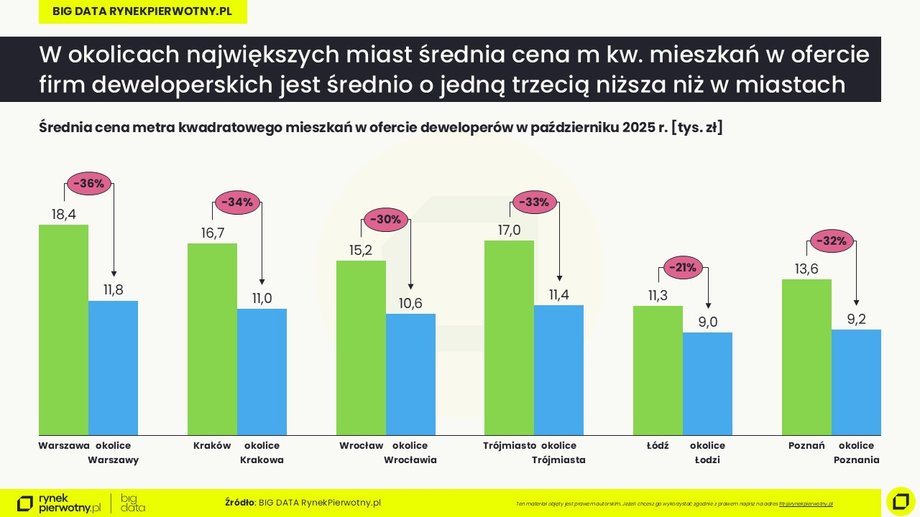
We observe similar differences in other agglomerations: the average price per square meter of apartments in the Tricity is approx. PLN 17,000. PLN, in Kraków – 16.7 thousand, in Wrocław – 15.2 thousand, and in Poznań – 13.6 thousand. The cheapest is in Łódź – PLN 11.3 thousand. PLN per meter, and in its vicinity – already PLN 9,000. zloty.
— The supply and price of land are key. In metropolises, the average price is driven up by premium apartments, introduced by developers with wealthy buyers in mind, explains Marek Wielgo.
The suburbs are becoming a viable alternative
Price differences are huge even within the same agglomeration. In the center of Warsaw, the average price of new apartments is almost PLN 37.8 thousand. PLN per square meter. On the outskirts of the city, in districts such as Białołęka or Wawer, a square meter costs on average less than PLN 14,000. zloty. In the vicinity of Warsaw you can find apartments below 9,000 m2. PLN in Góra Kalwaria or Radzymin, 10–11 thousand PLN in Marki and Wołomin and PLN 11–12 thousand PLN in Grodzisk Mazowiecki, Mińsk Mazowiecki and Ożarów Mazowiecki. The exception is Pruszków, where the average metro price reaches PLN 15,000. zloty.
Apartment prices in suburban locations
|
Primary Market
Read also: Changes in taxes from January 2026. Check whether you will not lose
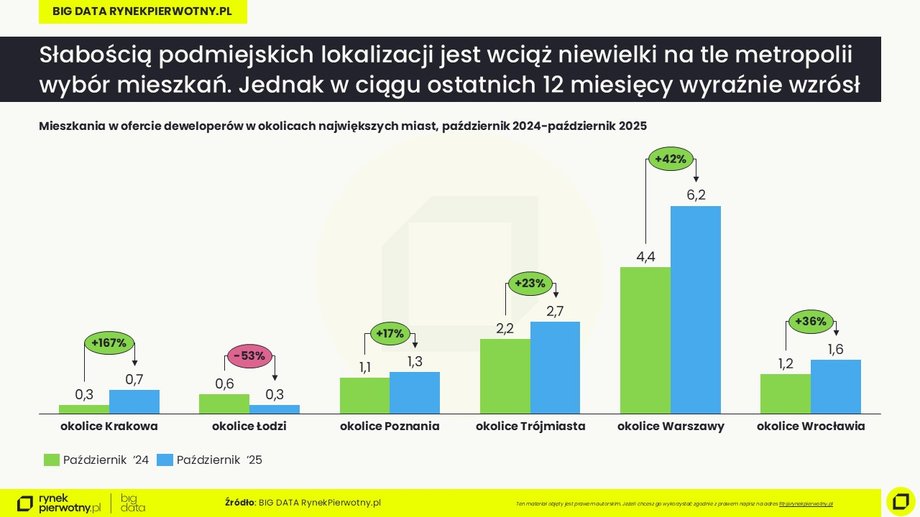
However, suburban locations have their limitations – primarily a smaller selection of apartments. In the vicinity of Warsaw, developers offer approx. 6.2 thousand. premises, while in the city itself there are almost three times as many – 17.6 thousand. However, the offer of developers near Warsaw has increased by as much as 42% over the last 12 months. — slightly less dynamically than in the vicinity of Kraków, where the number of apartments for sale more than doubled to over 700 units.
— For years, living in a metropolis was considered a status symbol. Today, rising prices and less availability of credit make it so prestige loses to common sense. A better choice may be a location outside the city limits, says Marek Wielgo.
Suburbanization and infrastructure: time is currency
— A decade ago we said: “I live 30 km from the center.” Today we say: “I have an hour to work.” Distance is no longer important, what matters is the real time we waste in traffic jams or waiting for the bus – emphasizes Dr. Hab. Katarzyna Kajdanek, sociologist and mobility expert. — One-way commute time is 10 hours a week, 40 hours a month. Additionally, there are the costs of gasoline or a monthly ticket. Weekends are taken up by matters that we would deal with “on the way” in the city.
– Distance is no longer important, what counts is the real time we waste in traffic jams or waiting for a bus – emphasizes Dr. Hab. Katarzyna Kajdanek
|
Colinmthompson / Shutterstock
Worth reading: Property tax increases. Which cities save their residents?
Infrastructure – roads, waterworks, sewerage, fiber optic – turns farmland into an attractive investment area. Private land owners know this very well and speculate on investment announcements. — Developers are selling houses promising connections “soon.” Residents are moving in, but the nearest bus stop may be far away, and the school will be built in a few years – adds Dr. Hab. Handcuffs.
Who is moving out of cities?
Analyzes of the Tabaofert portal show that mainly young families and people with hybrid jobs settle in the suburbs. — Internal migrations in the largest agglomerations show that the net inflow to the poviats surrounding the cities is much higher than to the city itself, says Ewa Palus, chief analyst at Tableofert. — In the Grodzisk district in 2024, 14 people per 1 thousand were recorded. inhabitants migrating to the vicinity of Warsaw, while in the capital itself – only 1.4.
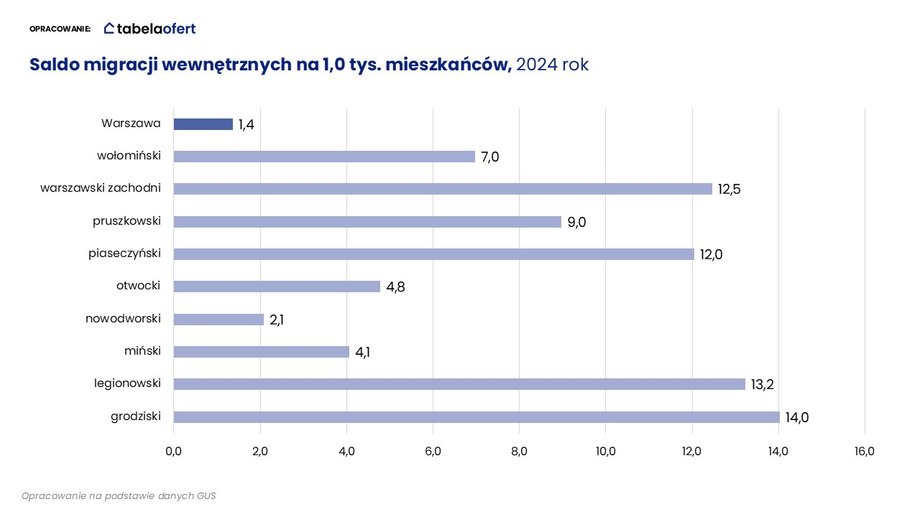
Balance of internal migration
|
latkaofert.pl
Read also: Banks in Poland are preparing record dividends. Investors may be rubbing their hands [KWOTY]
Demographic forecasts indicate to further depopulation of medium-sized cities and stable population growth in Warsaw and Kraków. The increase in the number of inhabitants of counties surrounding the largest cities is expected to continue in the coming years, which creates space for new development investments.
Development investments: suburban booms
— We discover the potential hidden in the neighboring communes of the Tricity – says Magdalena Reńska, vice-president of Euro Styl, Dom Development Group. — One of our first housing estates was built in Borków near Gdańsk – Nowy Horyzont, with over a thousand apartments, a supermarket, squash, fitness center and kindergarten. It was self-sufficient, almost district-like. The product was very well received, even though it was implemented during the 2008–2010 crisis.
Currently, the company focuses on Rumia, Pogórze and other so-called communes. Little Tricity. — The locations are well connected to Gdynia, Sopot and Gdańsk thanks to the Fast Urban Railway and the ring road. By investing in neighboring communes, we improve the quality of construction, create a functional product and stimulate the entire market to develop – adds Reńska.
The future of the suburban real estate market
According to Patryk Kozierkiewicz, legal advisor at the Polish Association of Developer Companies, land prices in suburban zones will continue to increase, and the development of infrastructure in the coming years will strengthen the attractiveness of these locations. — Investments in social and green infrastructure are becoming more and more important. The commune and developers build housing estates with roads, schools, recreation, and sometimes road systems costing millions, he explains.
Suburbanization will be a natural trend in the coming years near the largest agglomerations. However, experts warn that uncontrolled urban sprawl may generate hidden costs — time, health, family relationships, as well as economic losses estimated at PLN 85 billion annually.
— Financial rationality collides with everyday reality only after moving, sums up Dr. Hab. Handcuffs. — Suburbanization makes sense where infrastructure exists or is being built in parallel with development. Otherwise, it turns into an “accommodation parking lot” instead of a functional housing estate.
Poles are still standing before choosing between prestige and practicality. Rising prices in cities, better infrastructure in suburban locations and the availability of loans mean that common sense is increasingly winning. And for many young families, additional space, greenery and silence are still an invaluable value.