Vidraru, the “mountain sea” bordered by a concrete colossus. What hides the underground of the hydropower development


Six decades have passed since the construction of the Vidraru dam on the Argeș river. Its reservoir, in the process of controlled emptying, continues to stir fantasy and controversy, while its real history remains less known.
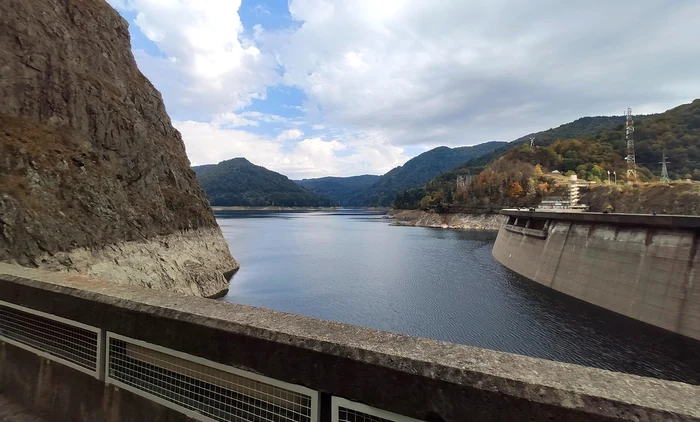
Lake Vidraru. Source: Pixabay.com
More than 165 meters high, the Vidraru Dam was built in just three years, from 1963–1965, and was, in the 1960s, one of the largest concrete hydroelectric dams in Europe. The works on the hydropower development on the Argeș River were initiated in 1960, and from the following year until 1966, thousands of people worked on the construction sites at Vidraru, in the severe conditions of the Făgăraș Mountains.
Lake Vidraru, emptied after six decades
In December 1965, the construction of the plots (vertical segments) of the dam reached its maximum height of 167 meters. The concrete arch dam is 300 meters long and is composed of 22 piers. On March 15, 1966, the filling of the reservoir began, which was to cover almost 1,000 hectares. On December 9, 1966, the Vidraru Hydropower Plant was inaugurated, with an installed power of 220 MW.
Over time, the new hydropower plant became a tourist attraction due to the construction of Transfăgărășan (DN 7C) in the 70s, the alpine lands of Făgărăș, until then very rarely explored, as well as due to its size and spectacularity.
Vidraru has also become a place of legends, some attributed to the construction of the dam, others born in the Cumpăna area upstream, at the medieval Poenari Fortress, located nearby, or at the Curtea de Argeș Monastery, located 30 kilometers below.
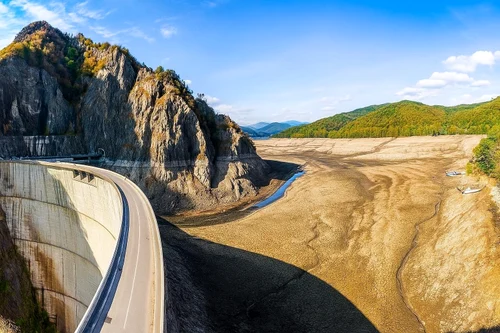
Image 1/12:
Vidraru was emptied PHOTO Facebook / AUR
In the summer of 2025, the controlled emptying of the Vidraru reservoir began, and the work necessary to preserve the hydropower facility gave birth to new “legends”, invented and amplified on social networks to turn the emptying of the lake into a dramatic event.
Controversial theories promoted online posit ulterior motives for draining the lake: “water theft” for bottling and clandestine sale, recovery of alluvial gold from the lake bed, or “sludge theft” with supposed health benefits.
According to the mayor's office in Curtea de Argeș, emptying the lake is necessary so that the technical teams can intervene on the dam's equipment, thus ensuring its safety and operation for the coming years.
The process will be done, initially, by turbine, then by evacuation through the dam's sluices, taking place in several successive stages. In the final stages, the flows will be discharged in a controlled manner downstream, in the Argeș river bed, with values between 20 and 47 mc/s. The Vidraru Hydropower facility will be re-engineered through an investment of 188.3 million euros, excluding VAT.
The fortress of Vlad Tepes
The real story of Lake Vidraru would not have needed to be embellished with “fake-news” (false news) about what its waters hide. It began in a place full of legends and historical and natural attractions, protected by the high ridges of Făgăraș, the bridge between the historical regions of Muntenia and Transylvania.
Until the end of the 19th century, the land at the Argeș gorge where the Vidraru lake would be developed was completely wild. The mountains were covered with centuries-old forests, untouched by humans, but on one of the rocks, currently located near the dam, the medieval Poenari Fortress was built. The chronicles of the Wallachia mentioned it as Vlad the Impaler's fortress, and legend says that in 1457, it was built with the help of the locals from Târgoviște, whom the voivode would have punished to work at the fortress in the mountains.
“When it was on the day of Easter, when all the townspeople were at feasts, and the young people were at the feast, so, without news, they seized them all. And how many were old and old people, they stung all of them, because they bypassed the whole fair with them; and how many were young, with their wives and older girls, as they were decorated on the day of Easter, they all took them to Poenari, from they worked at the fortress until all their clothes were torn from them and they were left naked, in their bare skins.” shows the chronicles cited in the volume Istoria Țării Românești (1960).
Many died falling from the slopes, others were worked to death, and the older ones were impaled, while their estates were taken by the nobility loyal to the prince, who would then be nicknamed “The Imp”.
Another chronicle of the era linked the construction of the fortress to the legend of the craftsman Manole, who had built his wife in one of its walls, so that she would not be hurt.
Cumpăna, the site of the First World War battles
Upstream of the dam, the place called Cumpăna also retains an aura of legend. Here, at the end of the 19th century, a colony of forest workers had been established, who then exploited the virgin forests at the foot of Făgăraș. Several roads and paths started from Cumpăna leading to the highest peaks, to the lakes in the mountains, and some crossed into Transylvania.
At the beginning of the 20th century, Cumpăna included several forest cabins and a former villa of the family of the politician Ionel Brătianu (1864–1927), one of the most influential politicians in the modern history of Romania. A forest railway made it accessible from Curtea de Argeș.
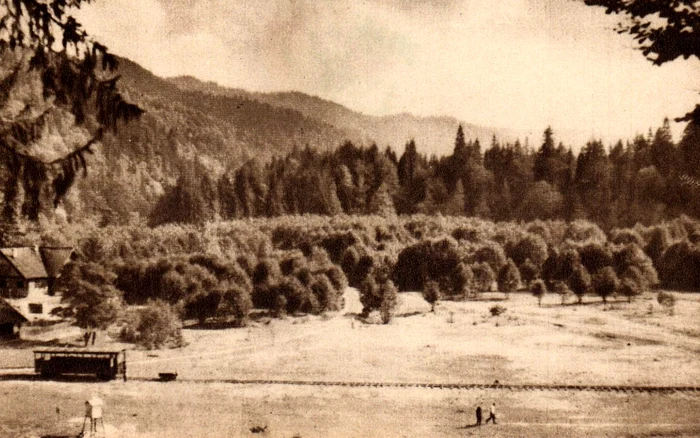
Buy it. Photo: Delcampe. net, Illustrated
During the war, fierce battles between the Romanians and the Germans took place in this land, and a heroes' cemetery was maintained here by the Brătianu family.
“In those days, Mrs. Pia Brătianu (not IC Brătianu's wife), with her bag on her back, roamed the hills of the mountains and collected the bones of heroes, which she deposited with great reverence in the heroes' cemetery”. informed the Universul newspaper in 1937.
That year, some students on vacation found the bones of a Romanian soldier who had died in the First World War.
“And from the middle of his chest, between his ribs, grew a beech which today is about three meters high and the thickness of a carriage's sheep”, the newspaper showed.
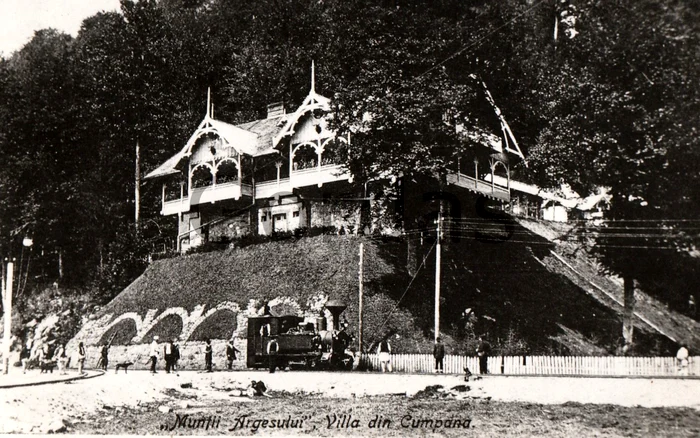
Buy it. Photo: Delcampe. net, Illustrated
Cumpăna had then become a kind of mountain resort, but the frequent floods caused by torrents made it difficult to access. The forestry railway, roads and the few settlements in the area were destroyed by a cloudburst in 1942, but the place was still sought after by mountain lovers. Since the 1930s, specialists have researched the hydropower potential of the Vidraru area.
“From the quay to Cumpana, the valley has the shape of a basin with an opening: the Argeș gorges. By closing the gorges, the valley can be filled with water, forming a level difference of 80 meters, which could set a hydraulic turbine in motion. This would serve a high-power electric plant, providing electricity for the entire Argeș valley, perhaps even for a larger region. A project was made in this regard, but it was not put into practice application (the project dates back to 1936). It would cost quite a lot to expropriate a lot of private property. Filling the valley with water would take about nine months, and the amount of electricity the plant would provide would cover all expenses.” informed the Journal of Sciences and Travels in 1943.
How the construction of Vidraru began
In the autumn of 1960, the communist authorities decided to build the hydroelectric plant on Argeș, initially called “16 Februarie”, then “Gheorghe Gheorghiu-Dej” and, finally, “Vidraru”. Its main purpose was to be the production of electricity, with a capacity of 220 MW, but the reservoir ensured the water supply of the Capital, located 180 kilometers away, the prevention of floods in the Argeș basin and the possibility of using and irrigating tens of thousands of hectares downstream.
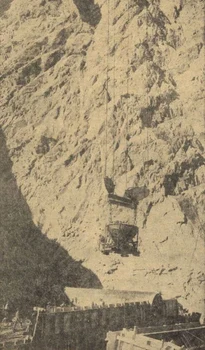
Image 1/8:
Vidraru Photo Flacăra Magazine (5) jpg
“Unlike other power plants, the importance of the hydropower plant on Argeş lies in its role as a peak power plant, which allows the supply of electricity at the times of maximum demand for electricity, at the push of a button, in the shortest possible time and without consuming anything other than “white coal” — that is, the energy of the accumulated waters. This is of particular importance if we consider the fact that the needs of electricity are highly variable during the course of a day, in the different seasons of the year or in the days work or holiday”, informed, in 1963, the engineer Mircea Sipinceanu, head of the hydropower plant project.
In the following years, aqueducts were dug that would capture the waters of several mountain rivers to divert them to the future Vidraru reservoir. The length of the galleries measured 42 kilometers, and the volume of excavations reached 1.8 million cubic meters of stone.
Since 1963, the miners' place was taken at Vidraru by the builders of the dam that connects Pleașa and Vidraru mountains. The concrete arch was erected in just three years.
“On December 30, 1965, at 2 p.m., the last bucket of concrete completed the construction of the great arch. The dam, 166 meters high, the fifth in Europe, the ninth in the world, has a base of 28 meters and a crown width of 6 m. For its height, 480,000 cubic meters of concrete were poured. Thus, the waters of Argeș and the nine rivers directed through underground channels towards a unique meeting point, the great reservoir was born, which stores 465 million cubic meters of water, a real sea in the mountains”. reported Economic Life in 1966.
Vidraru underground hydropower plant
The most difficult part of the hydropower development was the Vidraru plant, built about 104 meters below the level of the Argeș River and equipped with four energy groups totaling 220 MW. The Vidraru hydroelectric power plant uses the hydropower potential of the Argeș River on a 28-kilometer sector, between Cumpăna and Oiesti, with a total drop of 524 meters. The plant's power plant was built in a cavern and, at its inauguration in December 1966, was compared to a huge underground palace.
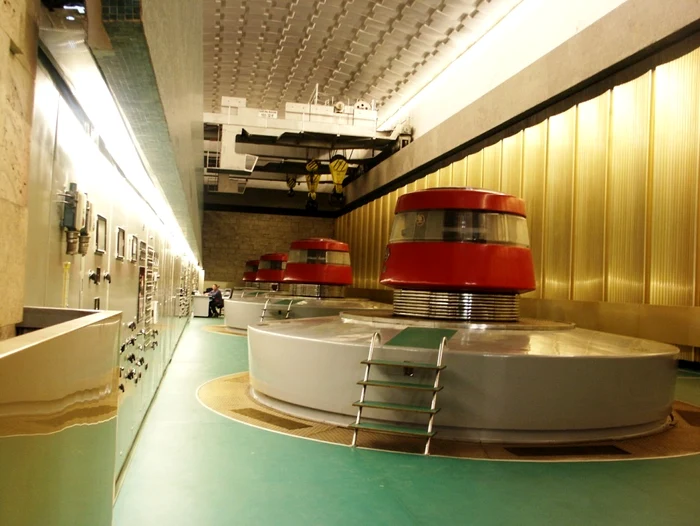
Vidraru Hydropower Plant. Source: Hidroelectrica.
“Light as day, the engine room — over 100 meters long and almost 25 wide — shatters, with its simple and bold architecture, the image we usually have of the underground. The source of the impression is fed by various elements that happily compete to create a pleasant working environment. The vast vault, 16 meters high, is made of boxed aluminum plates. In front, a wall has been clad with ceramic mosaic in the shade of the sea, and another with high aluminum plates, which appear as an infinite suite of windows filtering the rays of light. The care for the working conditions of the energy workers is completed by the existence of an automatic air conditioning system. Upstairs, which has a glass wall, and the others are covered with paltin veneer. 40 kilometers of cables”, informs the press of the time.
Access for personnel and equipment to the underground plant is through a vertical shaft with a diameter of 7.2 m, continued with a horizontal gallery 123 meters long.
The reservoir soon became an attractive tourist area, and after the completion of the works at Transfăgărășan, in the mid-70s, it became an emblem of the mountain road.